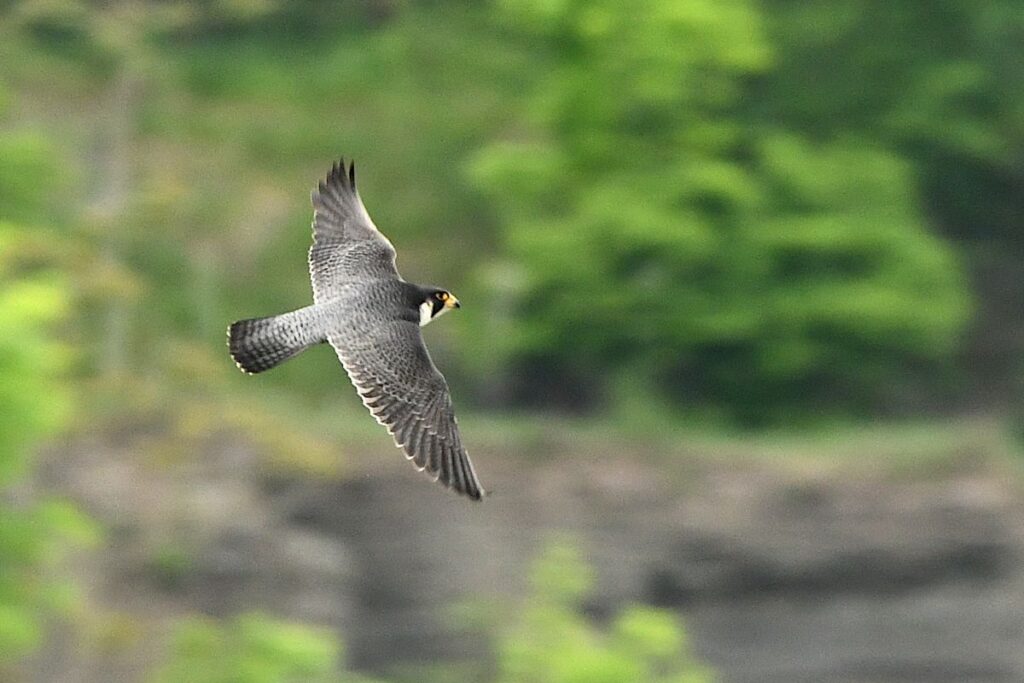
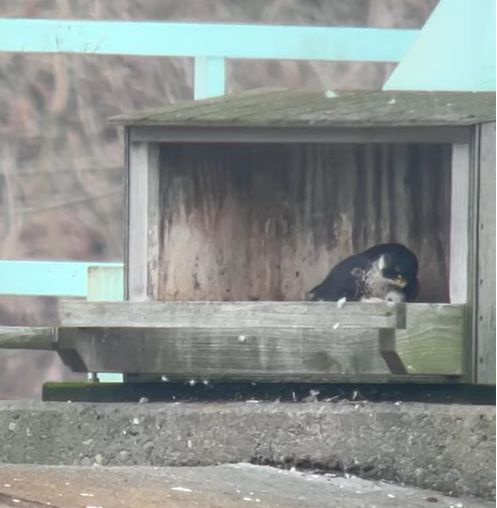
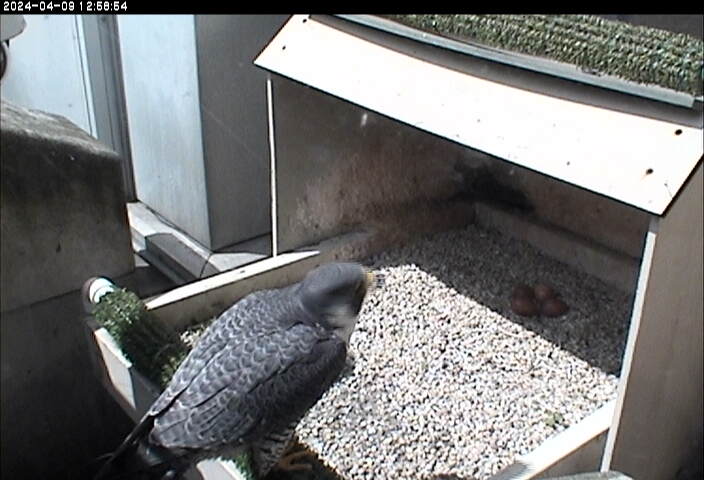
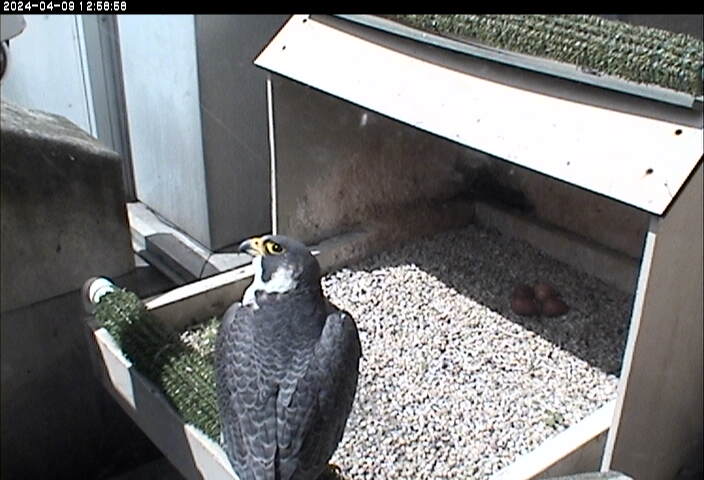
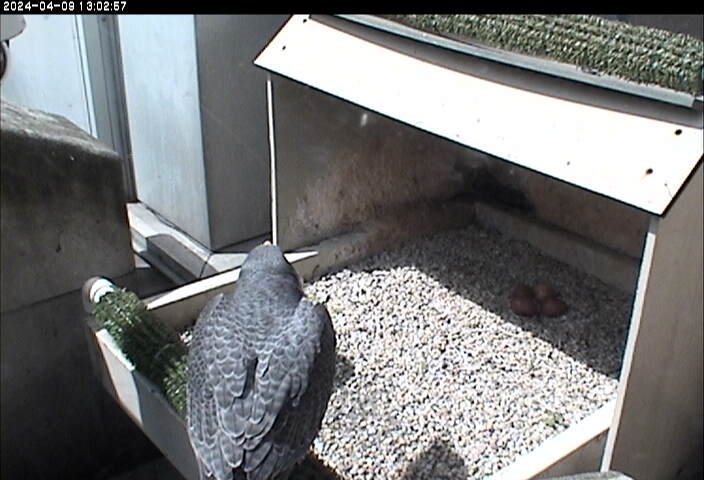
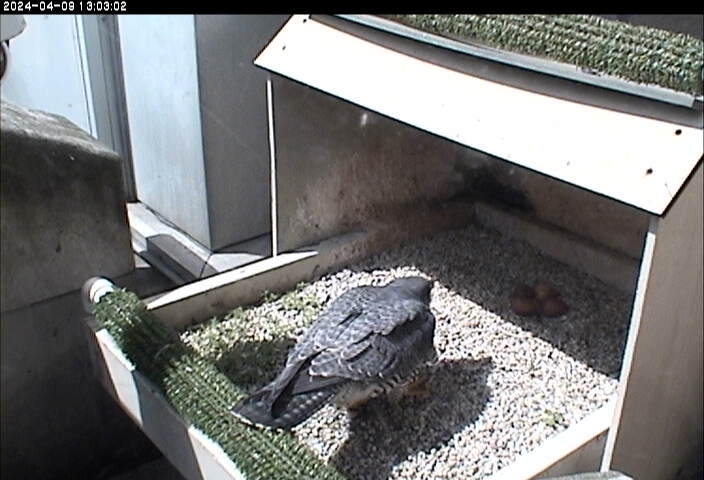
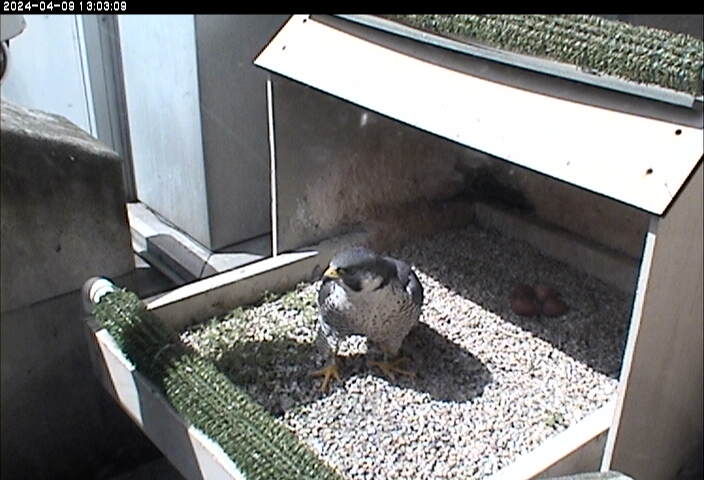
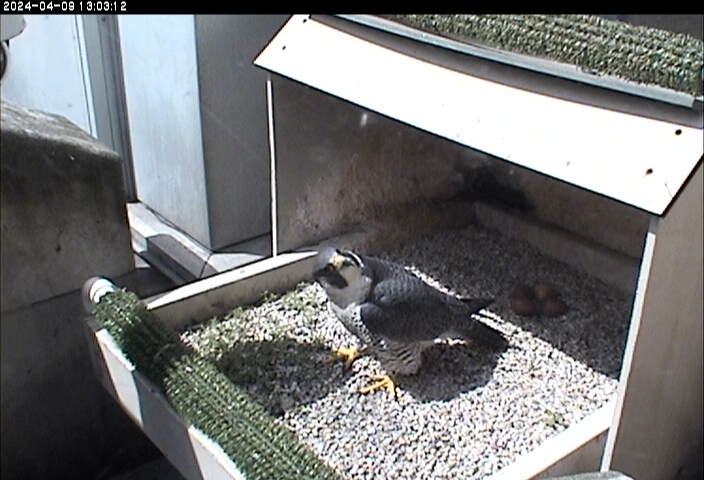
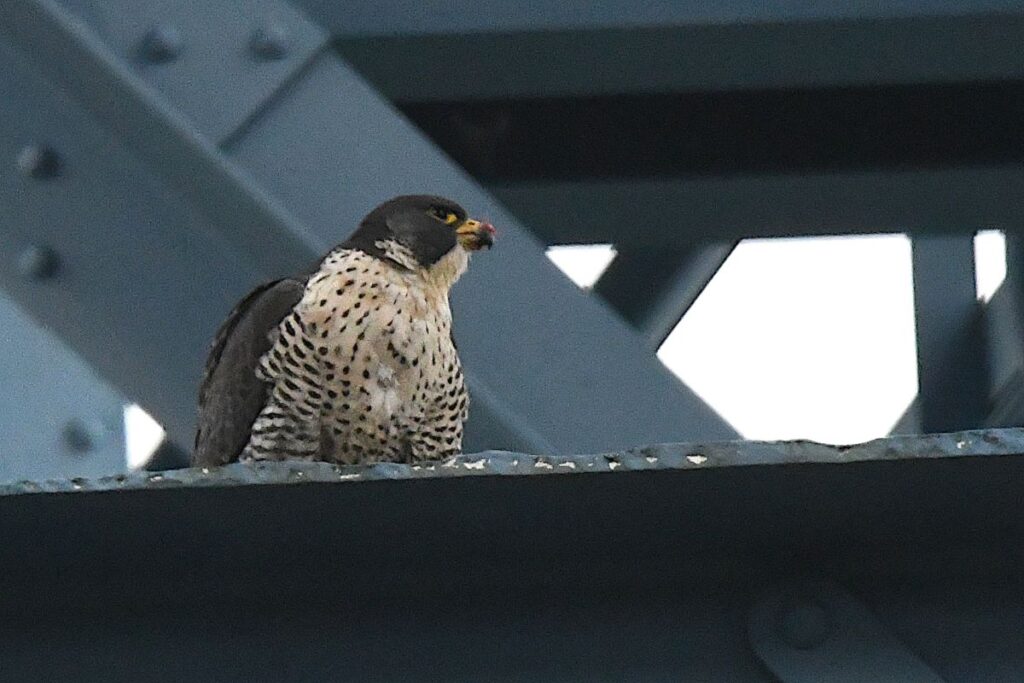
Peregrine at Sewickley Bridge, 16 May 2023 (photo by Jeff Cieslak)
14 April 2024
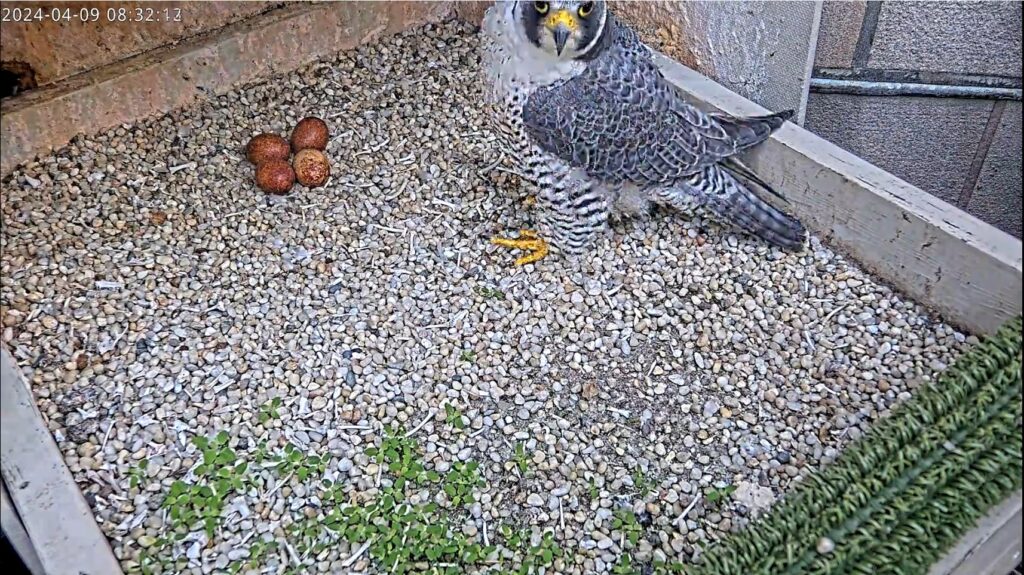
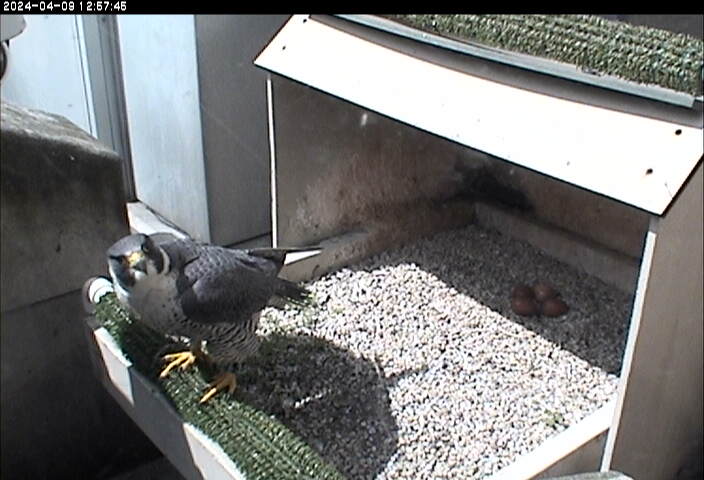
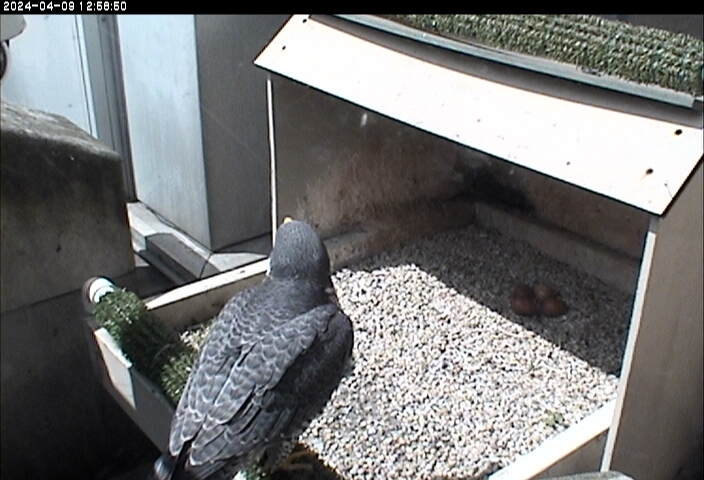
The Sewickley Bridge has hosted single peregrines since 2017 but a pair was not regular there until early 2021. At some point observers noticed that one of the pair is banded but who could read the bands?
Banded male peregrine at Sewickley Bridge, 6 June 2023 (photo by Jeff Cieslak)
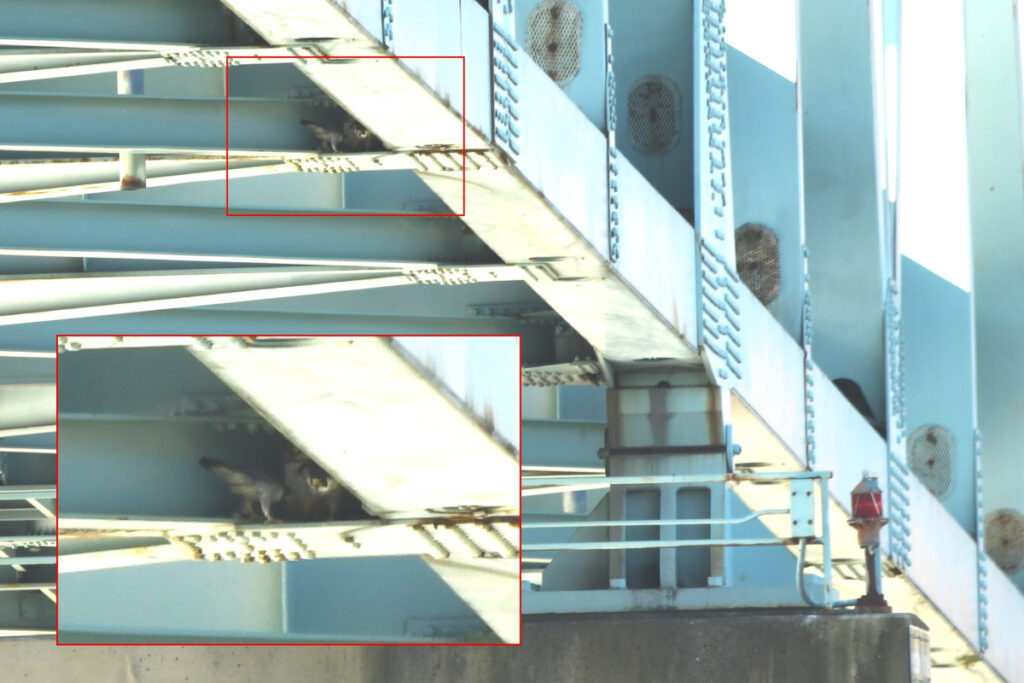
And where was this pair nesting on the bridge?
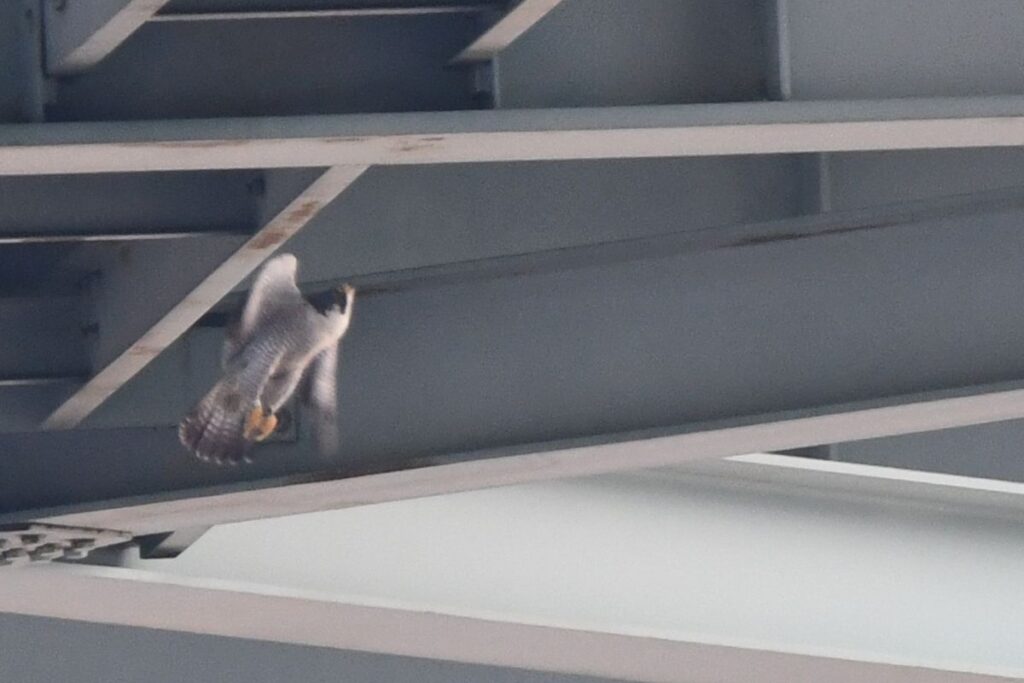
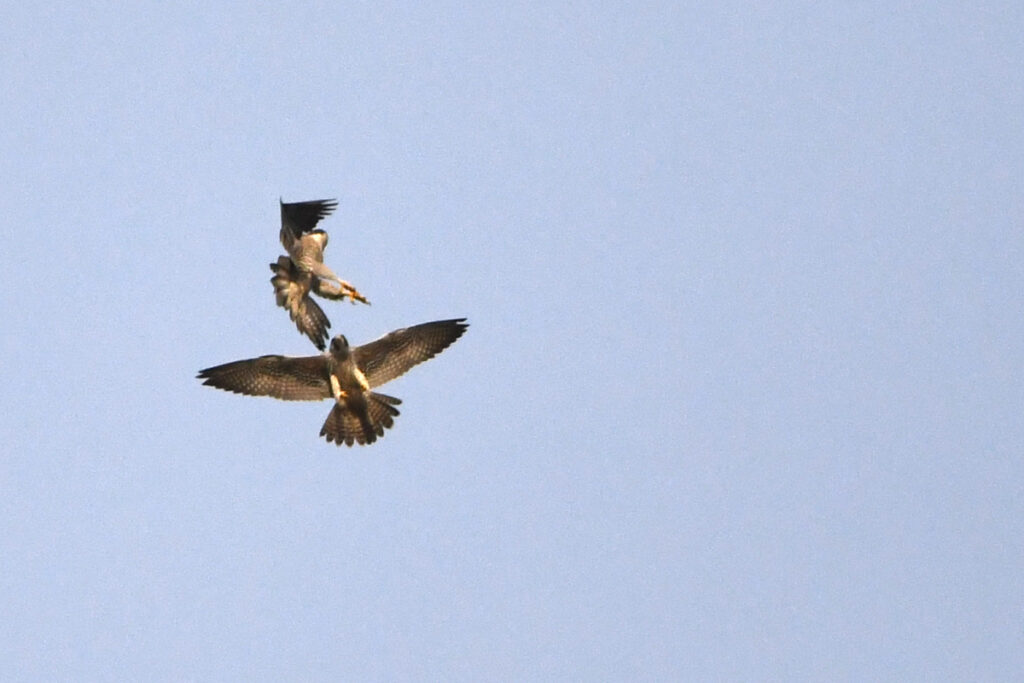
This spring Jeff Cieslak answered both questions. He photographed a nest exchange in which the male took over incubation and the female left the nest.
Peregrine nest exchange at Sewickley Bridge, 25 March 2024 (photo by Jeff Cieslak)
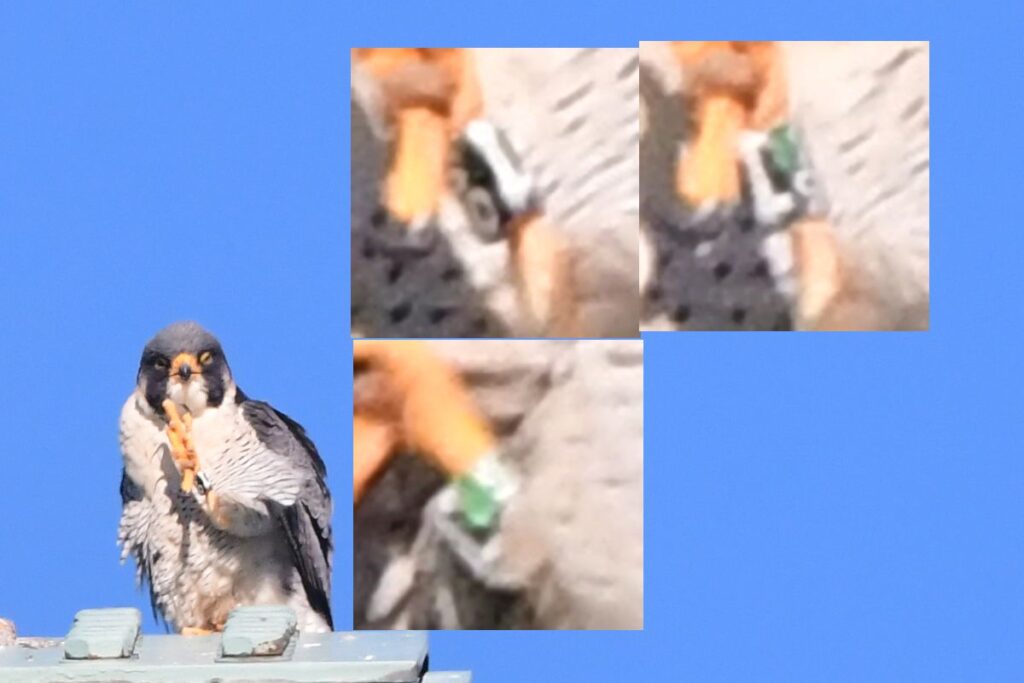
And he got a photo of the male’s bands.
[The male] was on the near tower so I only had to walk half-way across the bridge (so the sun was behind me). As soon as I stopped, he started to scratch his face, and his bands rotated enough and were focused enough that I think I can read them. They’re upside-down, so it’s “black 0 5 (or 6) over green S (or 5) 6.”
Banded male peregrine at Sewickley Bridge (Black/green, 05/S) on 4 Feb 2024 (photo by Jeff Cieslak)
The bands are Black/Green 05/S and he used to nest at the Neville Island I-79 Bridge (a.k.a. the Glenwood Bridge) until it was boarded up for construction in 2020 for more than three years. At Neville Island I-79 he was nicknamed Beau by site monitor Anne Marie Bosnyak.
Beau didn’t move far to find a new nest site and he didn’t move far from his birthplace. He hatched at the Cathedral of Learning in 2010 to parents Dorothy and E2. I know for sure that he is 05/S because his brother 06/S, nicknamed Green Boy, died in the Webster Hall chimney in June 2010.
Beau is now 14 yrs old but he has longevity in his genes. His mother Dorothy lived to be 16 and his grandad Louie from Downtown lived to be 17 and bred successfully at 3rd Ave in his 17th year. (Beau’s father, E2, was hit by a car in 2016 so we’ll never know how long he would have naturally lived.)
Read about the first time we identified Beau, Black/Green 05/S, in this vintage article.
Tarentum Bridge peregrines have two chicks, 11 April 2024 (photo by Dave Brooke)
13 April 2024
On Thursday 11 April, before torrential rain and flash floods hit the Pittsburgh area, Dave Brooke went down to Tarentum to see the peregrine family at the Tarentum Bridge. His video shows the mother peregrine sheltering two chicks.
Not only are the chicks sitting up with their eyes open but their faces are distinct. My guess, based on the clues in Peregrine Chicks Week-to-Week Development, is that these chicks hatched around April 2.
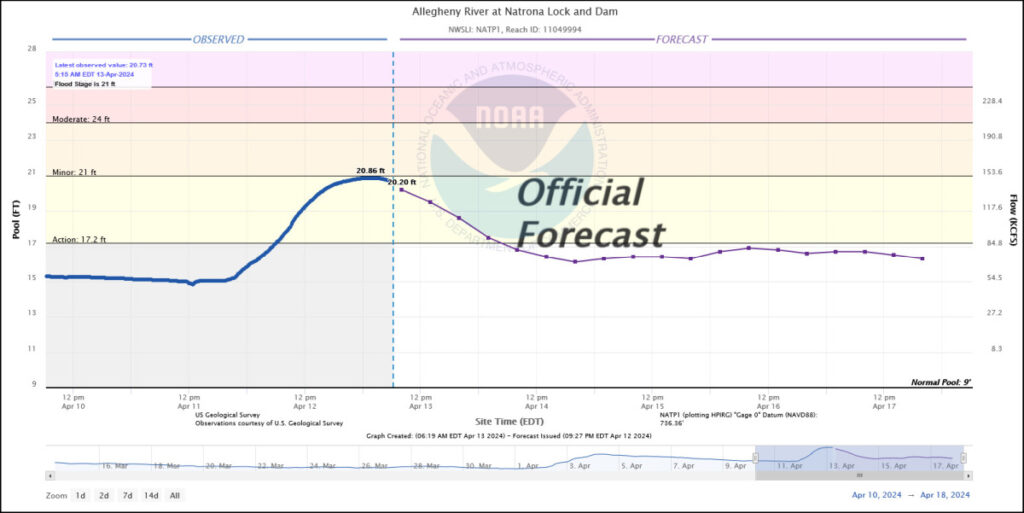
This weekend would be a good time to see the chicks but keep in mind the Allegheny River is in flood because of Thursday’s record-setting rainfall. Here’s the flood stage upstream this morning at Natrona Lock and Dam.
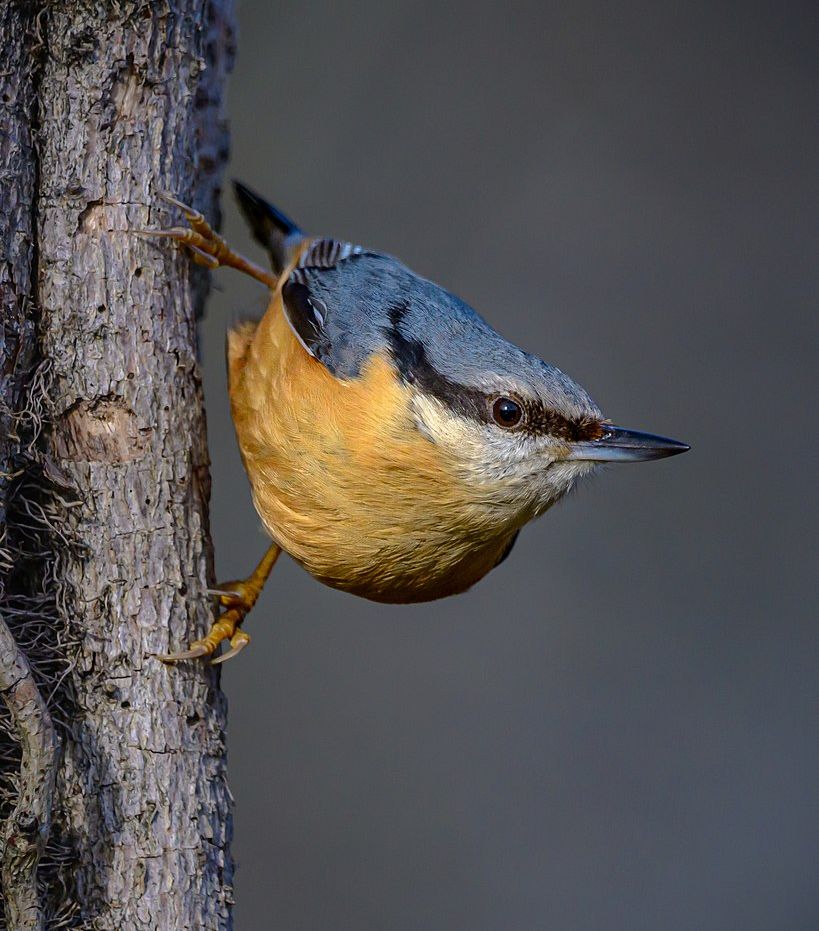
I will have to charge for this vandalism …. some potential tenants of this furnished apartment have taken a dislike to some of the decorations. Instead of letting me know, they decided to remove it themselves! ??#GwylltHollowpic.twitter.com/i3HoicKLhp
Heads up for North Americans: Though the bird resembles a red-breasted nuthatch the birdhouse is in Southern Wales so this destructive tenant is a Eurasian nuthatch (Sitta europaea). He is simply called a “nuthatch” in Britain because he is the only one.
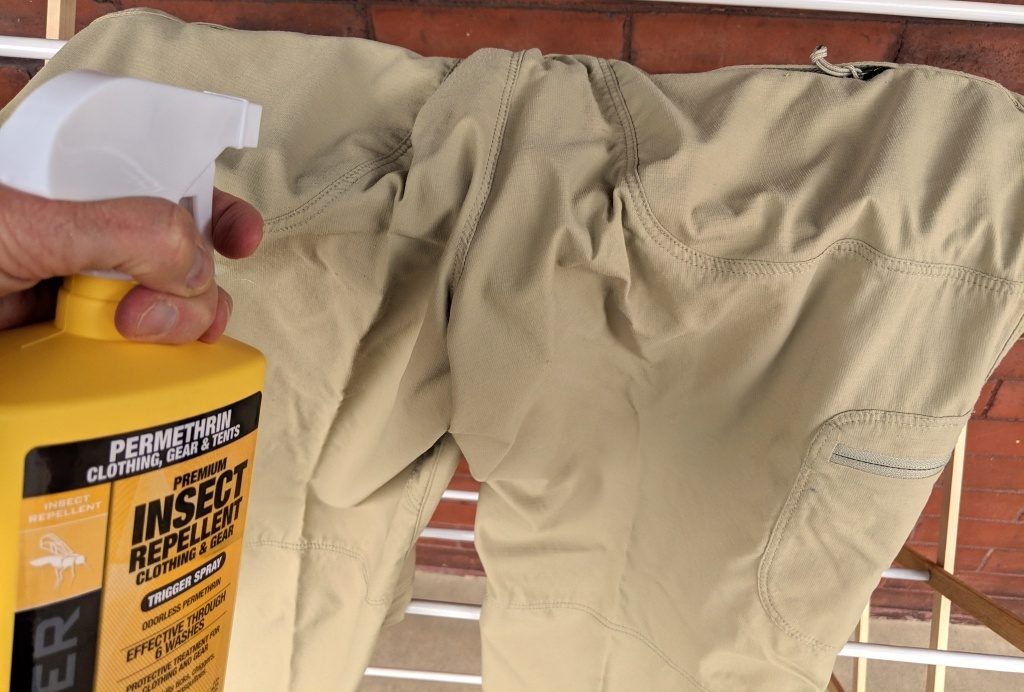
It’s Spray Your Clothes Day (photo by Kate St. John)
11 April 2024
There’s a danger outdoors in Pennsylvania’s suburbs, parks and woods. The first step to protect yourself is to spray your clothes in early spring.
The Danger:
When a black-legged tick (Ixodes scapularis) sucks your blood it can transmit a parasite that causes Lyme disease, an illness that can ruin your life for a very long time. Black-legged ticks are especially dangerous in May and June when the tiny nymphs, only as big as a poppy seed, are questing for a blood meal.
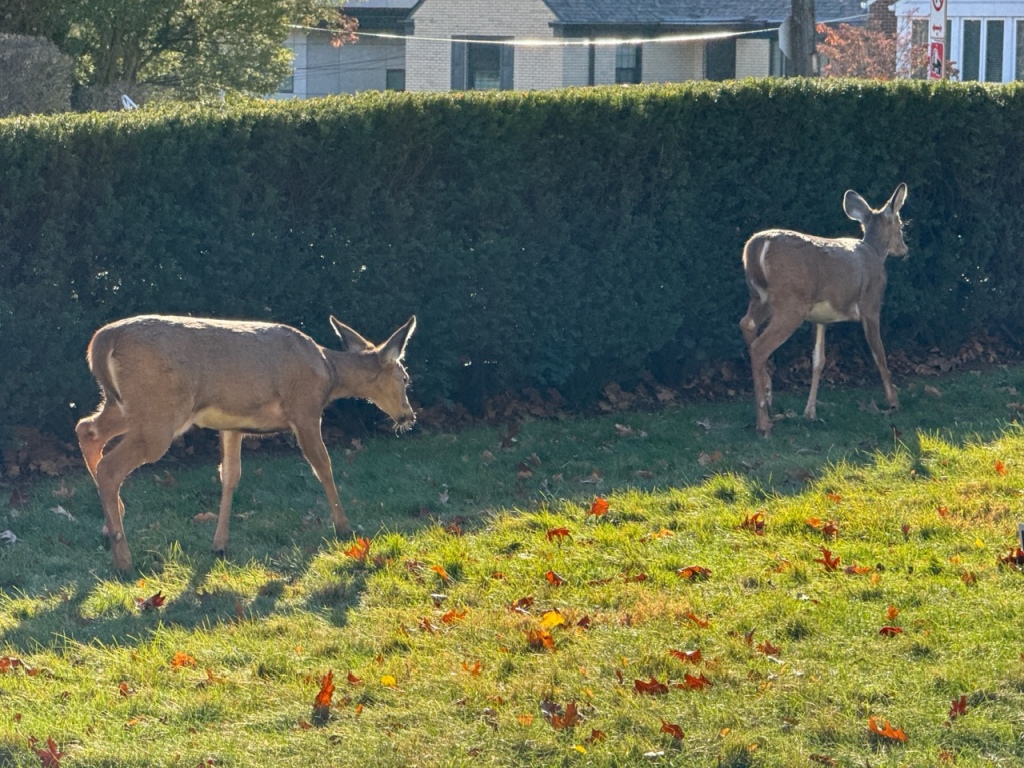
If you don’t think you’ll see a tick in Pittsburgh’s suburbs, city parks and your own garden, think again. Deer don’t carry Lyme disease but they do carry ticks — a lot of ticks — and deer are everywhere.
Deer on Forbes Ave, Squirrel Hill, 7 Nov 2023 (photo courtesy Mardi Isler)
Are there deer in your backyard? There are also ticks.
The Prevention:
By spraying your clothes with permethrin you repel ticks and lower your likelihood of a tick bite. Spray your clothes outdoors in early April on a dry windless day so the spray doesn’t touch your skin. (Read the directions on the bottle.)
Here’s all you need to know about Spray Your Clothes Day activities and how to prevent Lyme disease.
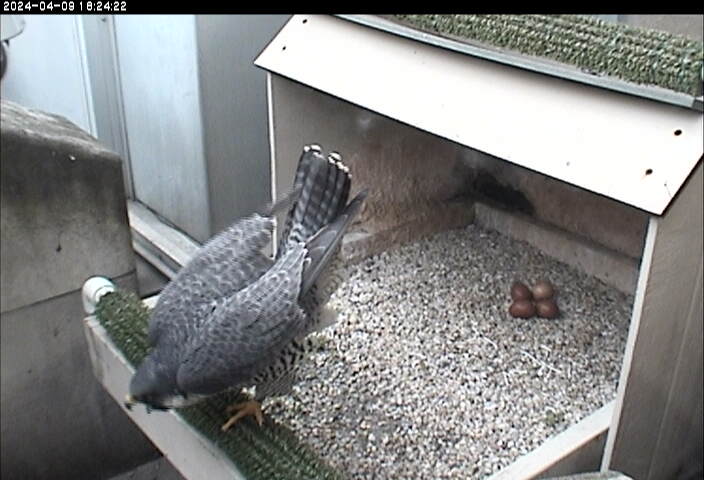
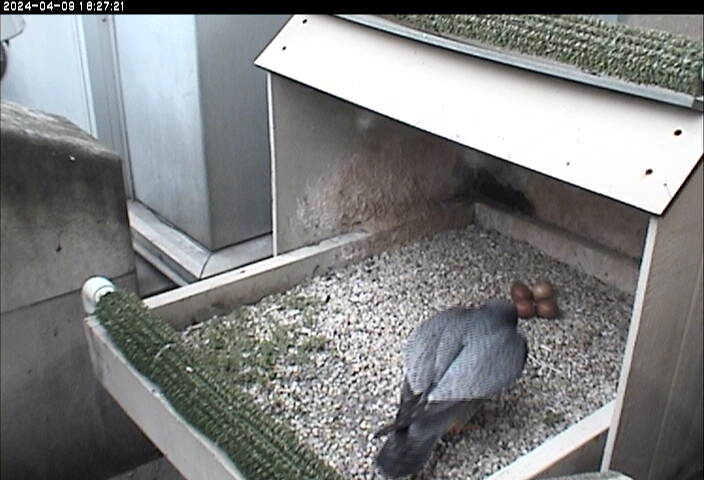
Peregrine news is quiet in early April while all the nests are incubating … or are they? I just did the math and Tarentum Bridge is going to hatch on or before today (see end of article). Here’s the news.
Cathedral of Learning, Univ of Pittsburgh: Yesterday I just happened to be on the roof deck of my apartment building at 6:24pm when I saw a peregrine burst off the Cathedral of Learning and head east over Fifth Avenue using territorial flappy flight. I could hear it kakking while a second peregrine was in the sky over South Craig Street circling up and up and up. The “flappy” peregrine circled up too and dove on the intruder, driving it to the east.
Yesterday’s motion detection photos indicate that the “flappy” peregrine was Carla. Both peregrines were watchful all day, then suddenly at 6:24pm Carla got mad and left the nest quickly, shouting to Ecco to take over incubation. I was very lucky to see the encounter in the air.
p.s. The falconcam is just fine but Ozolio’s stream is funky. You’ll sometimes see an old still shot, then spinning, then another still shot, then eventually the actual live stream. The National Aviary is working with Ozolio tech support to fix it.
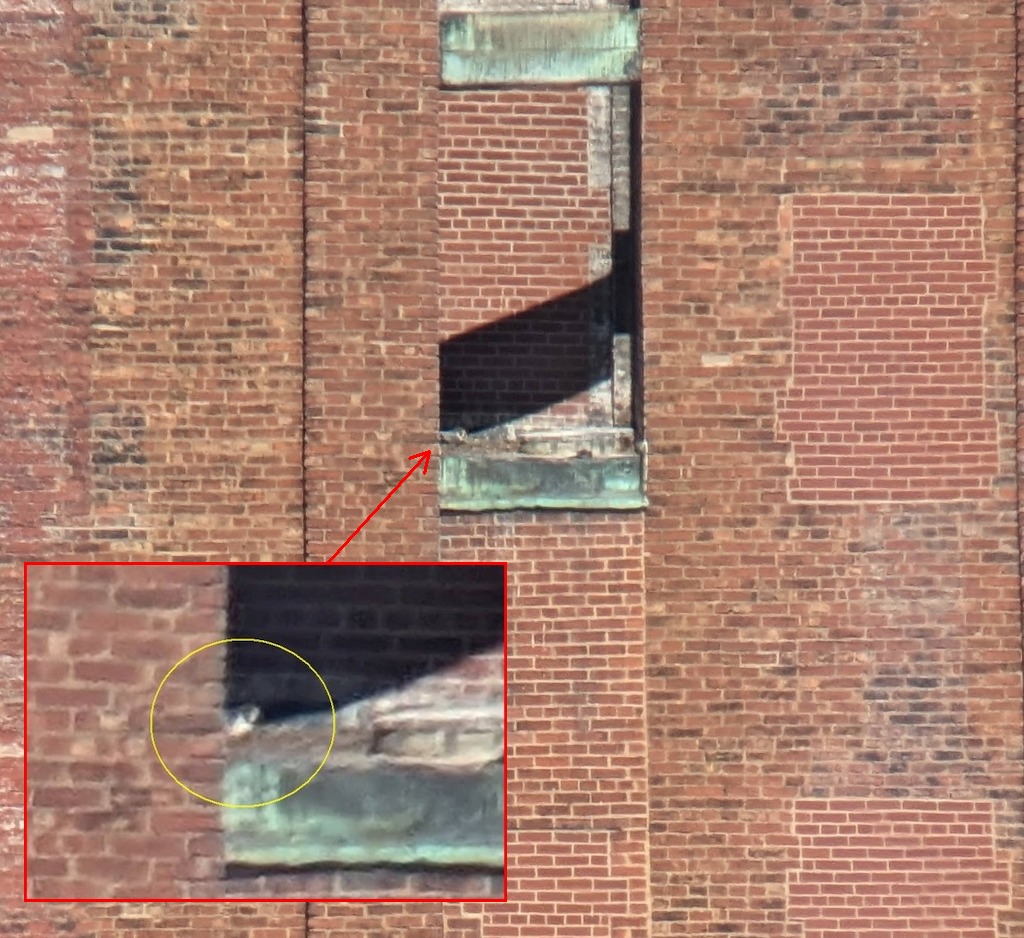
Downtown Pittsburgh: On 28 March 2024 I stood near the Monongahela Incline on Mt Washington and used my scope to peer into the Third Avenue peregrine nest where I saw a peregrine incubating eggs.
Third Ave peregrine nest Downtown as seen via scope from Mt Washington, 28 March 2024 (photo by Kate St. John)
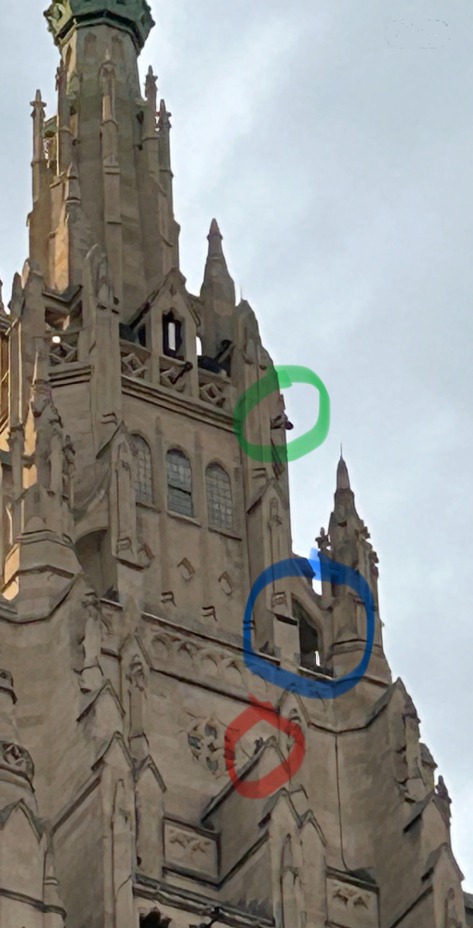
East Liberty Presbyterian Church, Pittsburgh: On 29 March Adam Knoerzer reported that the nest is definitely within the blue circle in his photo below. “The female is always there and never on the exterior except when the male pops in for a shift change.” (I think this on the Highland Avenue side of the steeple.)
East Liberty Presby Church steeple. Look in the blue circle for peregrines to/from the nest (photo by Adam Knoerzer)
Eckert Street, Ohio River: As of 5 April Jeff Cieslak reports that a peregrine pair is near the Eckert Street nest site but they don’t appear to be nesting there. He says it’s the same female, probably a new male.
Peregrines in flight near Eckert Street, Pittsburgh, 12 March 2024 (photo by Jeff Cieslak)
Sewickley Bridge, Ohio River: Jeff Cieslak reports: “On several visits during March, one or two falcons were fussing around under the bridge, near the far pier. On April 3, two were observed in what appeared to be a nest exchange on a beam near that area. This will be the third year that I’ve witnessed a breeding pair on this bridge, and I have never seen a fledgling.”
Peregrine pair at nest hole on Sewickley Bridge, 25 March 2024 (photo by Jeff Cieslak)
Monaca Railroad Bridge, Ohio River: For a while it looked as if the peregrines would nest but their attempt must have failed. eBird reports from the “Mouth of the Beaver River” hotspot in late March through 2 April indicate that both peregrines are visible simultaneously. Definitely not incubating.
Railroad bridge over the Ohio River from Monaca to Beaver (photo by Kate St.John)
Rt 40 Bridge, West Brownsville, Monongahela River: Fred Kachmarik and Jeff Cieslak both visited this bridge in mid to late March and saw a solo peregrine. Here’s Jeff’s photo from 23 March. Since this site was successful in the past, it looks promising for a family this year.
Peregrine at Rt 40 Bridge, West Brownsville, PA, 23 March 2024 (photo by Jeff Cieslak)
Every potential site is listed below …
and you’re probably wondering …
When will the eggs hatch? … How about TODAY? see below
The usual calculation is “34 days after incubation begins,” though in most cases we don’t know when it started. Of the four nests that seem to be incubating here’s a rough guess.
Cathedral of Learning: Started around 3/19; Hatch approximately 22 April.
Downtown Third Avenue: Your guess is as good as mine. We didn’t know they were incubating until 3/28 because we didn’t look.
Sewickley Bridge: Saw a nest exchange on 4/3; Hatch on or before 7 May … probably before.
Tarentum Bridge: Saw incubation 3/7; Hatch on or before TODAY!UPDATE: Dave Brooke got video today of the two chicks at Tarentum Bridge. They are more than a week old as of 10 April — possibly 9 days old!
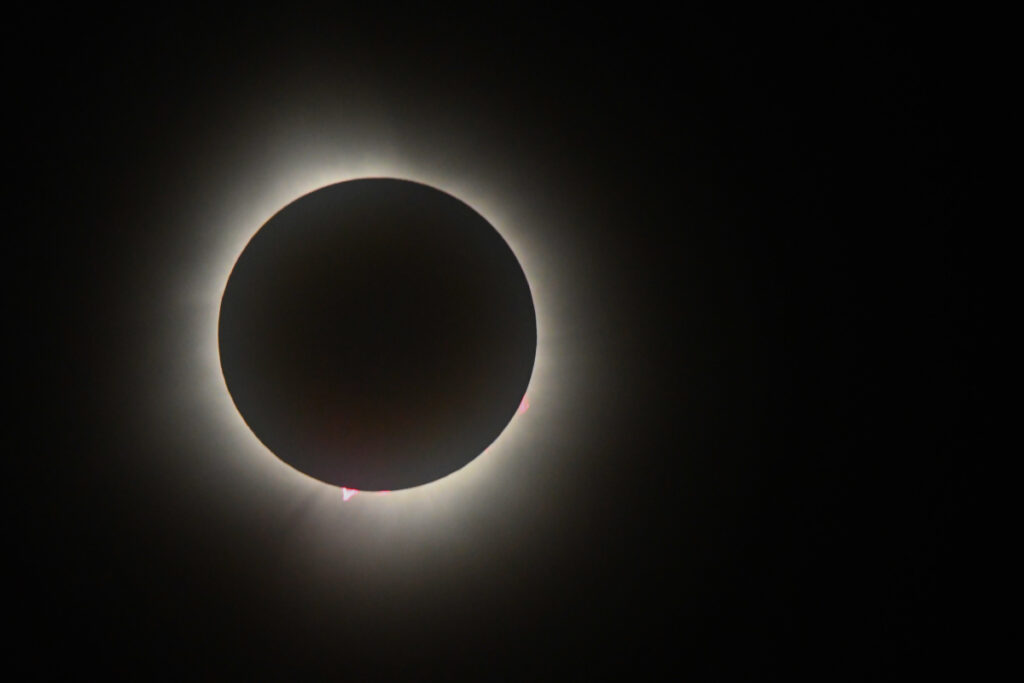
Total solar eclipse, Berea, Ohio, 8 April 2024 (photo by Jeff Cieslak)
9 April 2024
For three minutes yesterday afternoon, people in a wide swath of the U.S. from Texas to Maine were wowed by the total solar eclipse. Jeff Cieslak was in the totality zone in Berea, Ohio and captured the photo at top. Look closely at the dark edge and you’ll see solar prominences (flares).
Pittsburgh and Dubois, PA, just east of the totality zone, were both close enough to experience a 97% eclipse. Our light level was like dusk and the temperature got cooler. Charity Kheshgi captured the partial eclipse in Pittsburgh at 3:17 to 3:20pm.
View of the 97% eclipse in Pittsburgh, 8 April 2024 at 3:19pm ET (photo by Charity Kheshgi)
Meanwhile Marianne Atkinson noticed a change in honeybee behavior at her home in Dubois, PA. She’s providing a honeybee feeder this spring, filled with sugar water, to feed hungry bees in the early days before the flowers bloom. Yesterday morning her feeder was mobbed with honeybees and was running dry.
Honeybees at the feeder, Dubois, PA, 7 April 2024 (video by Marianne Atkinson)
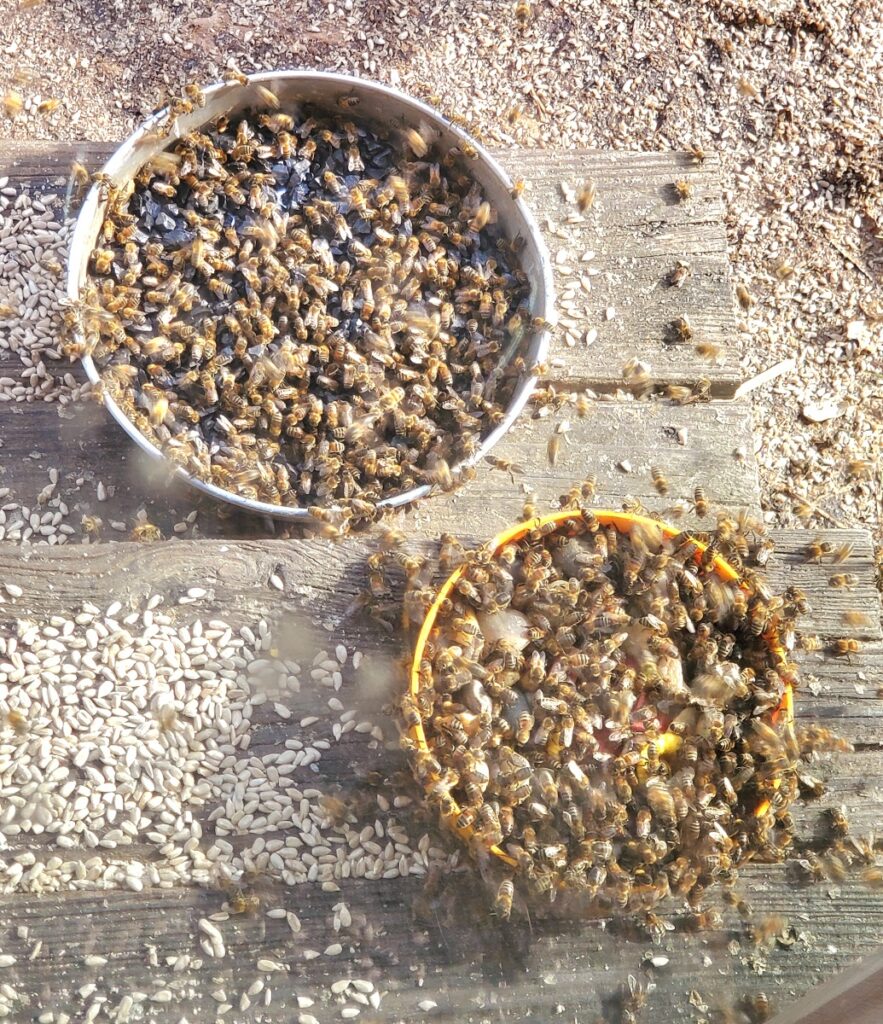
There were too many bees for her to safely refill the feeder so she put out a second one (white rim). It was mobbed, too.
Honeybees at two feeders in Dubois, PA, 8 April 2024 before the partial eclipse (photo by Marianne Atkinson)
And then the eclipse began. Marianne describes what happened.
I had just added a second honey bee feeder this afternoon, not long before the eclipse started. But, during the eclipse at 97%, there were very few bees on either feeder! The yellow feeder only had two bees and the gravel feeder had 3 bees. I took this opportunity to add more nectar to the yellow feeder, since it was empty.
[Meanwhile] The many American Goldfinches and Pine Siskins were chattering away in the trees nearby during the whole eclipse. The sky had gotten a little darker, but not dark like a solar eclipse in totality. There were clouds during most of the eclipse, with occasional peaks of sun or seeing it through thin clouds. I was able to view it off and on.
— email from Marianne Atkinson, Dubois, PA, 8 April 2024
Honeybees are diurnal and they return to their hive at dusk to spend the night indoors. Apparently the light level during a 97% eclipse is low enough to prompt bees to go home. After the eclipse the honeybees came back quickly to both feeders. Marianne said, “They had just recently discovered the pea gravel feeder, but did not waste any time in utilizing it!”
Did you notice any special animal or insect behavior during the eclipse? Leave a comment with your observations.
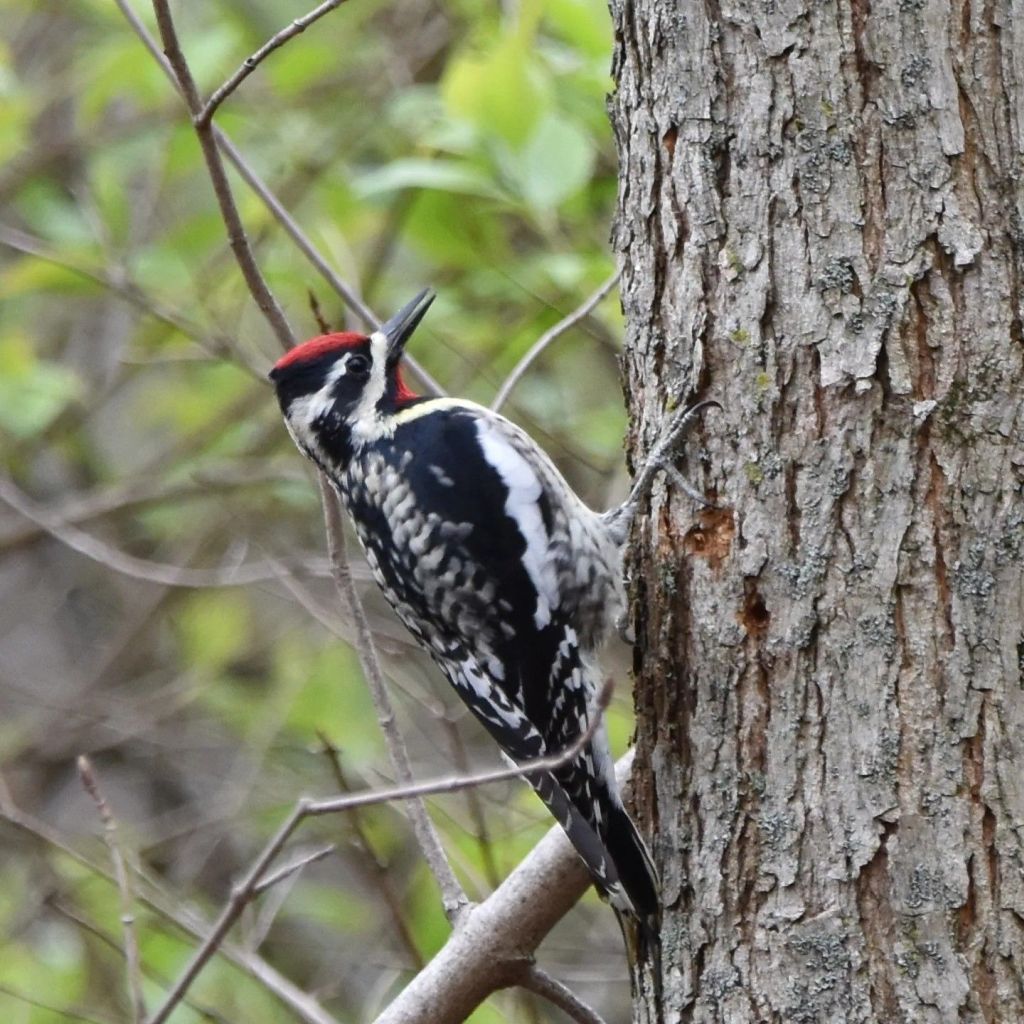
Yellow-bellied sapsucker, Frick Park, 6 April 2024 (photo by Charity Kheshgi)
8 April 2024
Surprise! Instead of an outing on the last Sunday of the month, let’s go birding next weekend. Join me at the Schenley Park Visitors Center for a bird & nature walk on Sunday 14 April, 8:30a – 10:30a.
Yellow-bellied sapsuckers migrate through Allegheny County in April so mid-month is the best time to find one in Schenley. Charity Kheshgi and I saw this one at Frick.
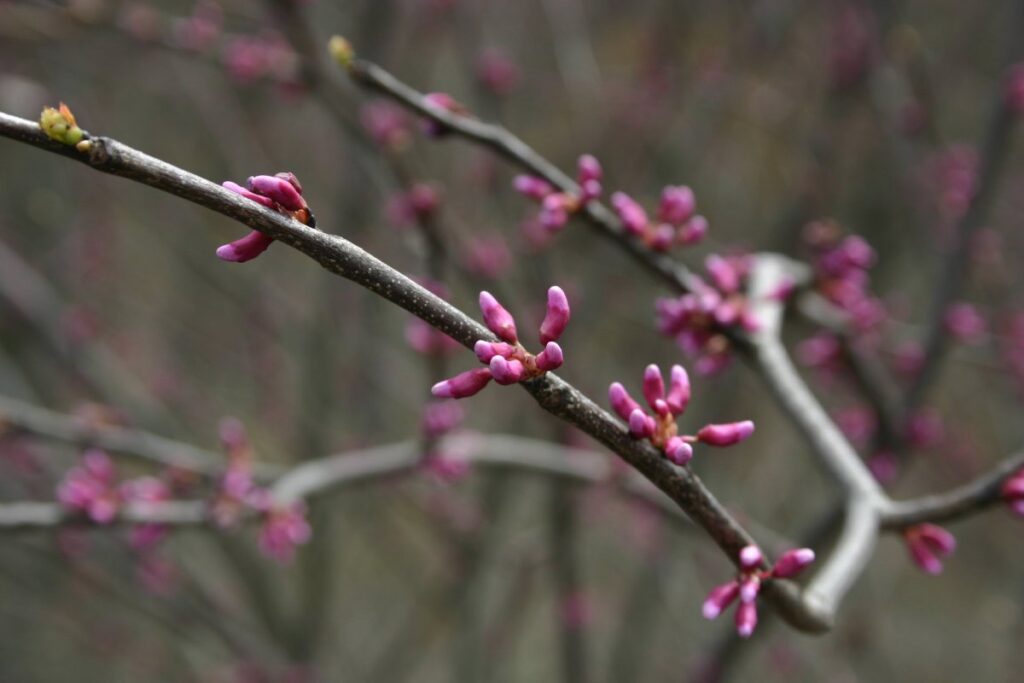
We’ll also see trees in bud, in bloom, and with tiny leaves. Ten years ago the redbuds had not opened yet. Will they be blooming next Sunday?
Redbuds in bud, Schenley Park, 18 April 2014 (photo by Kate St. John)
April showers won’t stop us. This event will be held rain or shine, but not in downpours or thunder. Check the Events page before you come in case of cancellation.
Dress for the weather and wear comfortable walking shoes. Don’t forget your binoculars.
Hope to see you there.
p.s. If the birding is good I’ll give an option to continue until 11:00am.
p.p.s. Don’t expect a big show of spring wildflowers like we used to see several years ago. Pittsburgh’s overabundant deer have eaten everything except the toxic flowers.
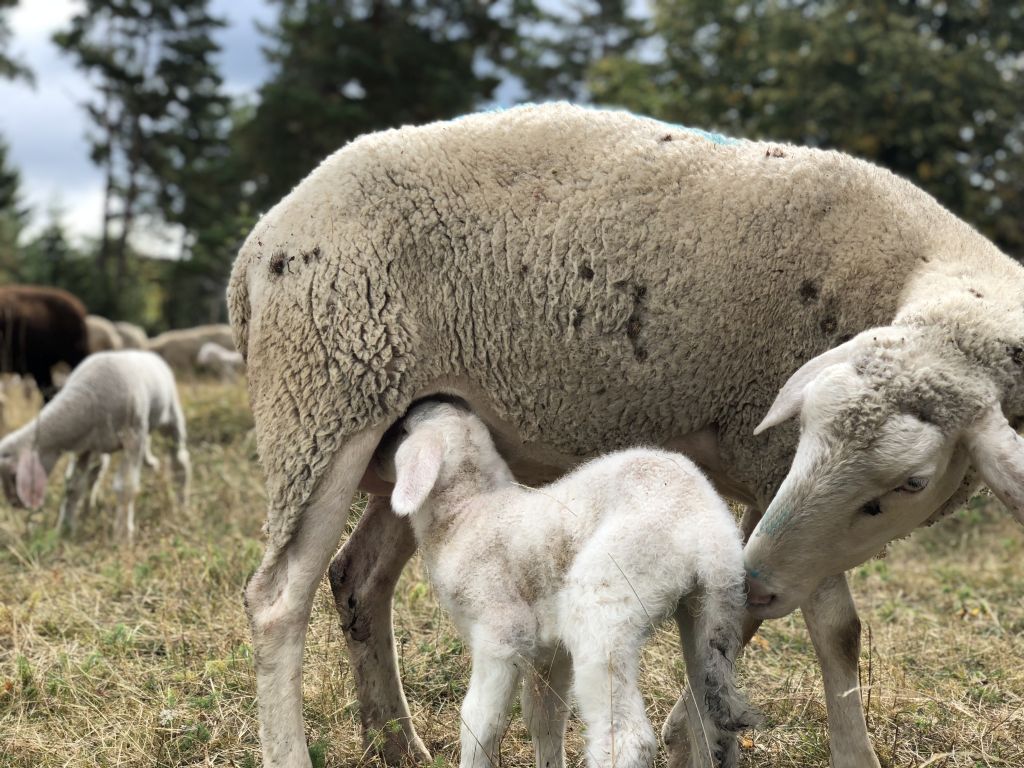
If you live in close contact with animals you get to know them well. Shepherds of small flocks develop an especially close relationship with their sheep because they tend them every day — and for 24 hours a day during lambing in early spring.
Paula Aarons, originally from Valencia PA, runs a small sheep farm in New Hampshire called the Dancing Pony Sheep Farm. Last month she appeared on Junction Fiber Mill‘s Millcast program to tell the story of her flock supporting each other and supporting her, their shepherd.
Our mutual friend Jeff Cieslak introduced her 15-minute video.
People: My friend Paula told this wonderful story about her sheep for a podcast. I watched it, and I wept a little, and now you, too, must weep.
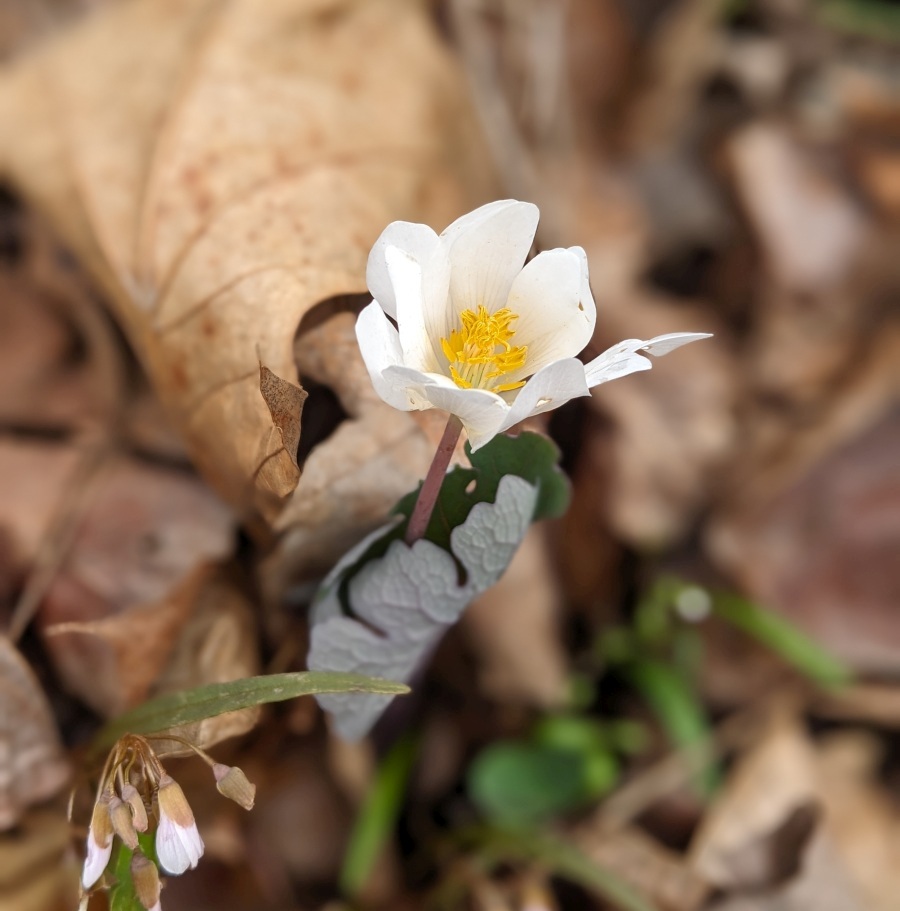
Bloodroot blooming at Independence Marsh, 31 March 2024 (photo by Kate St. John)
6 April 2024
This week March went out like a lamb and April came in like a lion.
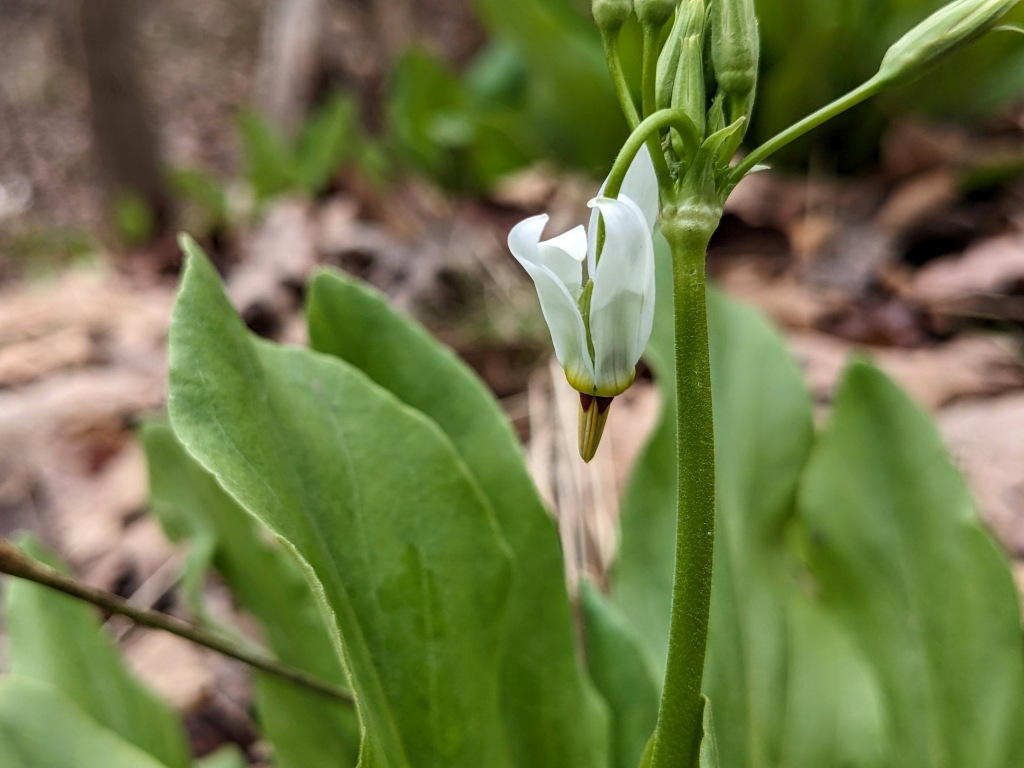
After photographing garden flowers on Easter morning I traveled out to Independence Marsh in Beaver County. I did not find my target bird, rusty blackbirds, but I did find spring flowers: Dutchmans breeches, cutleaf toothwort, bloodroot (above) and the first tiny bloom on shooting star (below).
Early bloom on shooting star, Independence Marsh, 31 March 2024 (photo by Kate St. John)
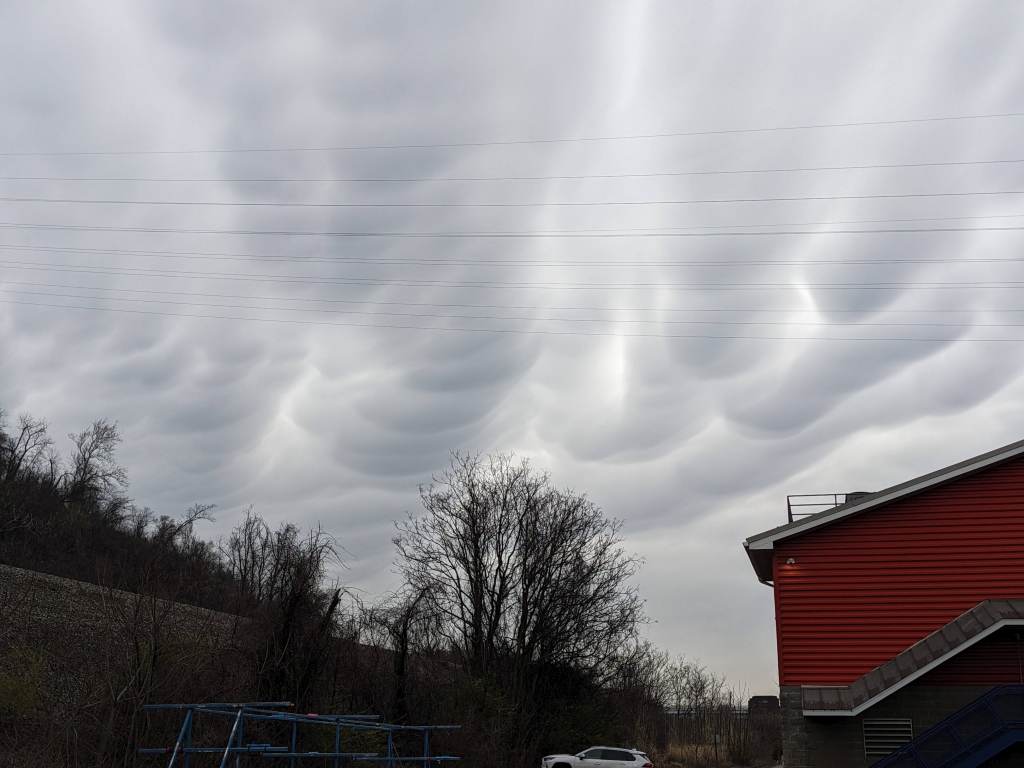
As soon as March was over, things went wrong. I should have known when I saw this troubled sky of mammatus clouds on Saturday, 30 March. Not a good sign.
Mammatus clouds presage a week of rain, snow and graupel in Pittsburgh, 30 March 2024 (photo by Kate St. John)
It rained and rained and rained on April 1-3, setting a record of 2.68 inches on April 2. Streams and basements were hit hard while the rain was falling. The rivers rose, as shown at at Duck Hollow on 4 April with the Monongahela River at parking lot level. (more flood photos and videos here)
Duck Hollow parking lot — A River Runs Through It — 4 April 2024, 7:19am ET
Later that same day, Thursday 4 April, the temperature fell and so did graupel.
Graupel falls o n4 April 2024 (video by Kate St. John)
Today it’s cold but the precipitation has finally stopped.
Meanwhile ….Remember those beautiful tulips I posted last Sunday, Easter morning?
BEFORE –> Tulips on N. Neville St on Easter morning, 31 March 2024 (photo by Kate St. John)
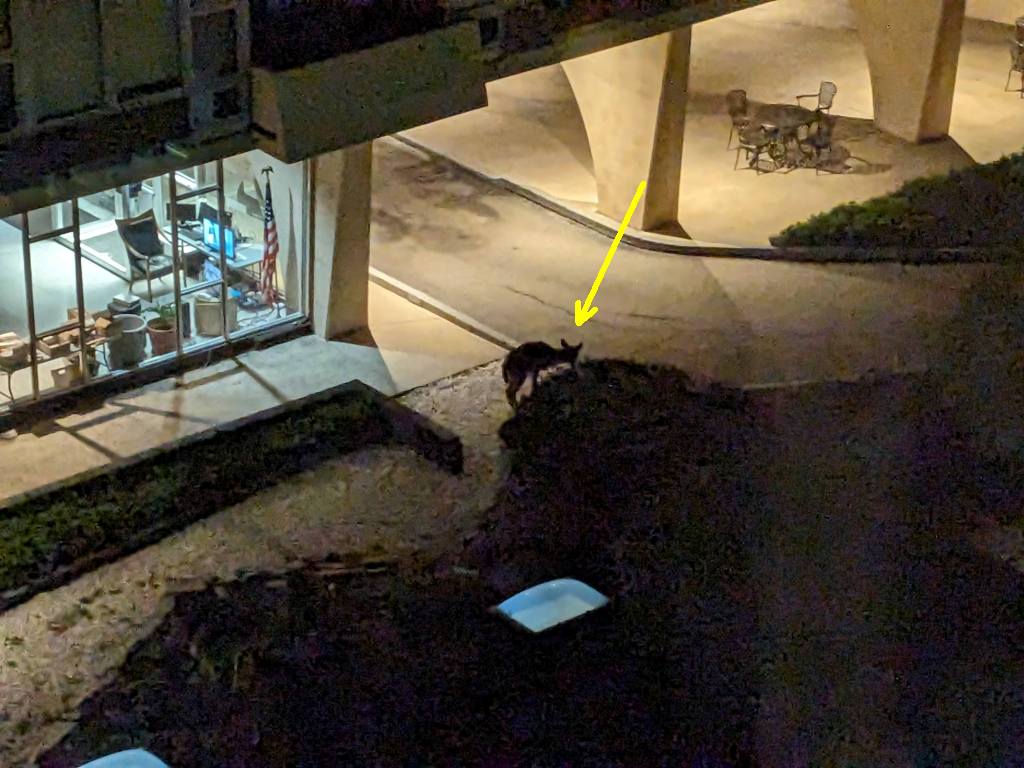
And remember the deer I saw between two highrises in Oakland on 24 March?
A deer browsing the garden at a highrise in Pittsburgh, 5:30am 24 March 2024 (photo by Kate St. John)
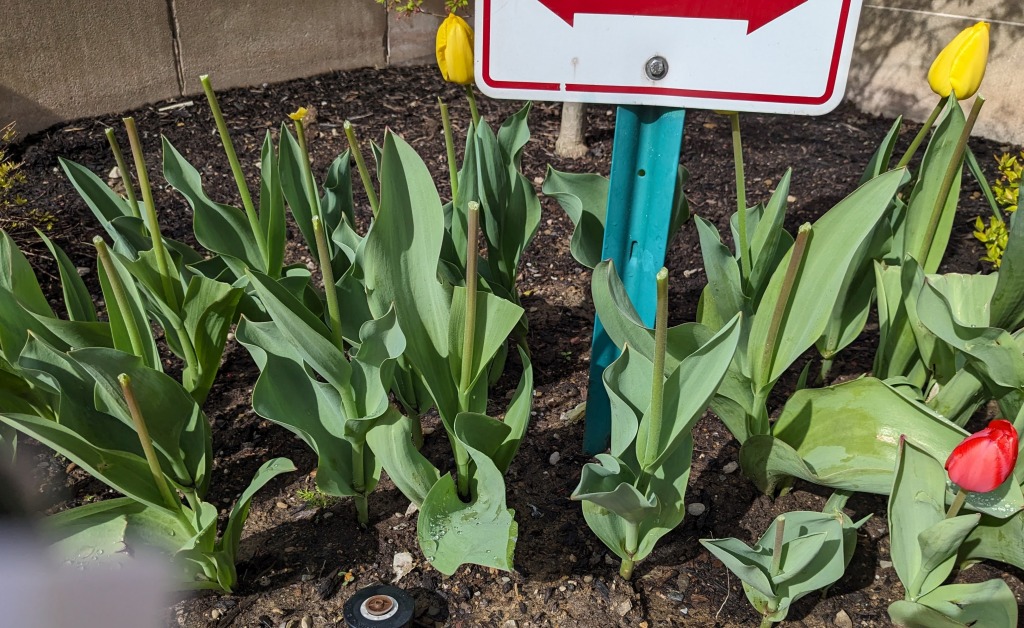
Well, the two met up and the tulips did not fare well.
AFTER –> Same tulips eaten by deer on N. Neville St as of 2 April 2024 (photo by Kate St. John)
That was on N Neville Street. Here’s N Craig Street.
BEFORE –> Tulips in front of a highrise on N Craig St, Easter morning, 31 March 2024 (photo by Kate St. John)AFTER –> Tulips eaten by deer on N Craig St, 4 April 2024 (photo by Kate St. John)
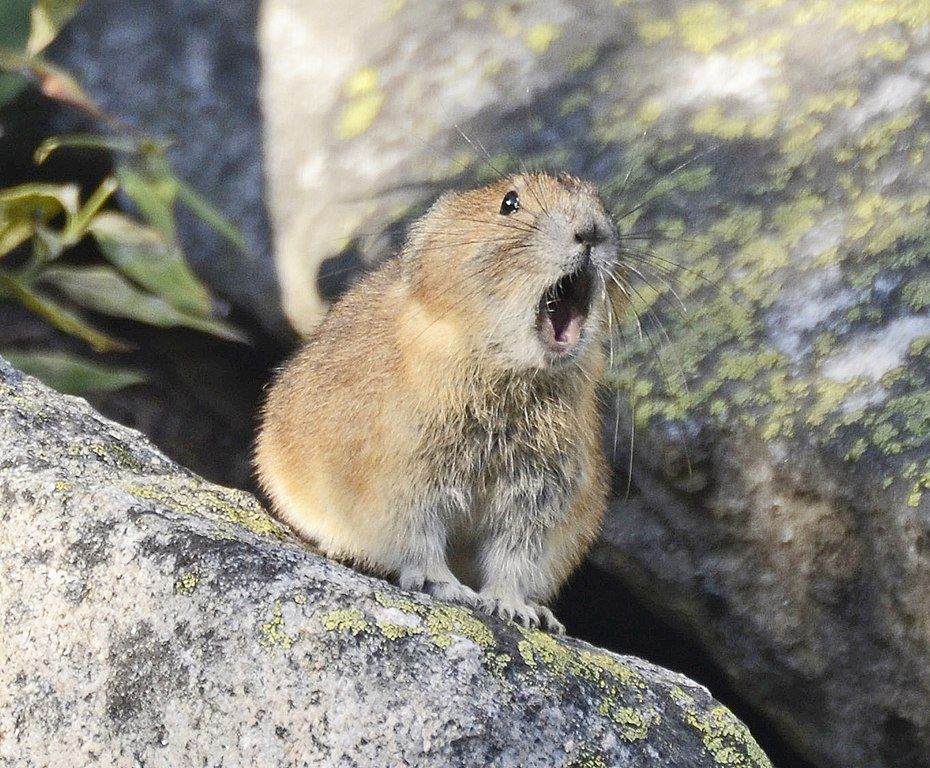
Rabbits rarely say anything but this small mammal, related to rabbits, stands on a prominent rock and shouts to his friends when he sees danger.
American pikas (Ochotona princeps) weigh 6 ounces and are only 6-8 inches long, covered from head to toe in thick fur. They live in boulder fields above the treeline where they eat flowers, grasses and other plants that they cache in a “haystack” for the winter. Though tiny these small mammals are a tasty meal for hawks, eagles, coyotes, bobcats, foxes and weasels.
Pikas very social and vocal, calling out danger and “singing” during the breeding season. When a pika sees danger he lets all the nearby pika’s know.
Though he has a small voice, he works on projection.