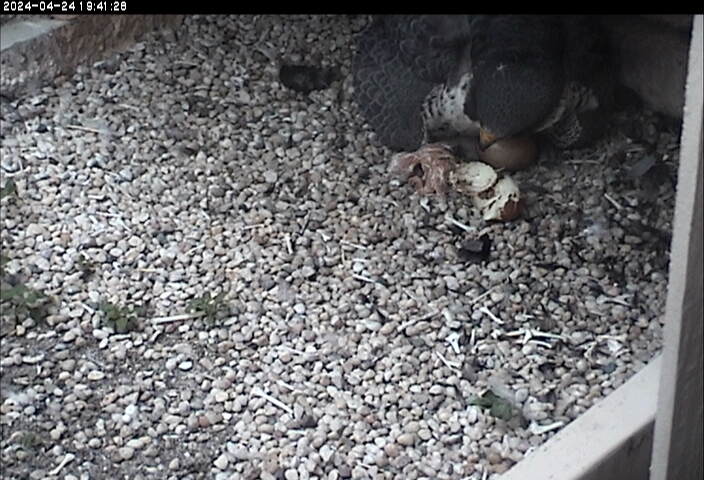
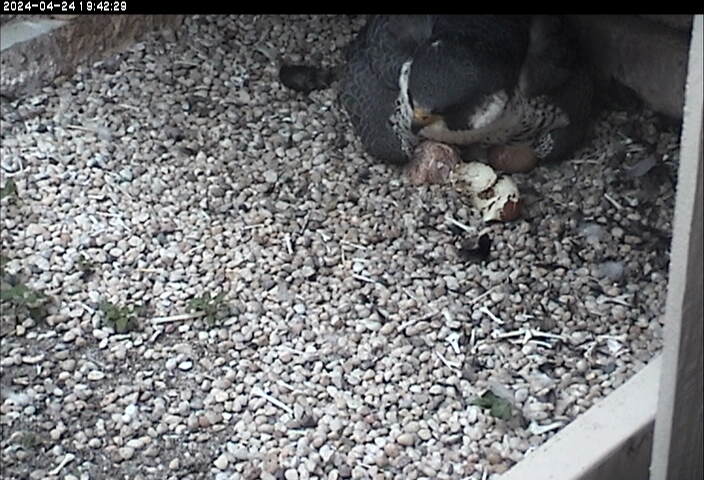
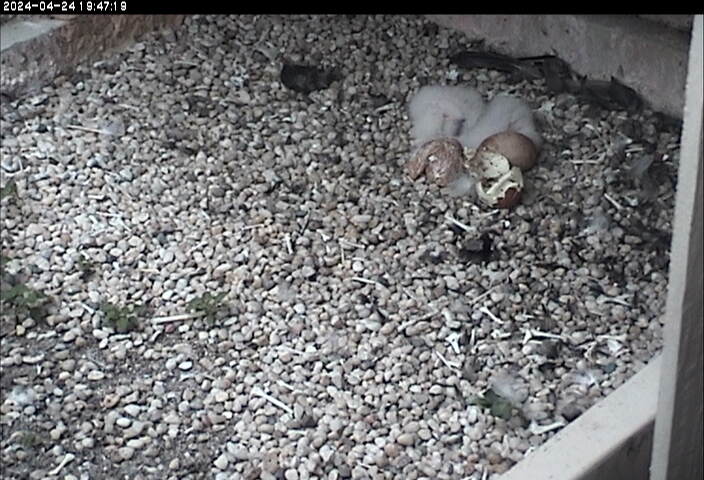
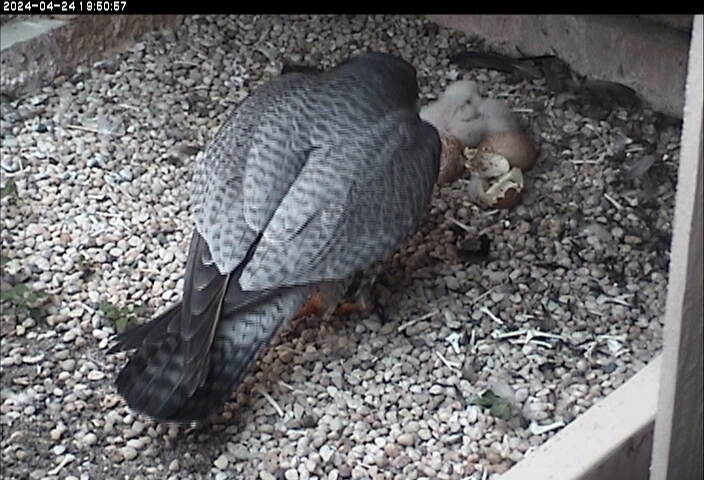
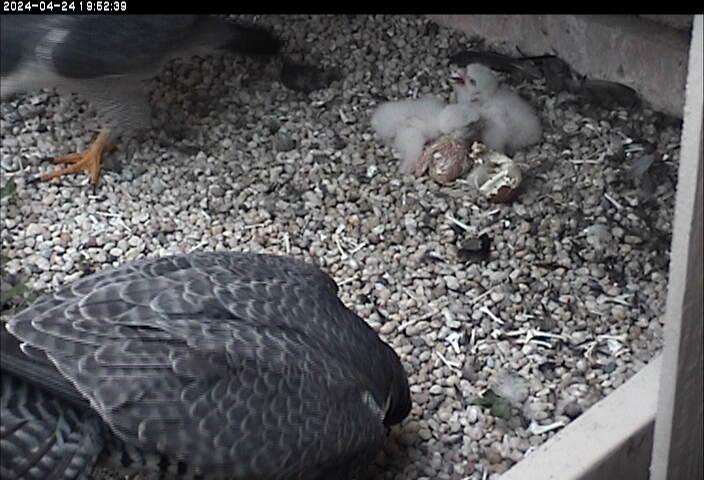
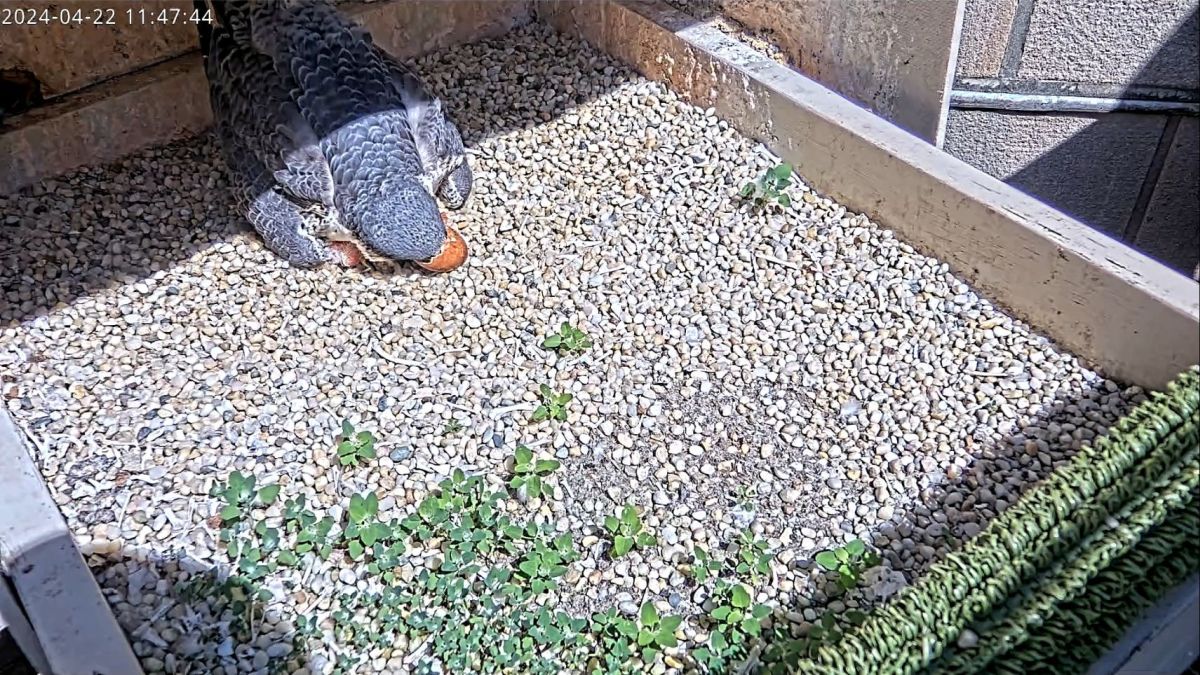
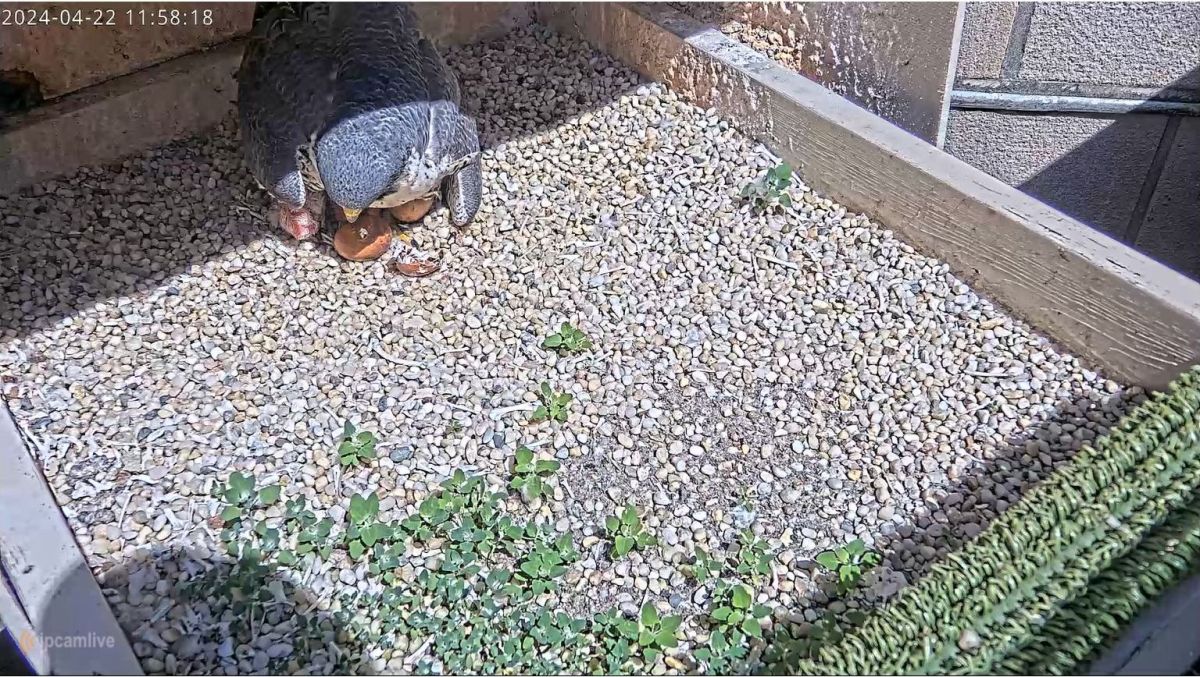
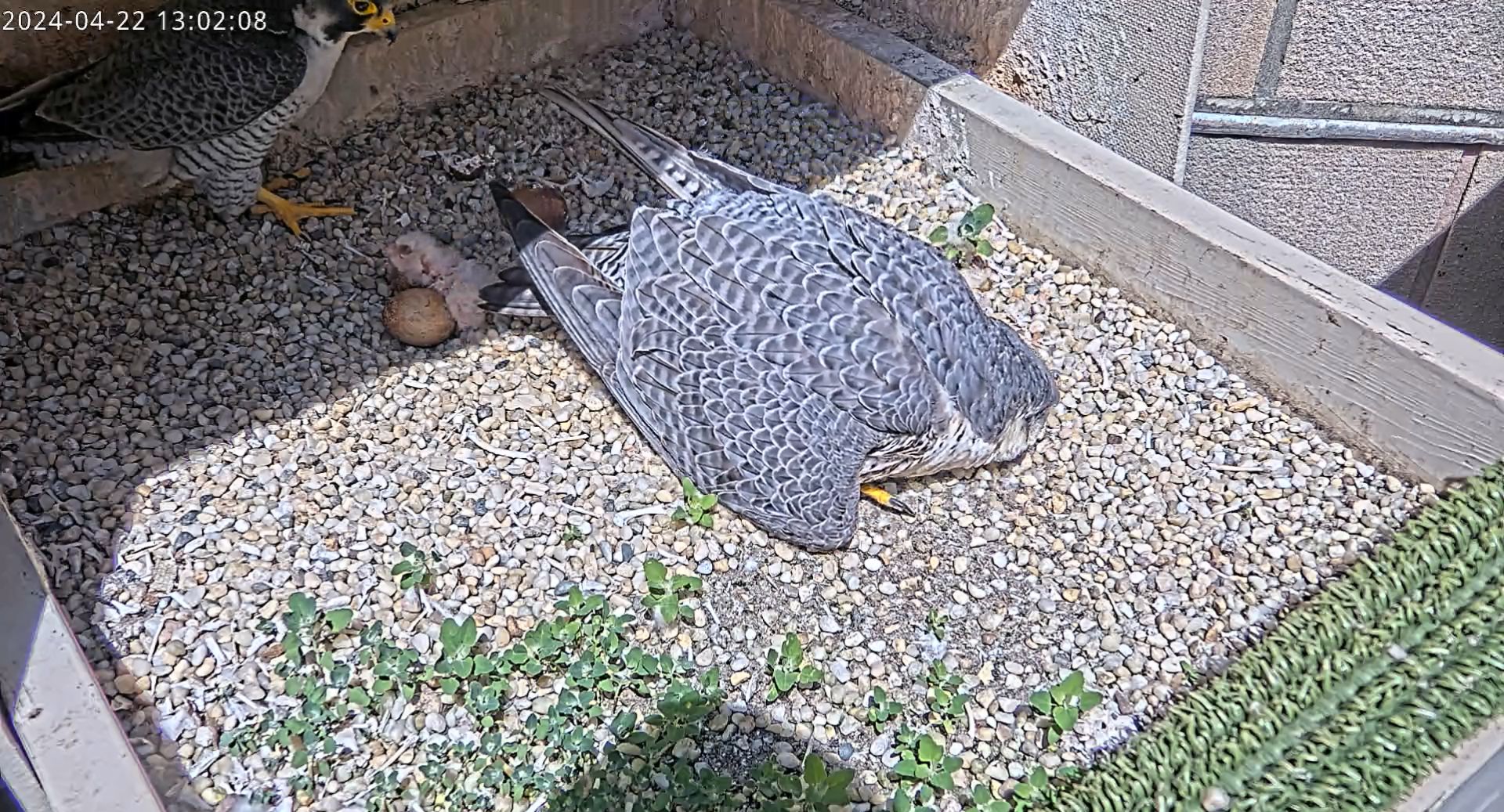
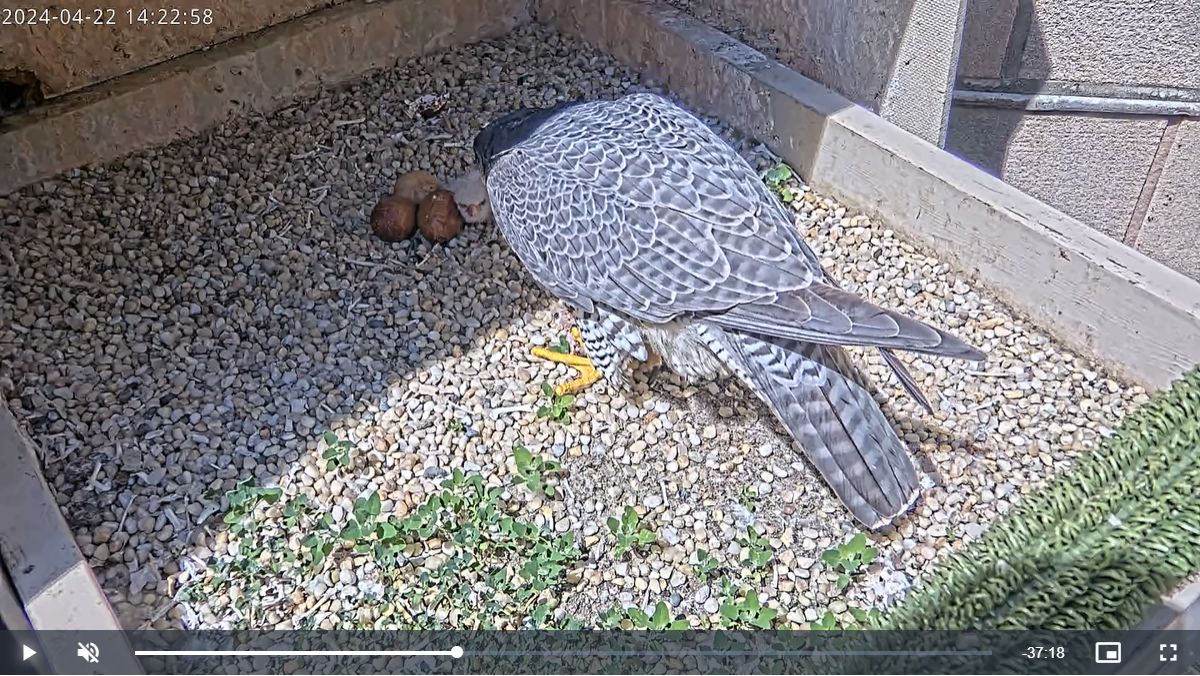
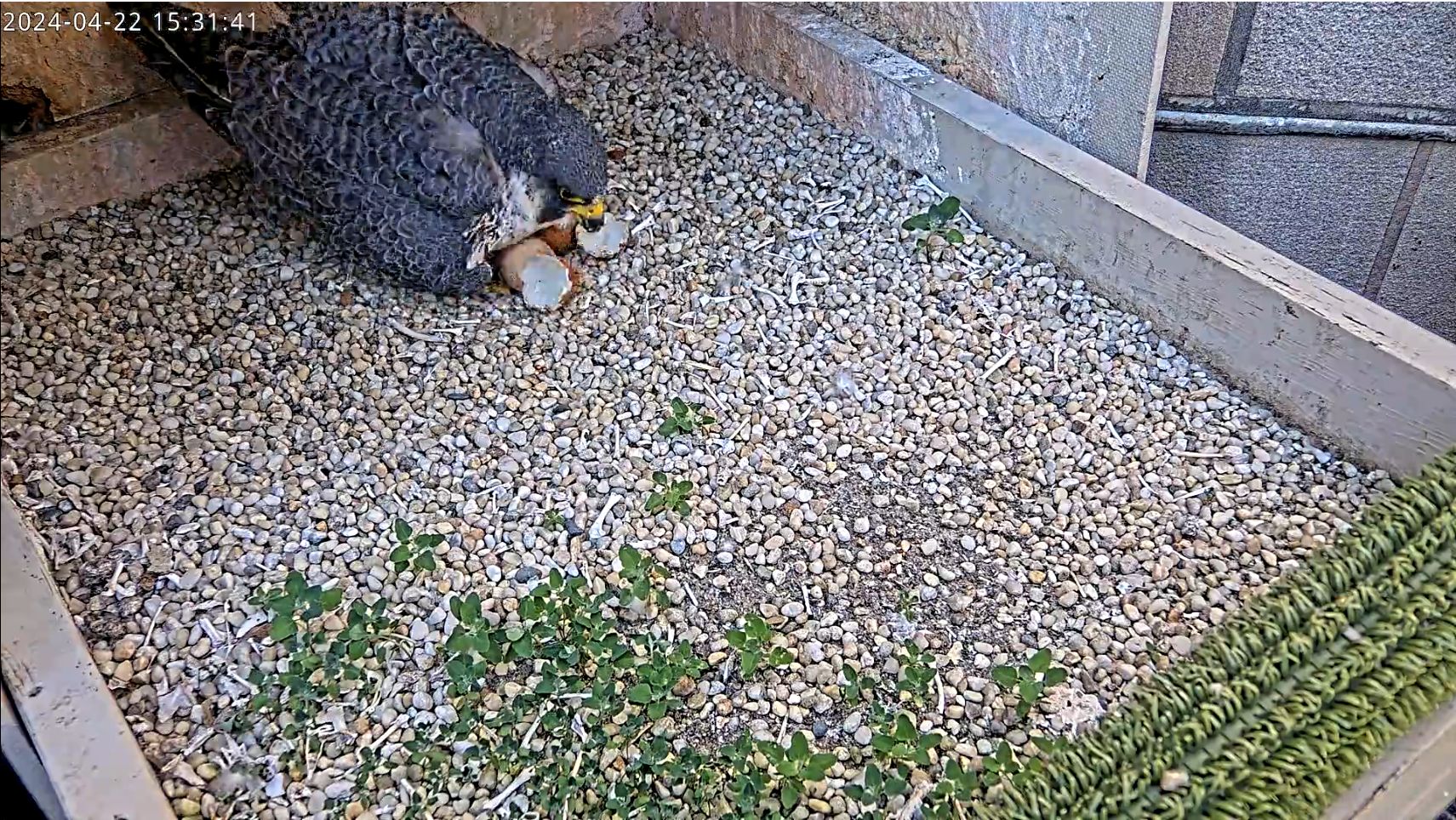
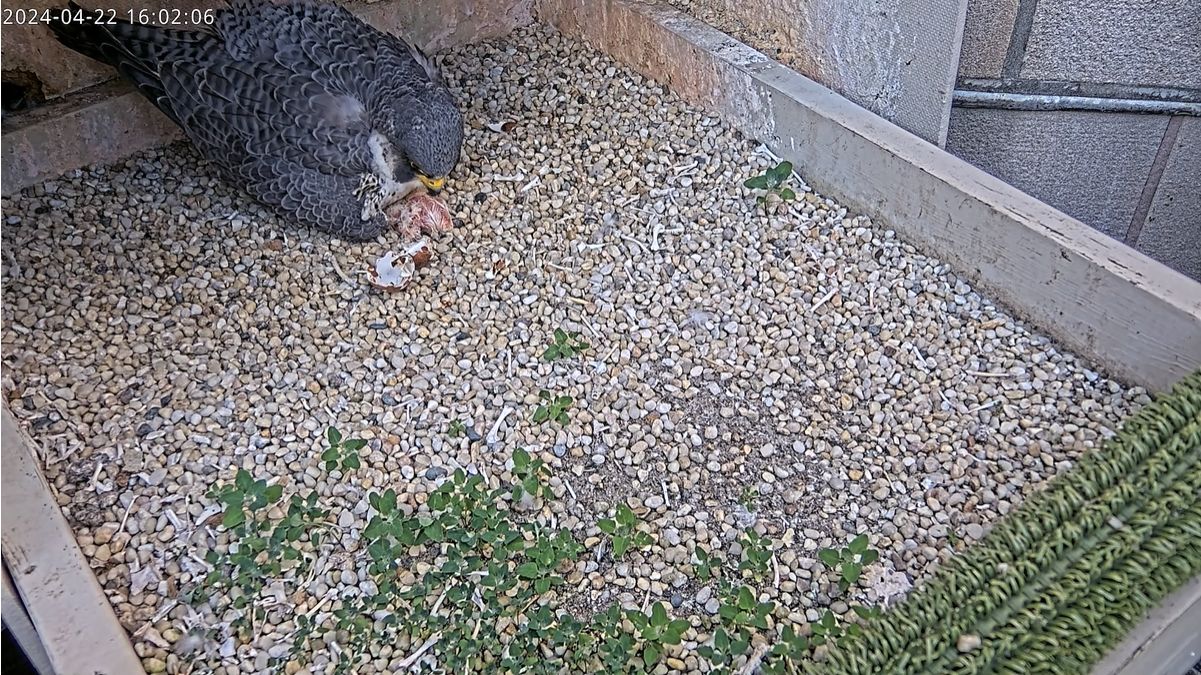
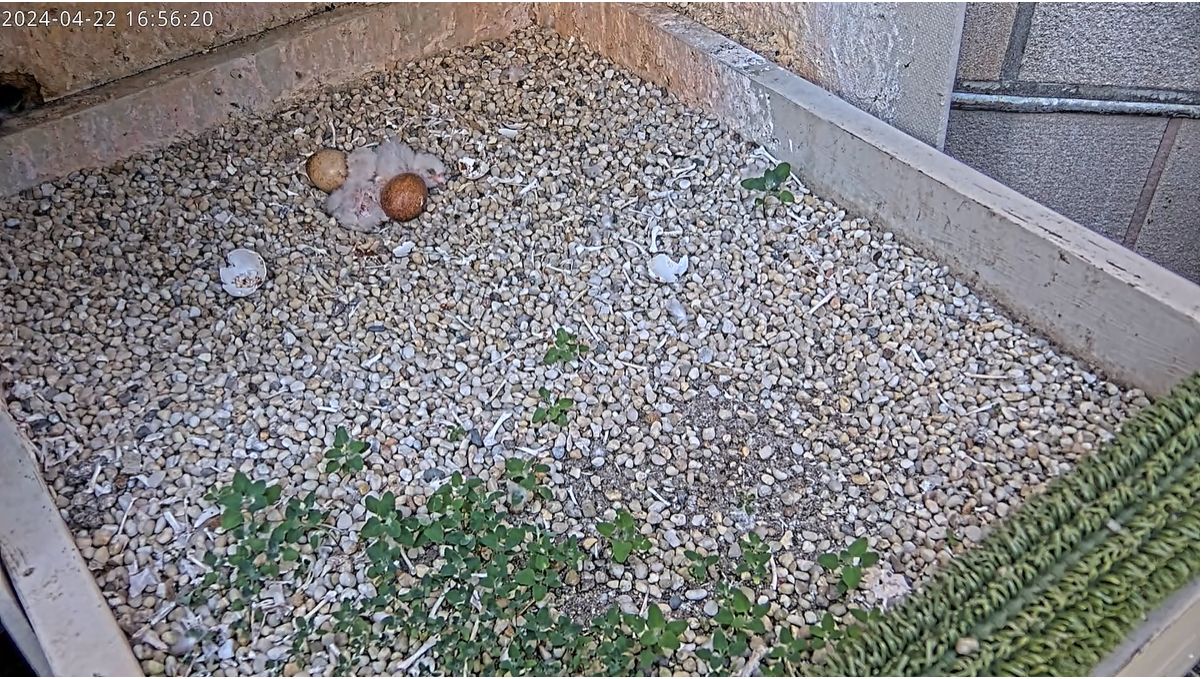
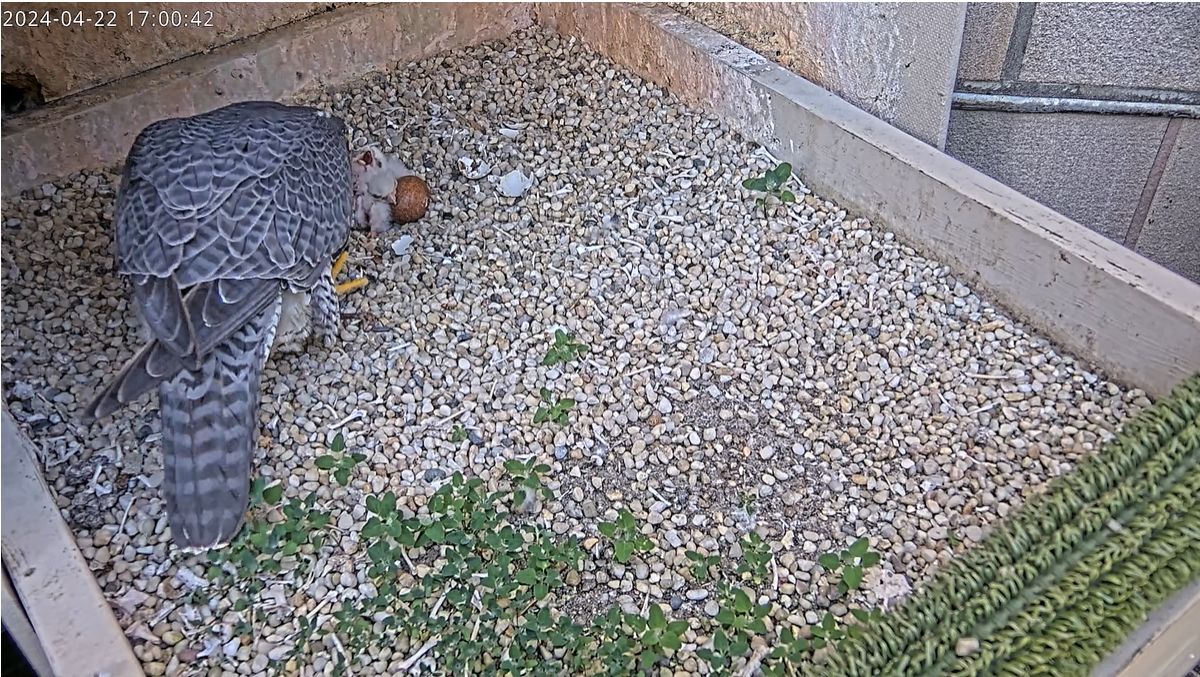
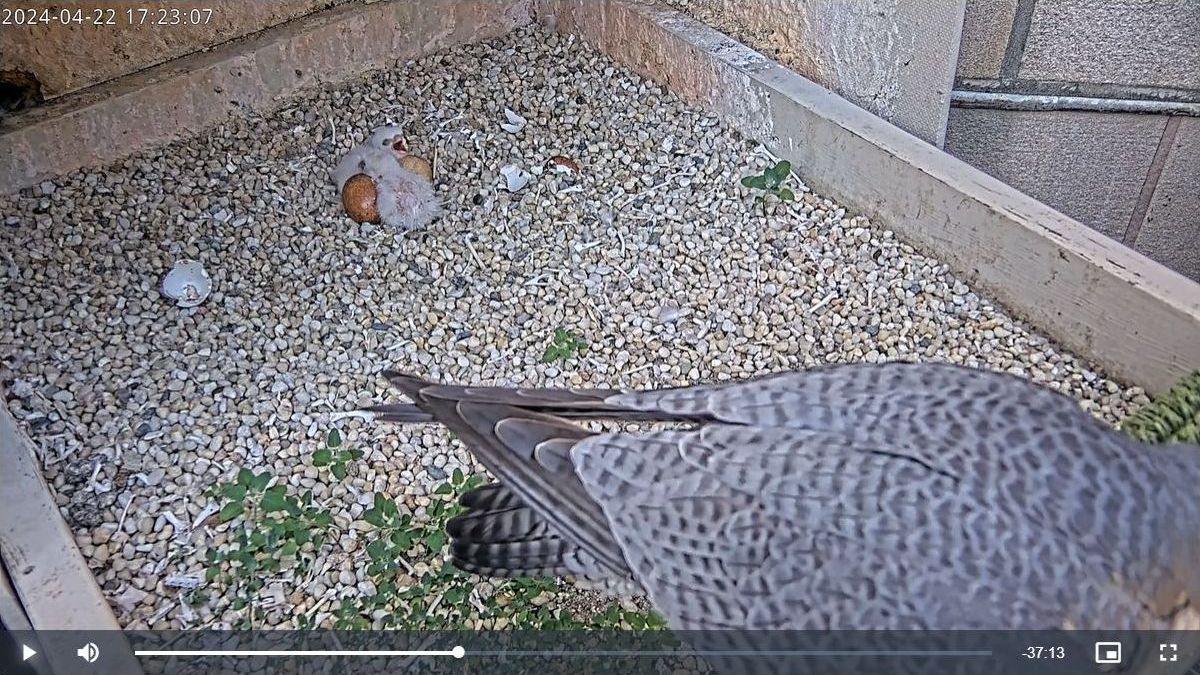
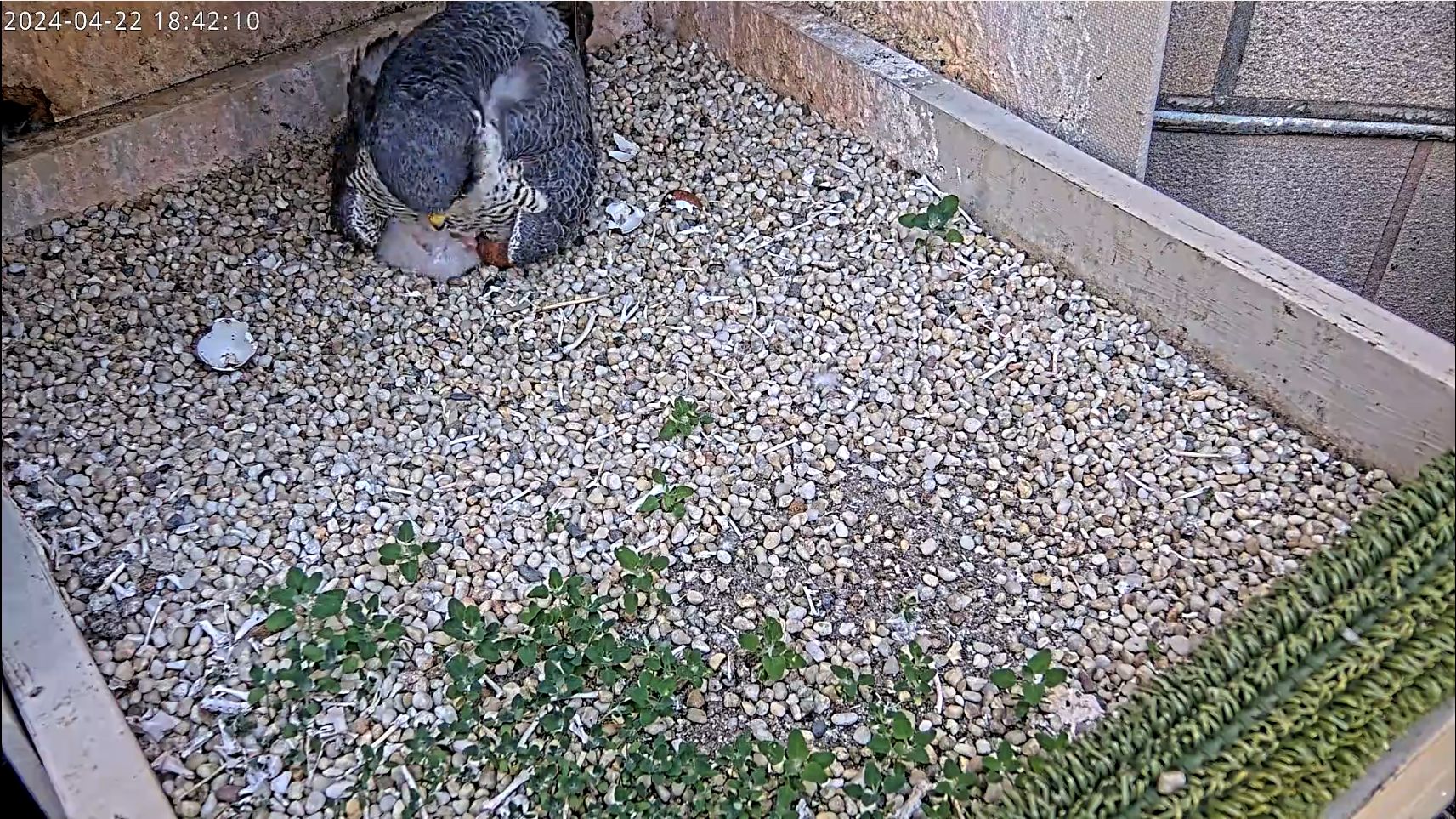
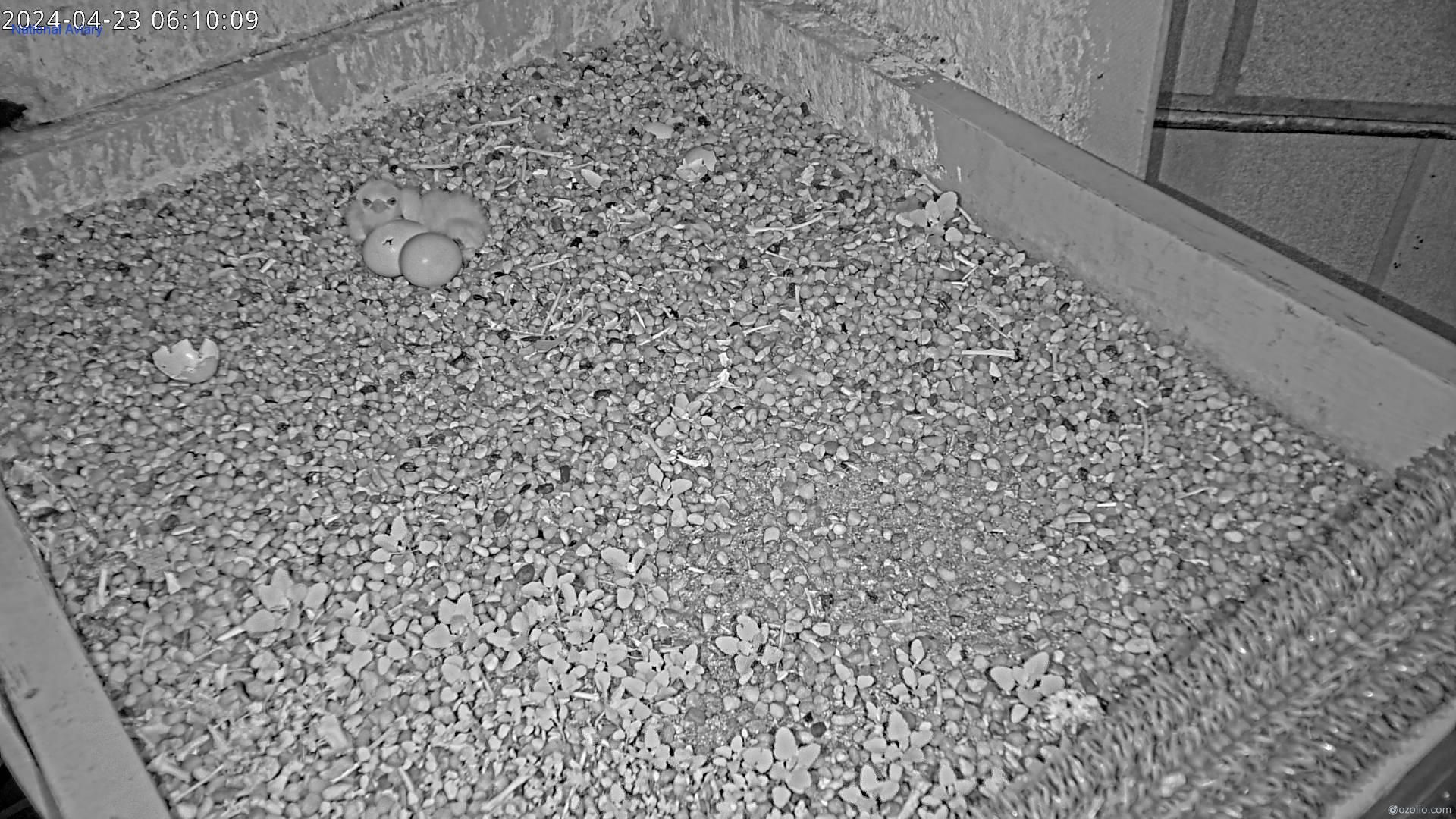
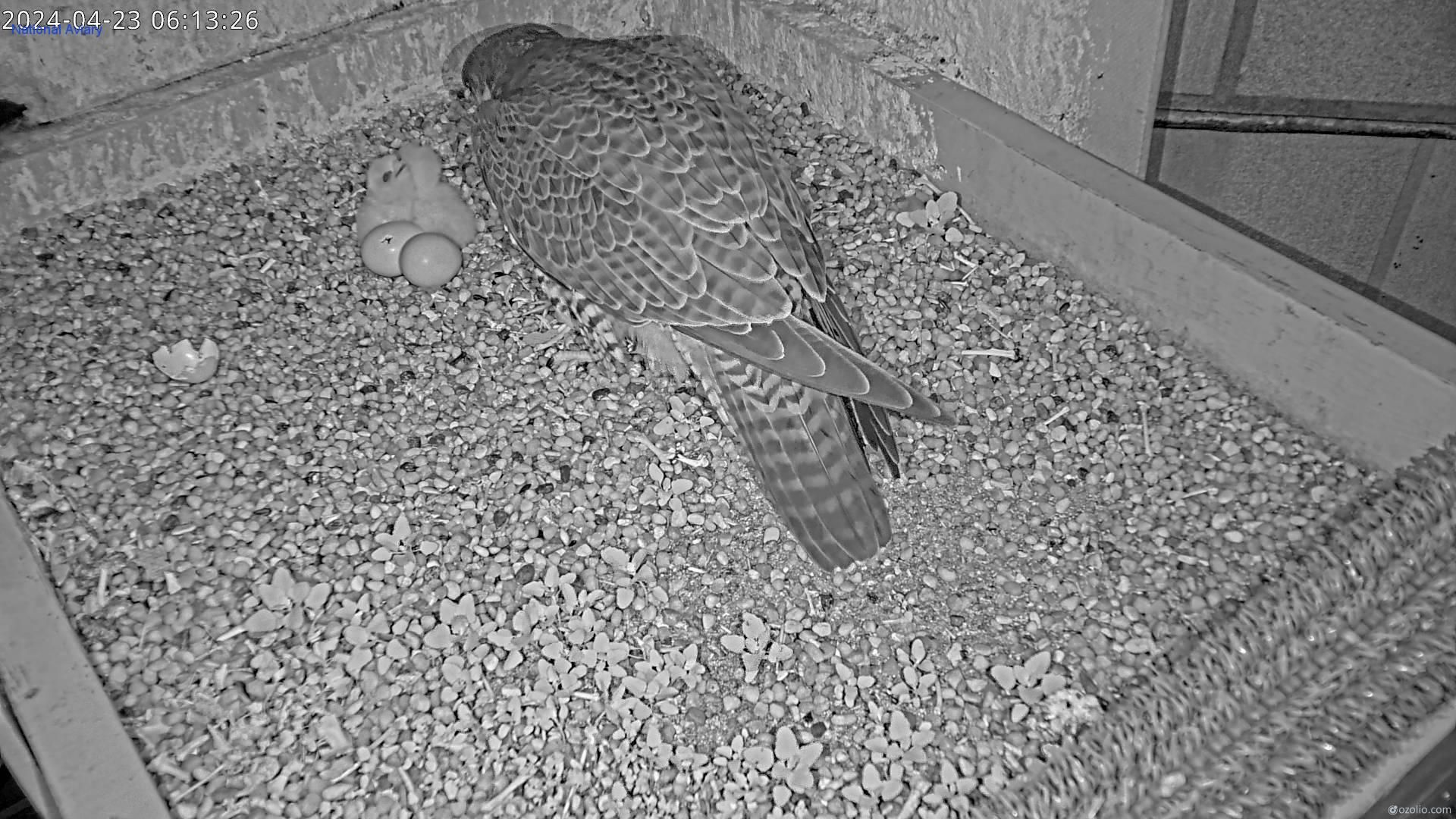
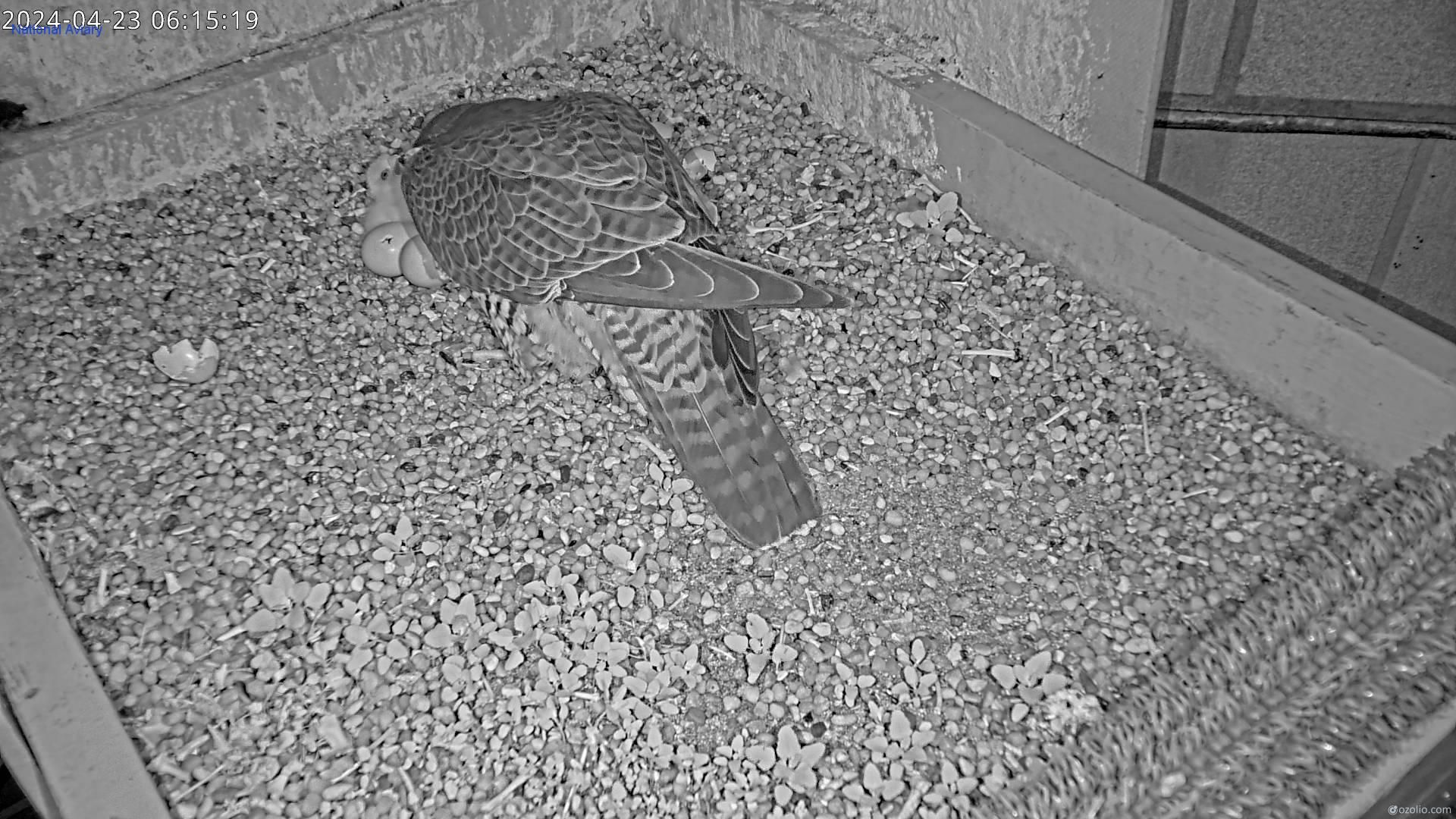
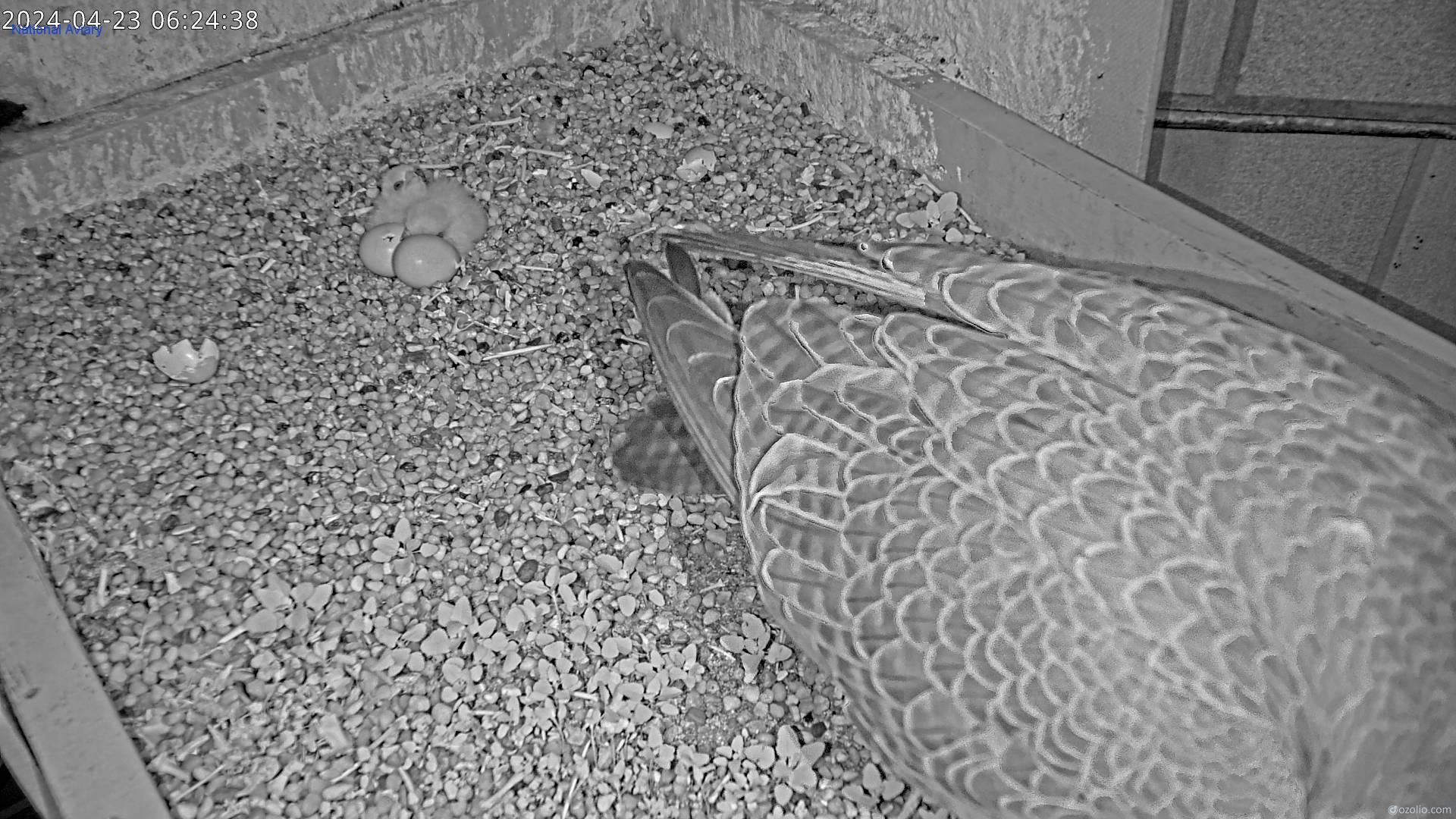
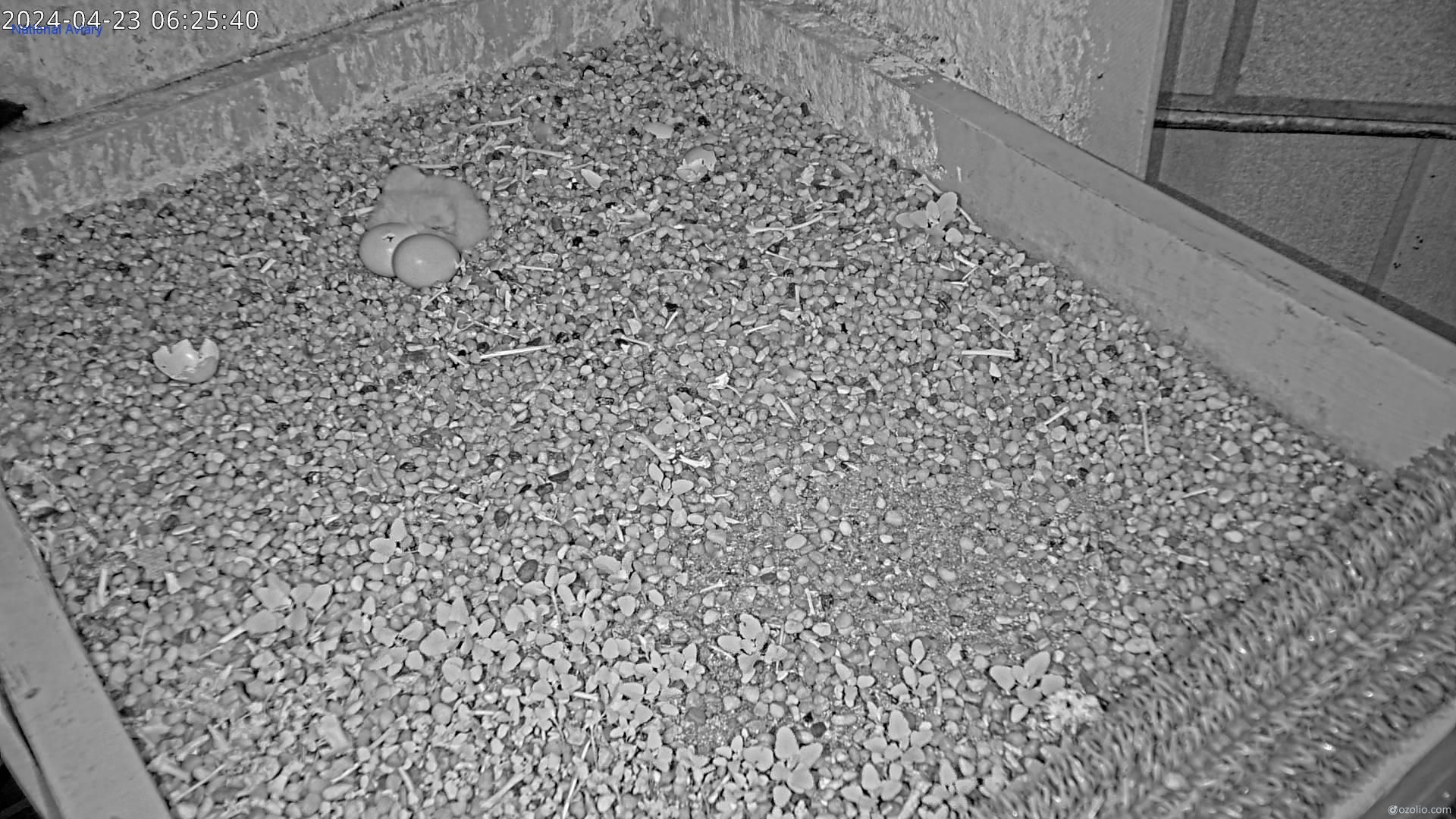
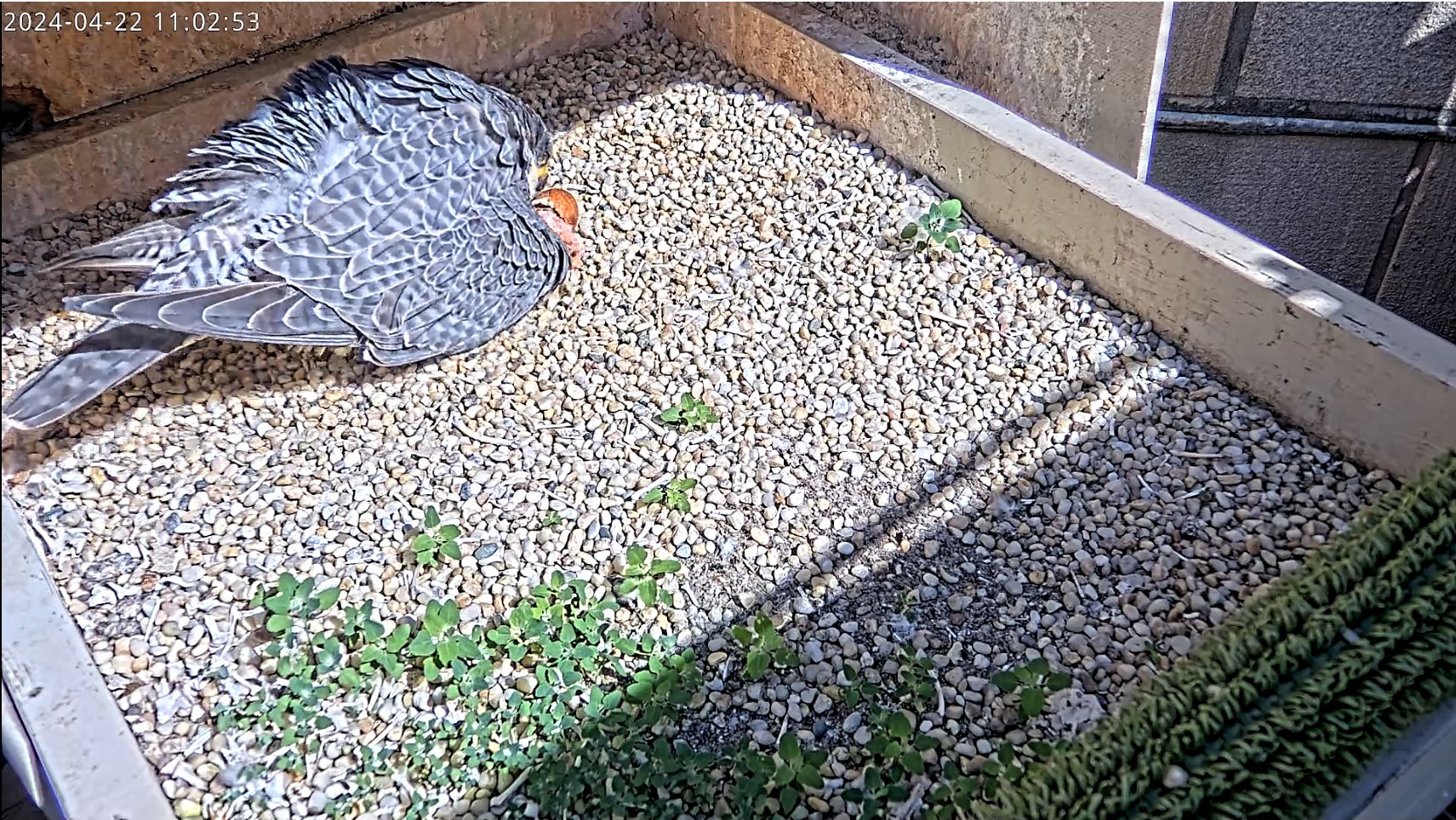
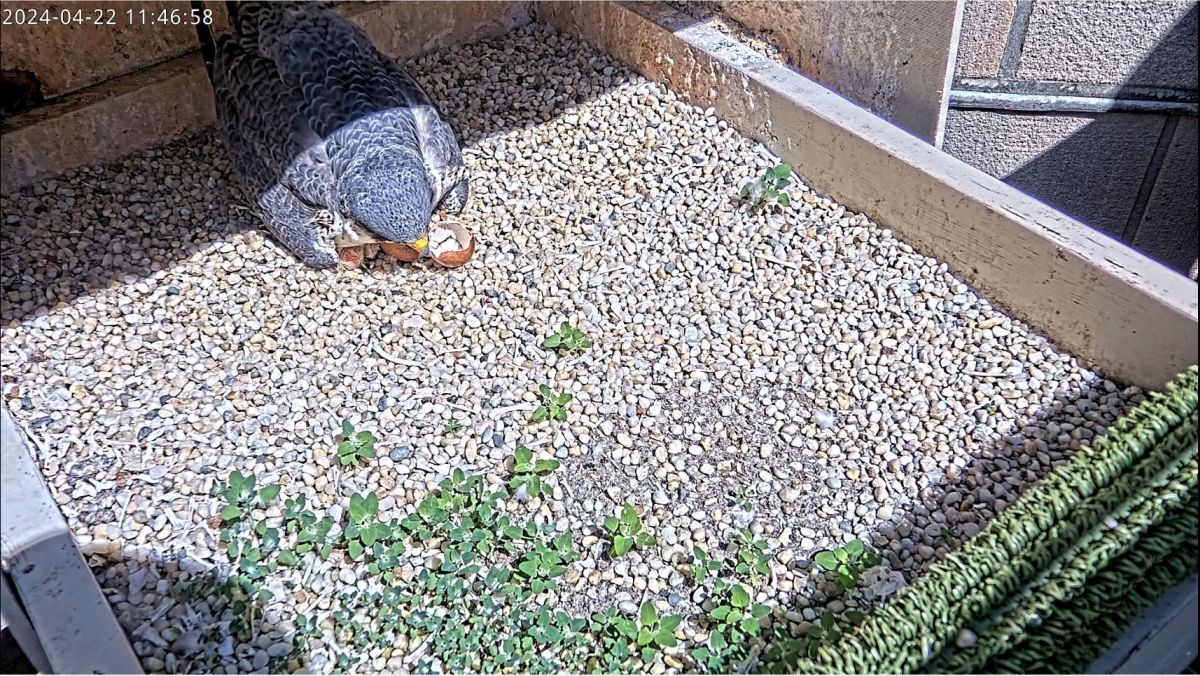
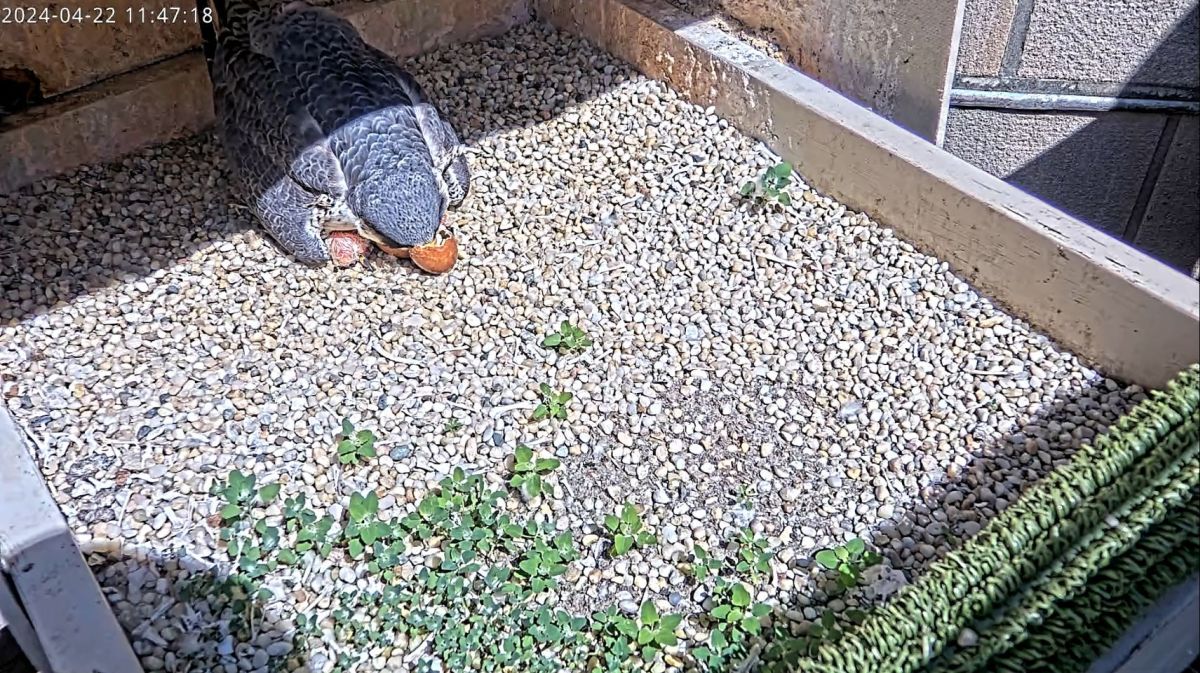
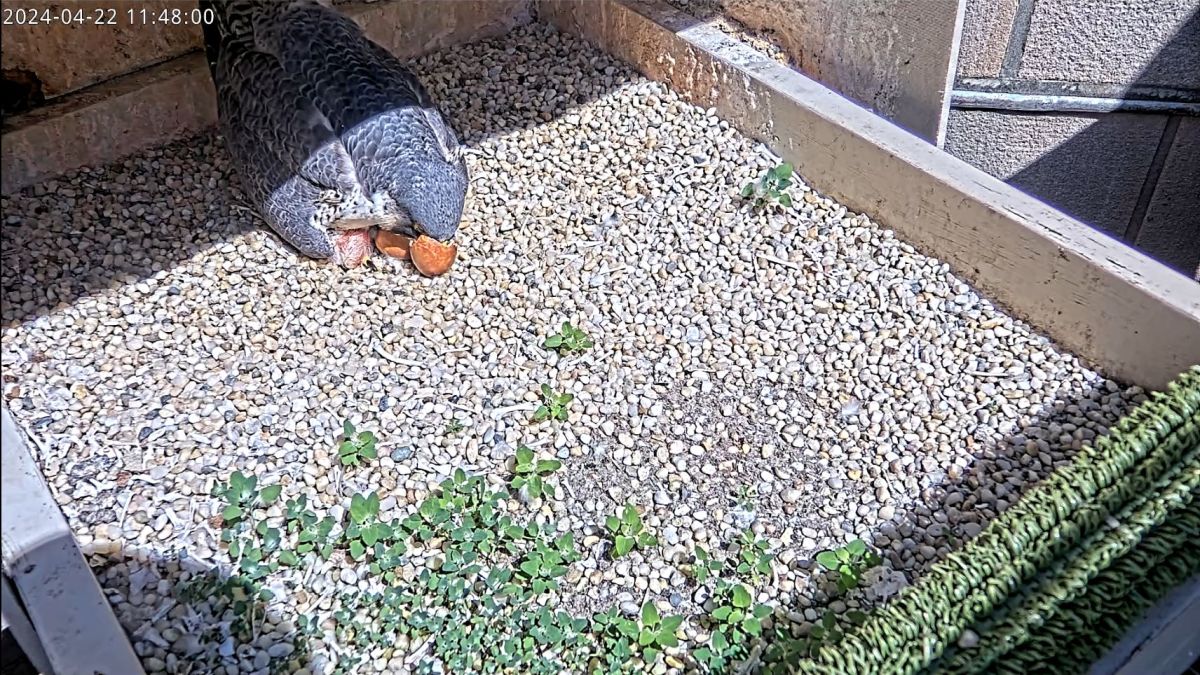
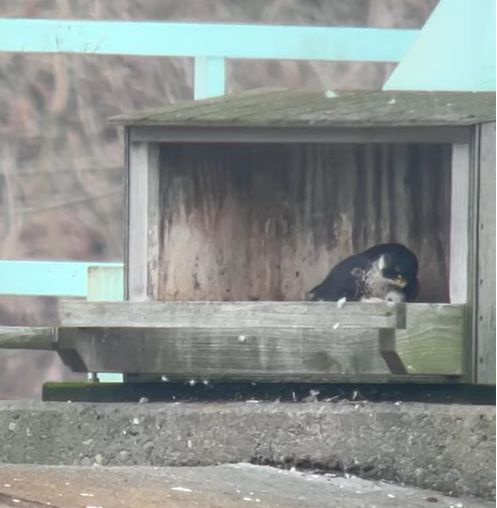
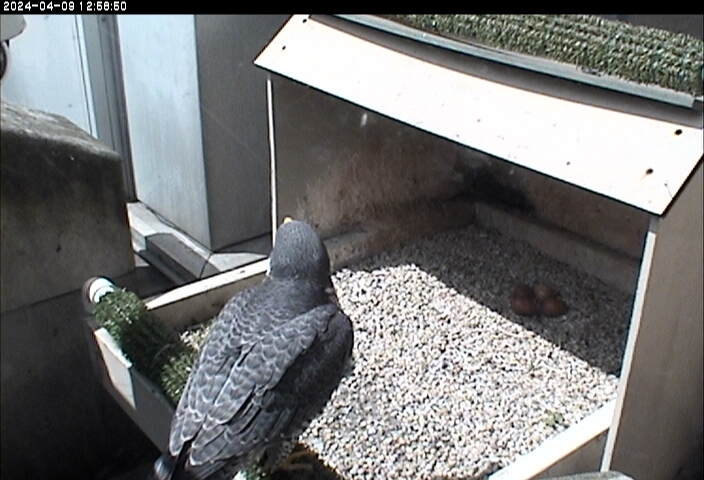
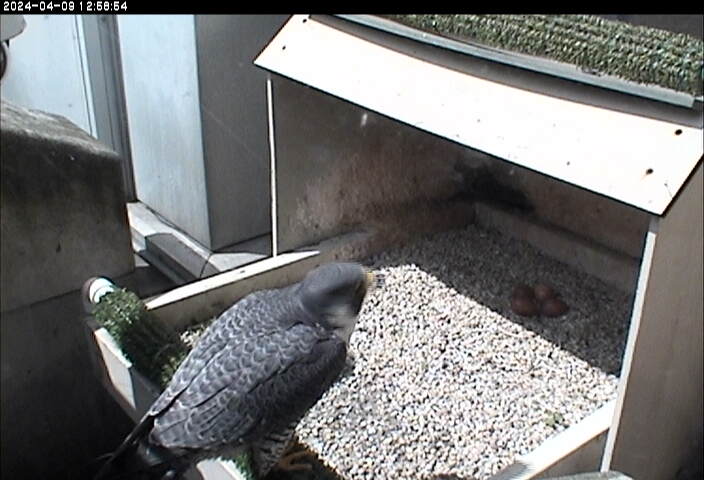
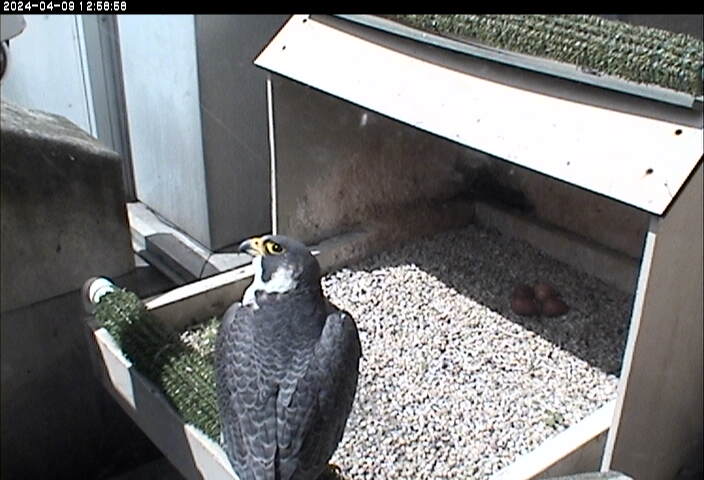
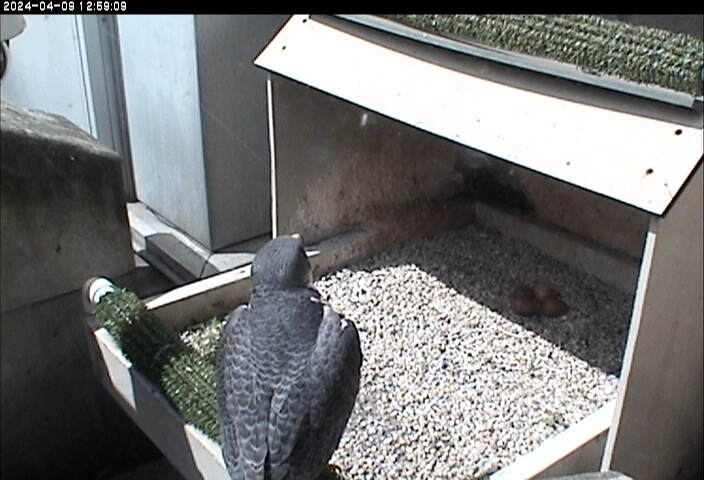
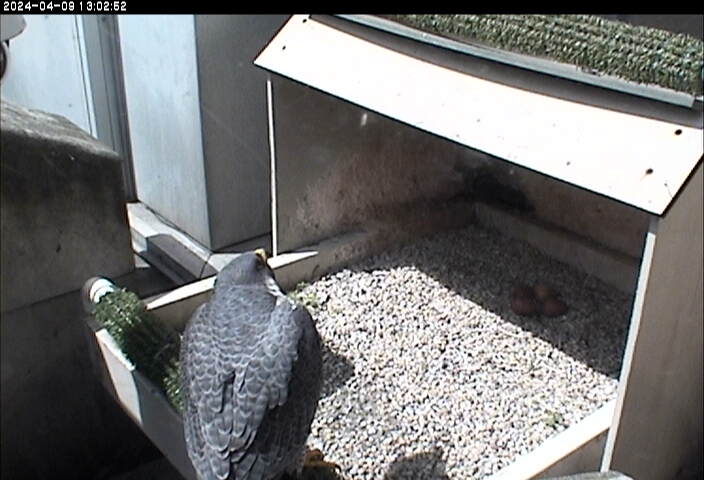
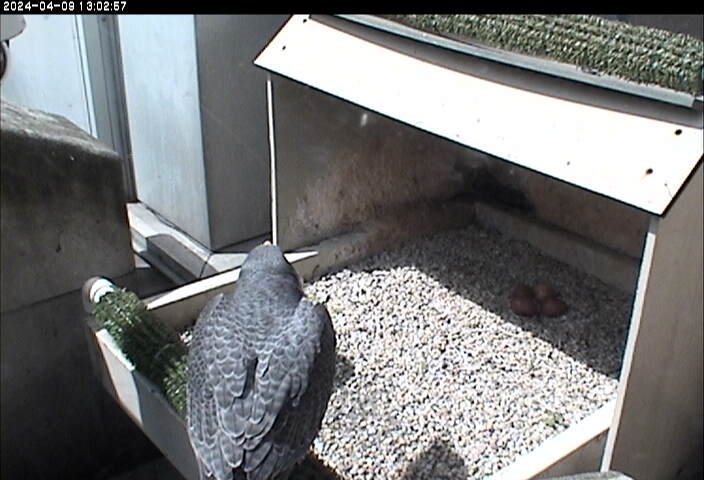
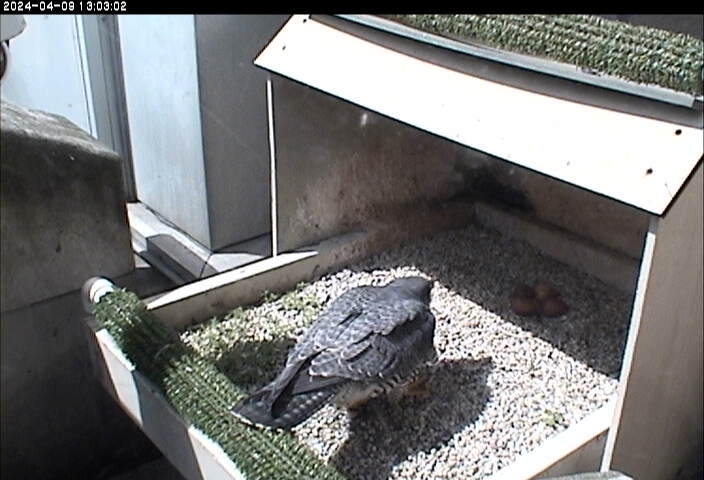
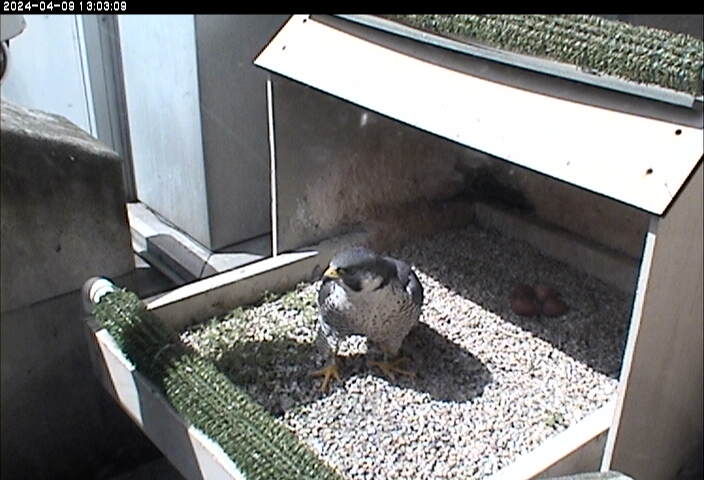
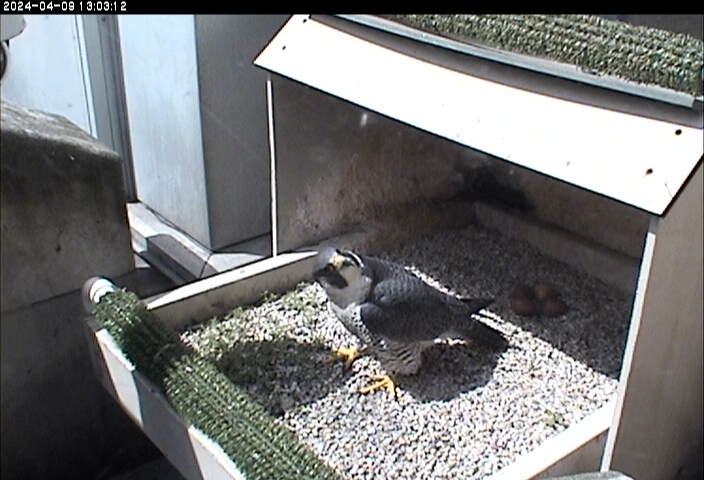
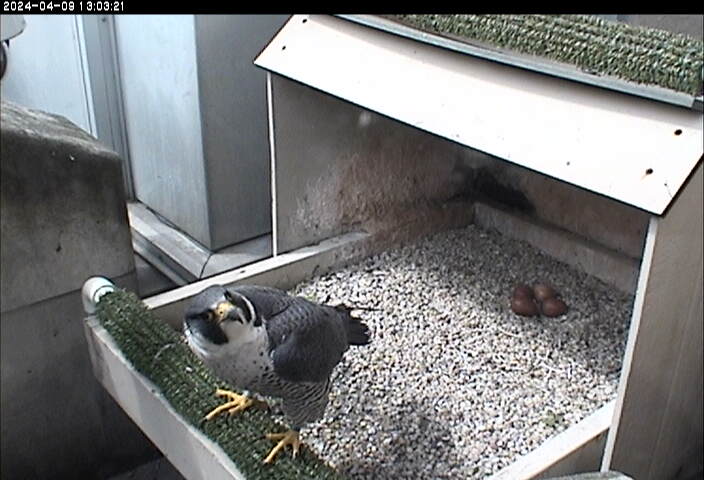
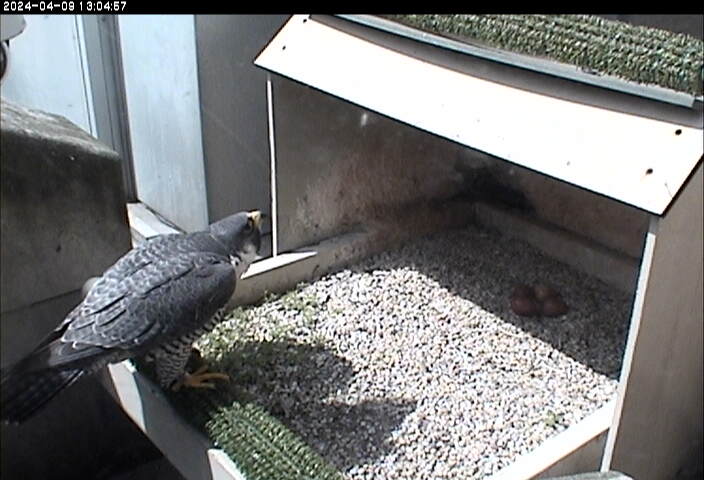
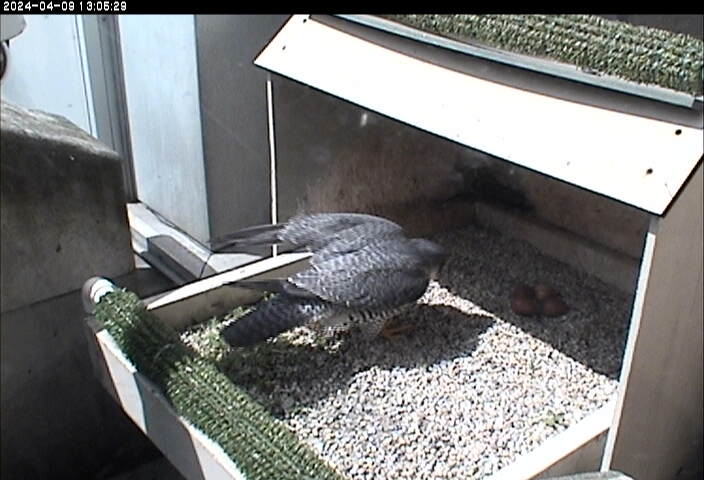
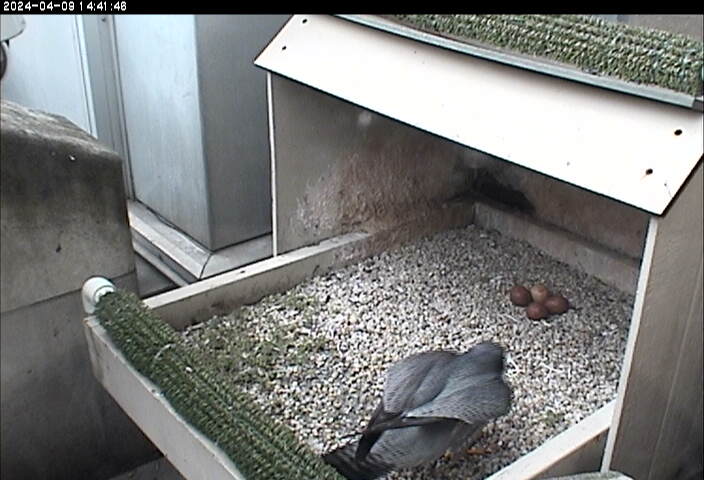
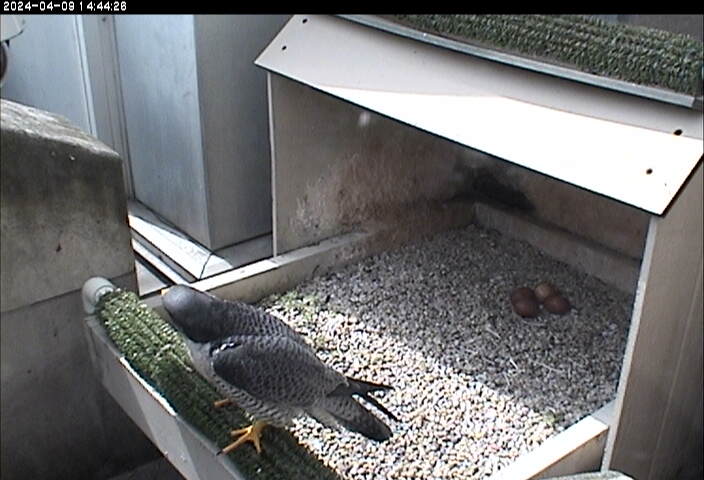
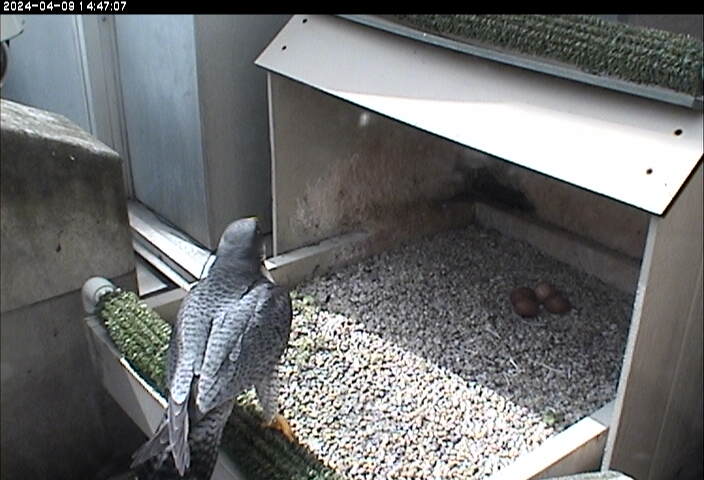
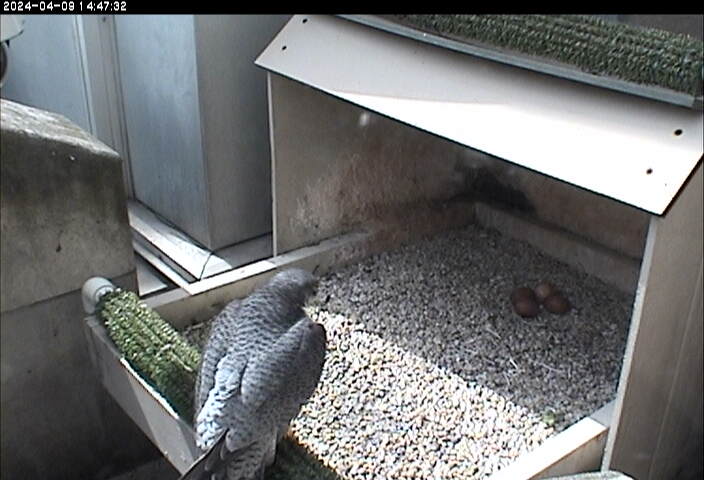
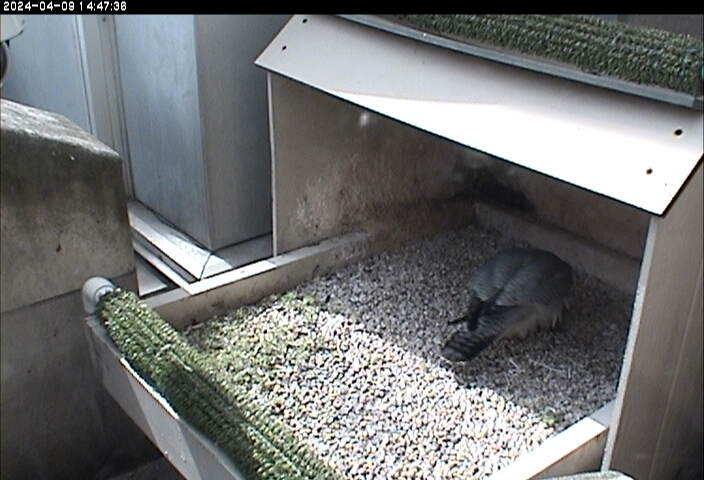
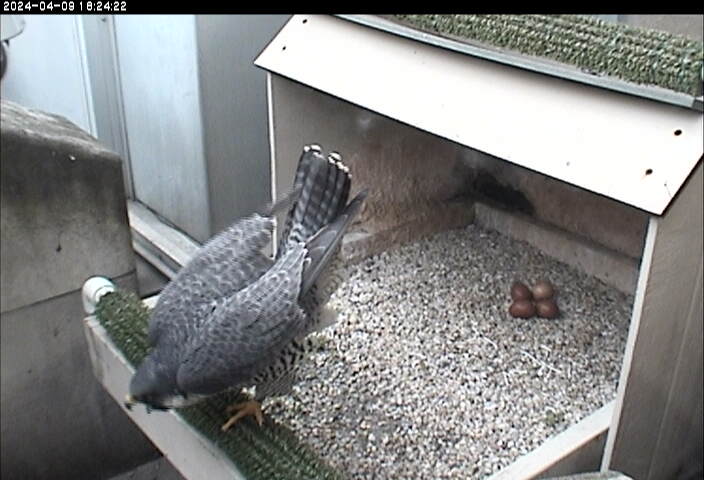
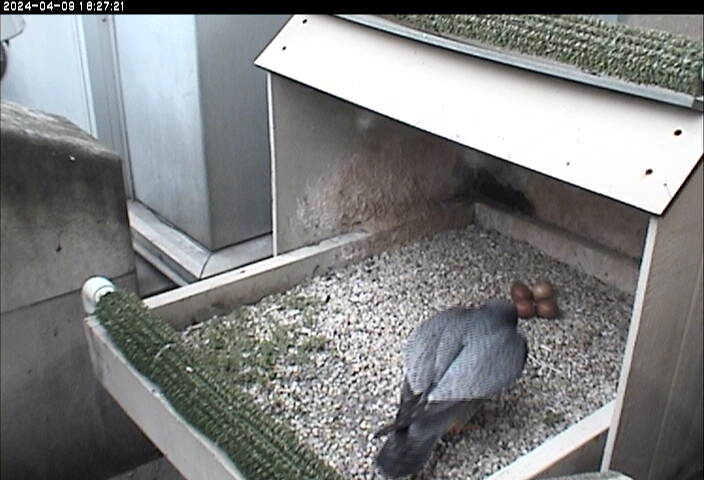
Two thriving chicks, 3rd chick inert, 28 April 2024, 12:26pm
29 April 2024
When Carla and Ecco’s third egg hatched on 24 April we expected that all three chicks would thrive but our expectations had to change as we watched the third chick in its first days of life. By yesterday afternoon it was apparent that the third chick had died. He had trouble feeding and never grew. Unfortunately he failed to thrive.
This slideshow from the National Aviary snapshot camera shows key moments that indicate he was not in good condition on 26-28 April. For instance:
During feedings the third chick faced away or fell down.
On 26 April he motored far from the group during a feeding.
By dawn on Sunday 28 April his body was flat and unresponsive. He had probably died overnight.
The remaining two chicks are growing rapidly and doing well. They are nearly too large to brood.
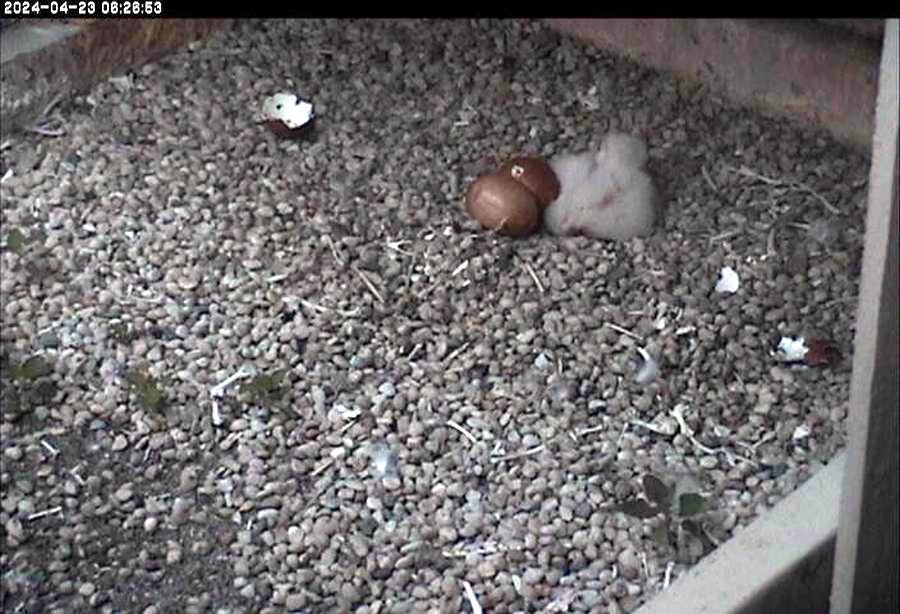
The third chick at the Cathedral of Learning peregrine nest hatched last evening around 7:40pm. All day long he hammered on his shell, expanding the pip to a crack surrounding the egg. Just before nightfall he opened the shell and rested face down. Hatching is exhausting work!
You can see the open eggshell and the wet, pink chick in snapshots above and below.
After the third chick emerged it was time for the last feeding before dark. When Carla left to get the food we could see all three chicks (two white, one pink) as well as the remaining unhatched egg behind the open shell.
UPDATE, 28 April 2024, 3:30pm: Sad to say, the 3rd chick has died. He had trouble feeding and never got any larger. Both are signs of a failure to thrive.
(photos from the National Aviary snapshot camera at Univ of Pittsburgh)
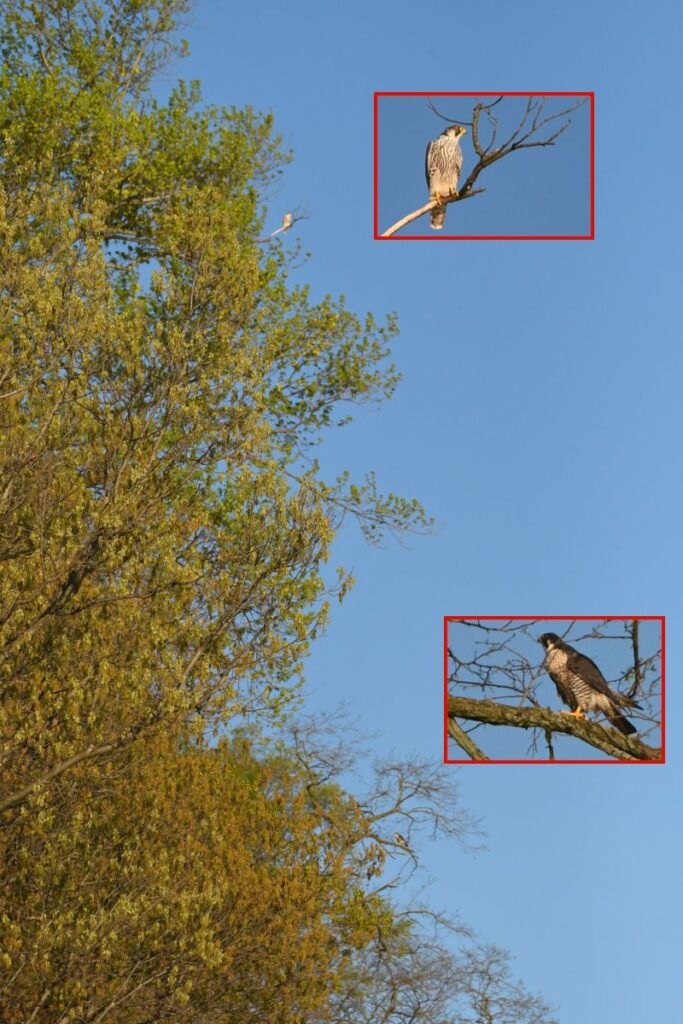
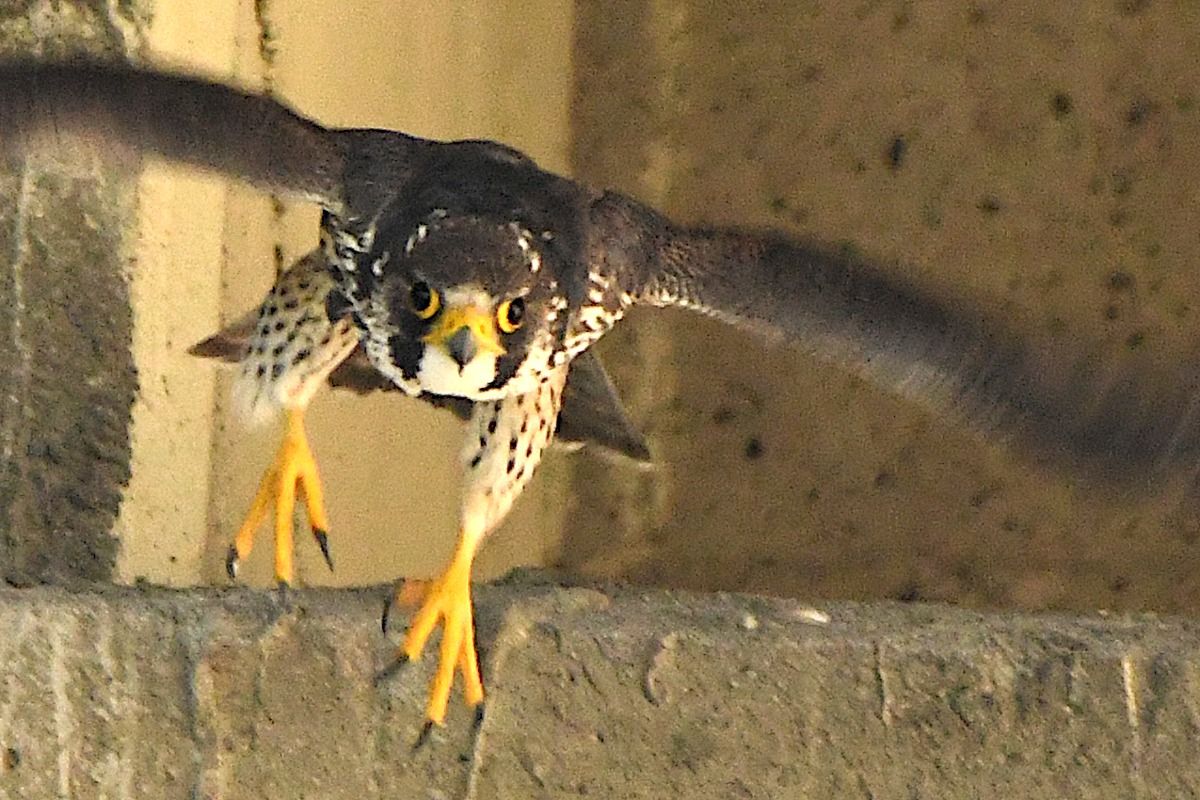
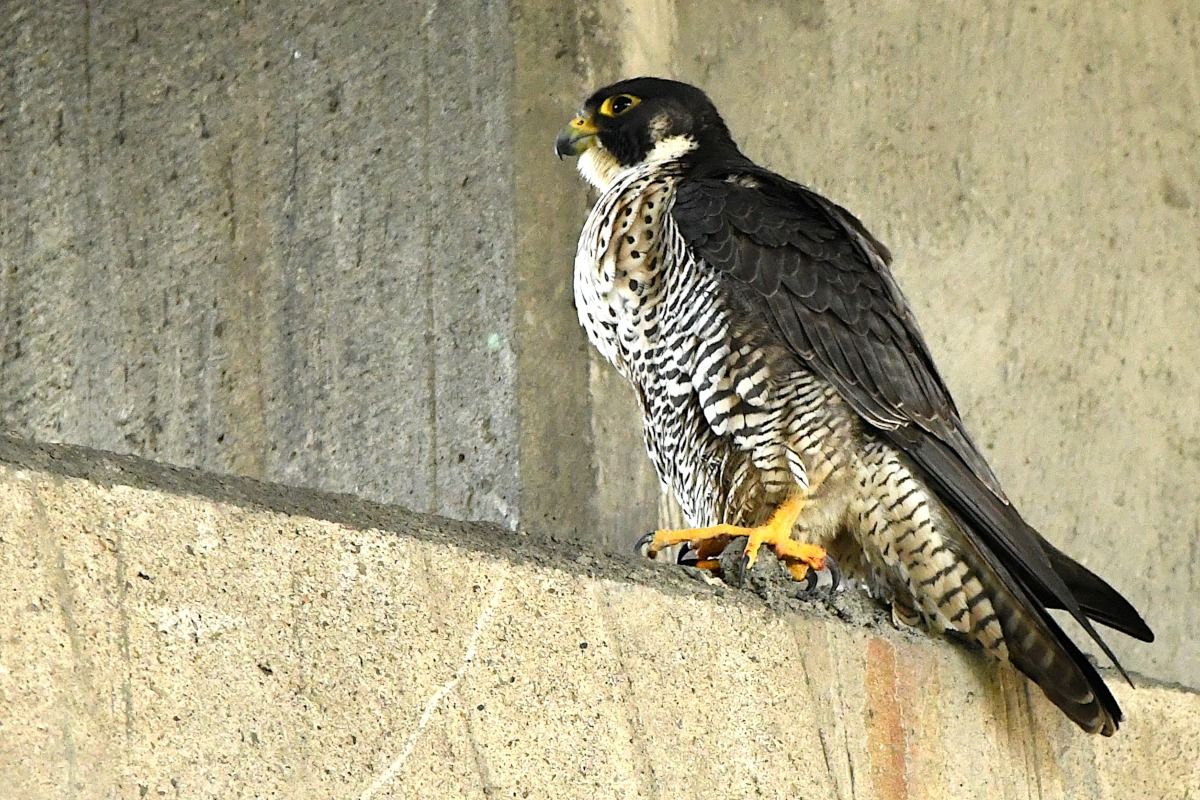
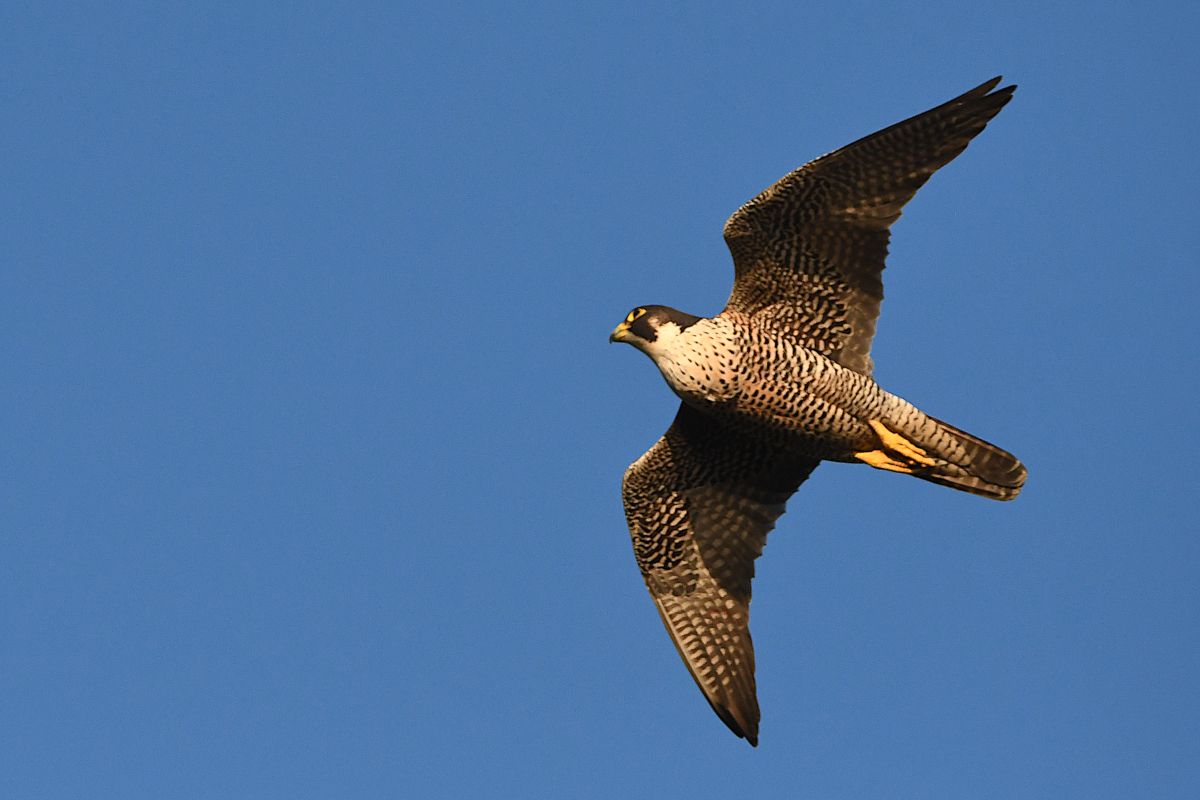
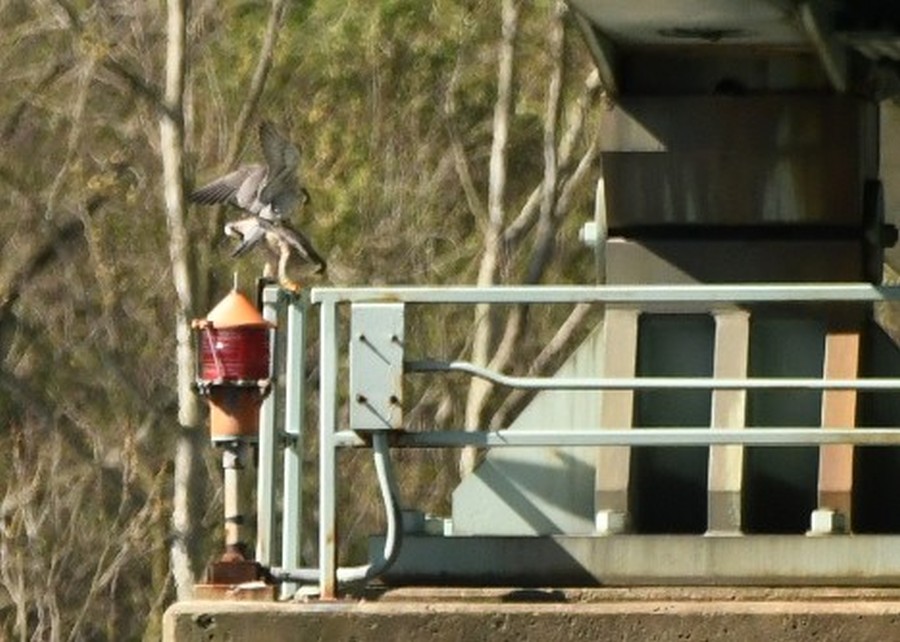
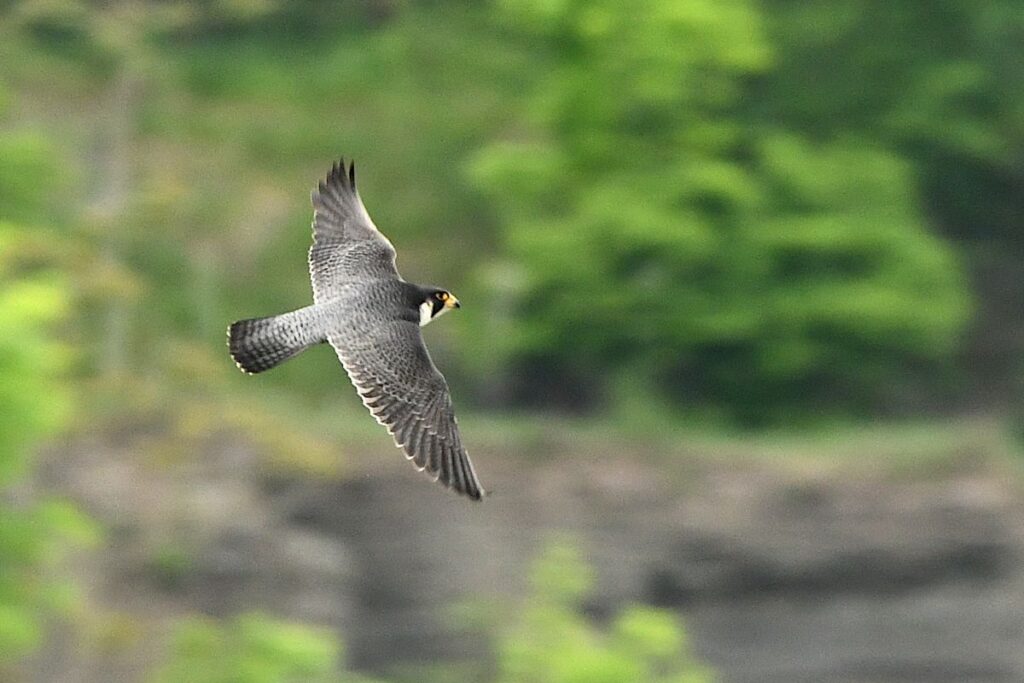
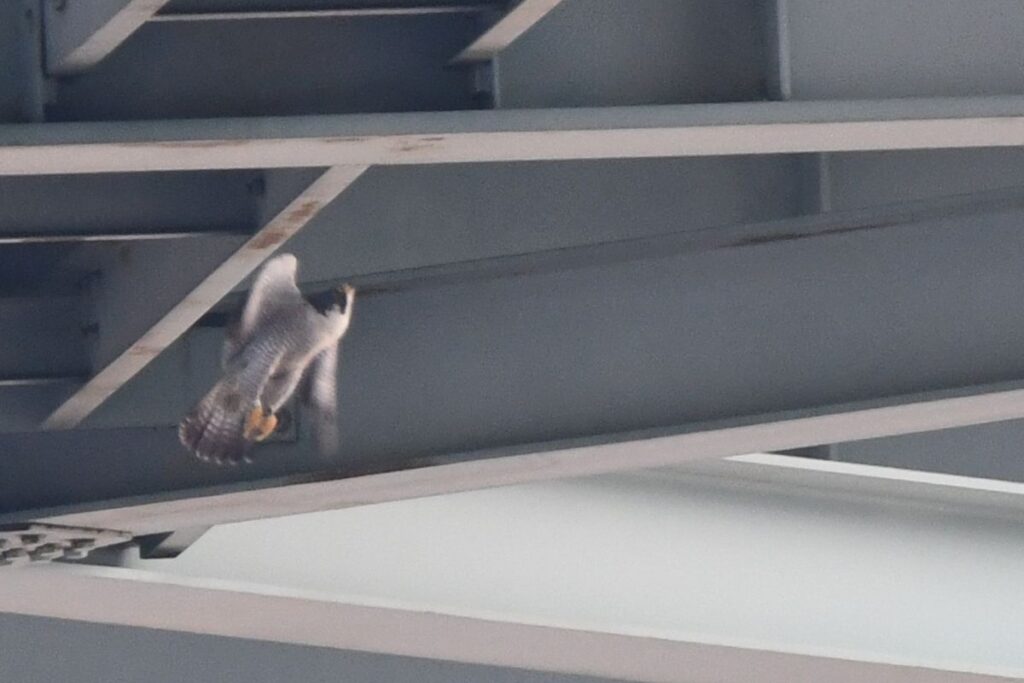
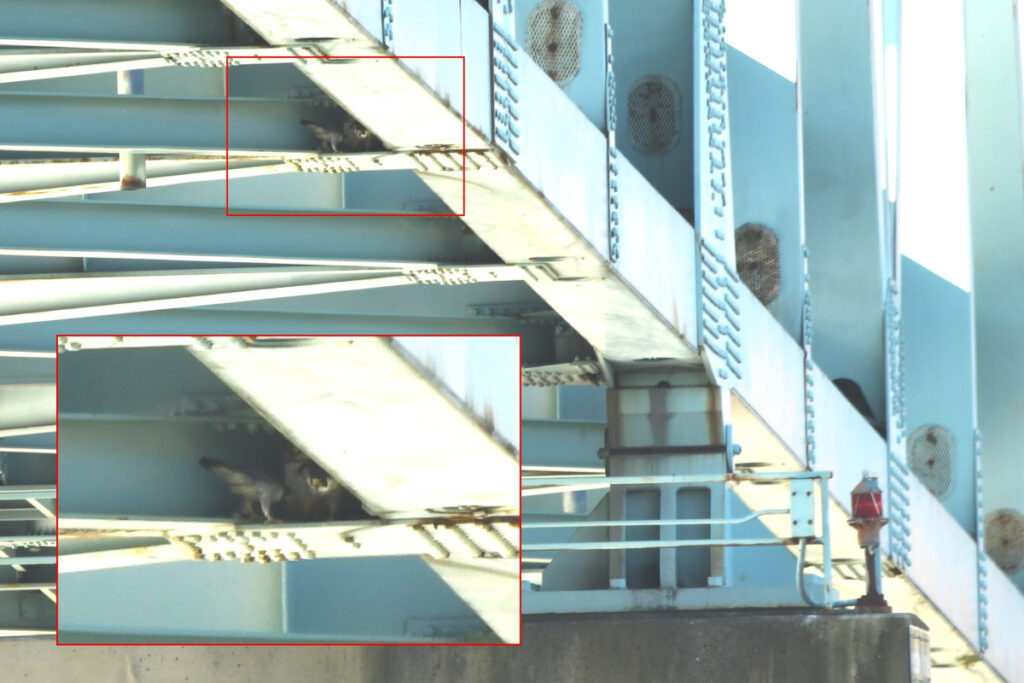
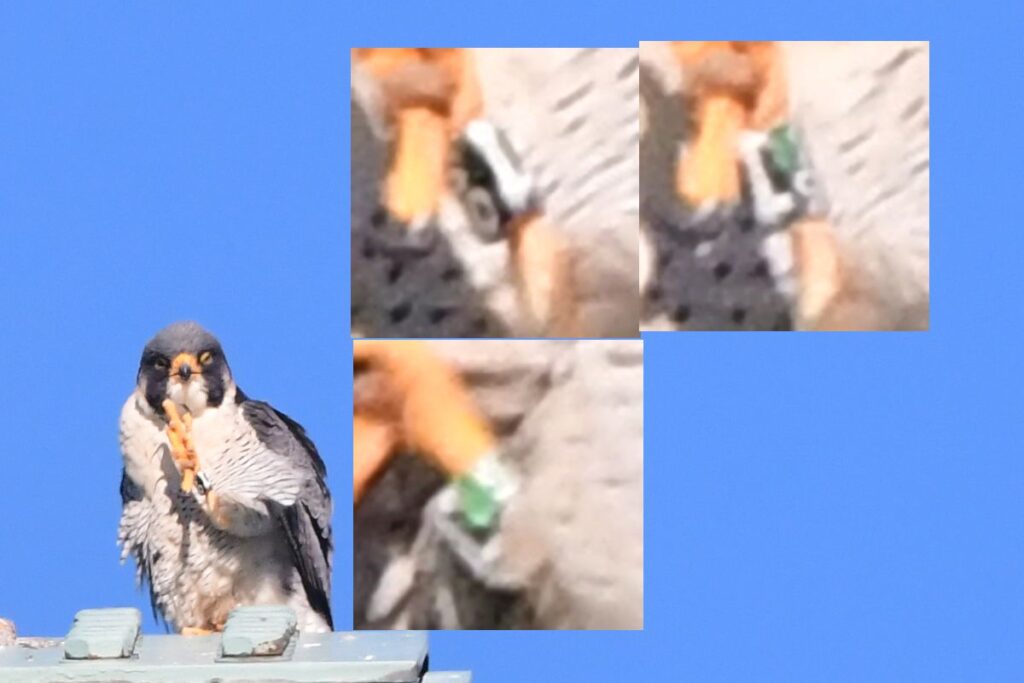
After Jeff Cieslak discovered an immature male peregrine in Ben Avon on 5 April he’s returned often to the Spruce Run Bridge to check on the bird’s status. On 22 April Jeff was surprised to find the male had attracted a mate! The pair courted at the bridge, flew around, and posed in hillside trees (photo at top). Here’s Jeff’s series from Earth Day 2024.
Tarentum Bridge, Allegheny River:
Dave Brooke frequently records the Tarentum Bridge peregrine family. On 19 April he saw four chicks. On 23 April their growing wing and tail feathers were quite evident, though only two stood up enough to be seen. These birds will start ledge walking during the week of 6 May. The first will probably fledge on 11 May.
Peregrines at Tarentum Bridge, 19 April 2024 (video embedded from Dave Brooke on YouTube)
Peregrine chicks at Tarentum Bridge, 22 April 2024 (video embedded from Dave Brooke on YouTube)
Westinghouse Bridge, Turtle Creek:
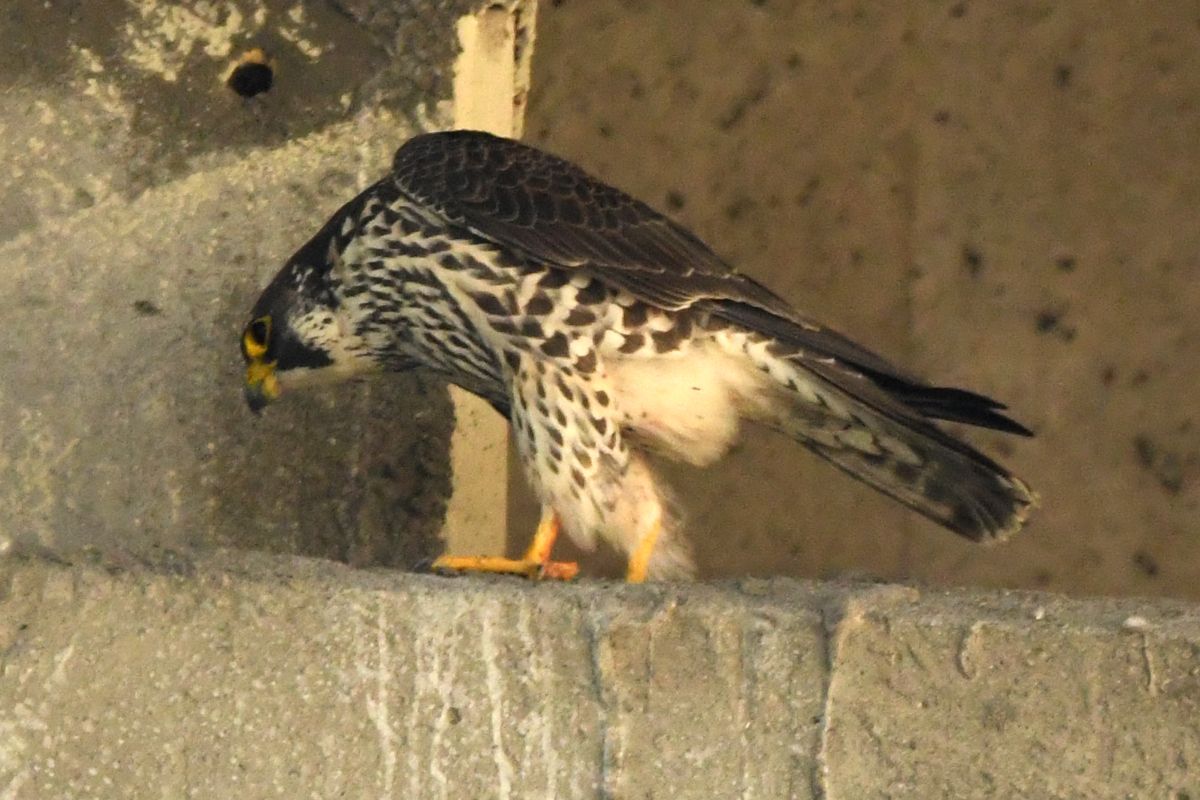
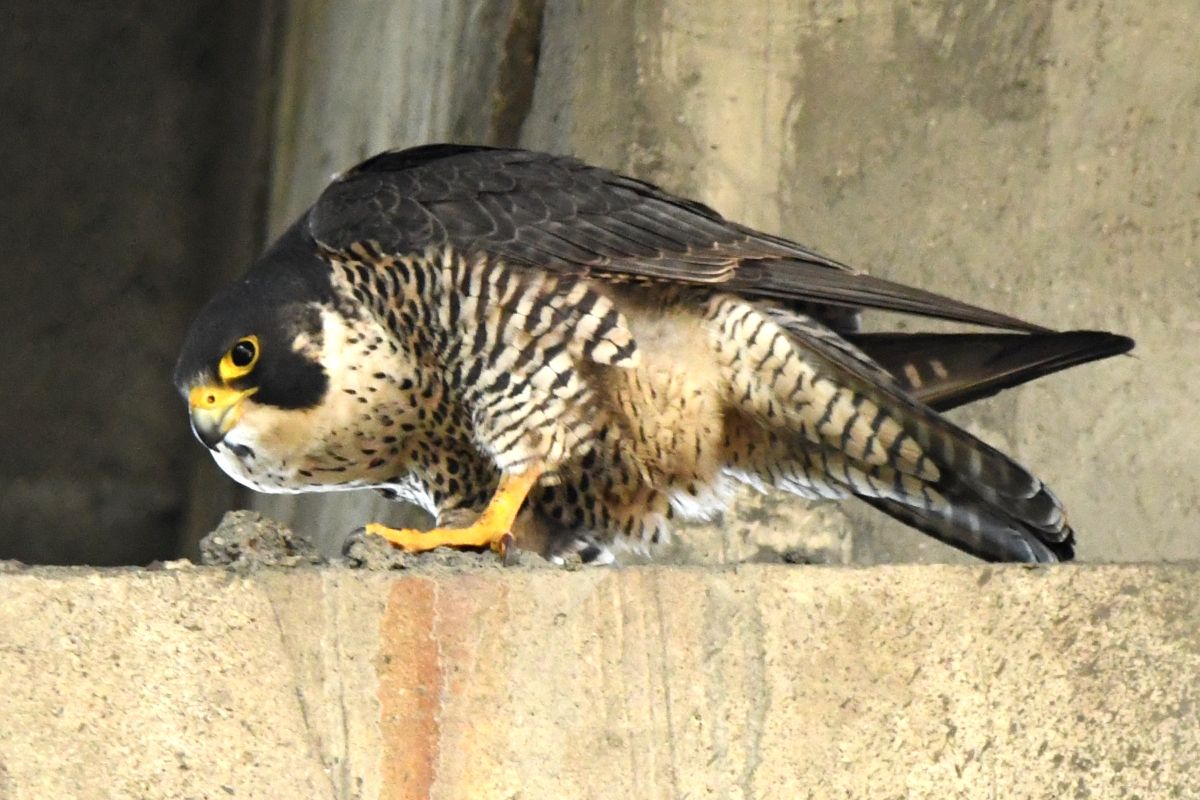
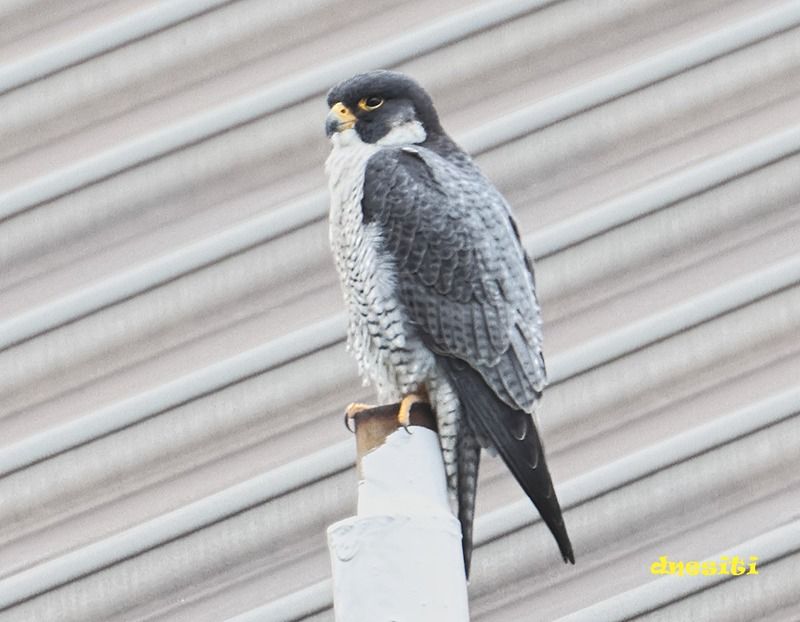
Peregrines have nested at the Westinghouse Bridge since at least 2010. Last Sunday, 21 April, Dana Nesiti found the male perched near the bridge. The female was probably busy incubating at the time.
Peregrine at Westinghouse Bridge, 21 April 2024 (photo by Dana Nesiti)
Sewickley Bridge, Ohio River
Jeff Cieslak was disappointed to see the pair at the Sewickley Bridge mating again on 22 April. If their nest had been a success they would still be incubating, not mating. Jeff says this activity follows the typical pattern at Sewickley of repeated nest attempts but no young each year.
Peregrine pair mating at the Sewickley Bridge, 22 April 2024 (photo by Jeff Cieslak)
This list is not fully updated but will help you decide where to look for peregrines.
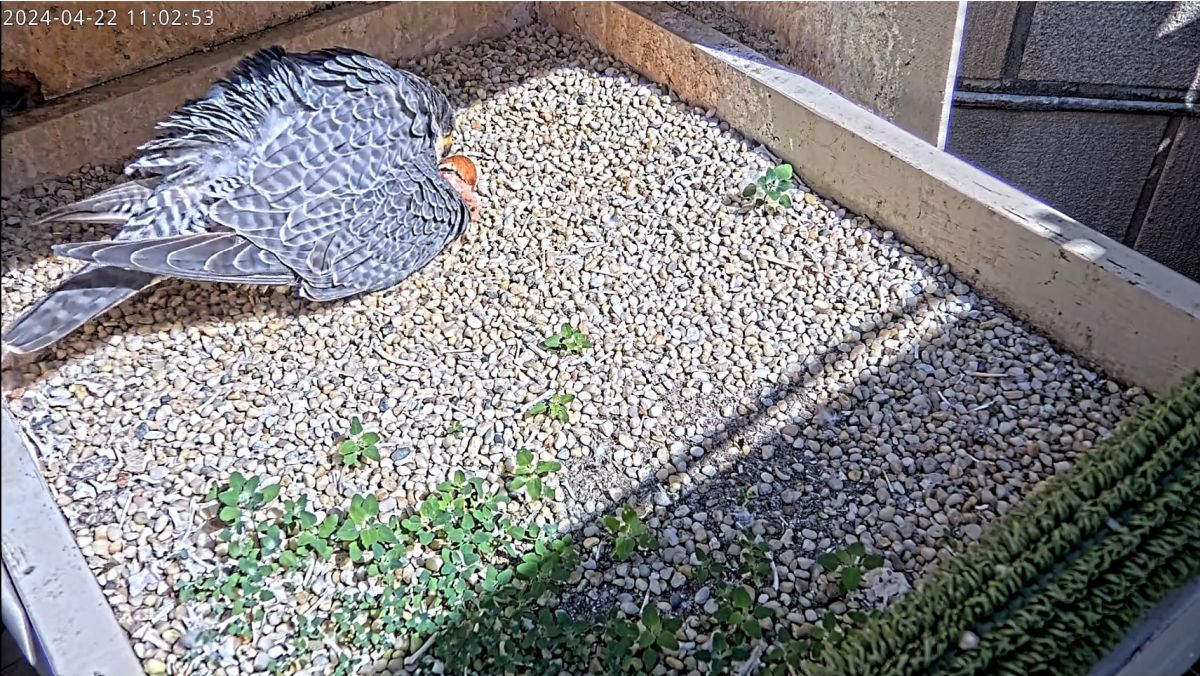
Yesterday two of Carla and Ecco’s four eggs hatched: one at 11:02am, the second at 15:28 (3:38pm). The evidence each time was the half eggshell that Carla pulled out from under her. She ate most of the shells immediately.
This morning the chicks ate just before sunrise, then slept in a heap (at top) while Carla took out the garbage. This slideshow highlights their first day of life including this morning’s feeding.
Today will be a big day for Chick#3 whose egg has a large pip. He will probably hatch today.
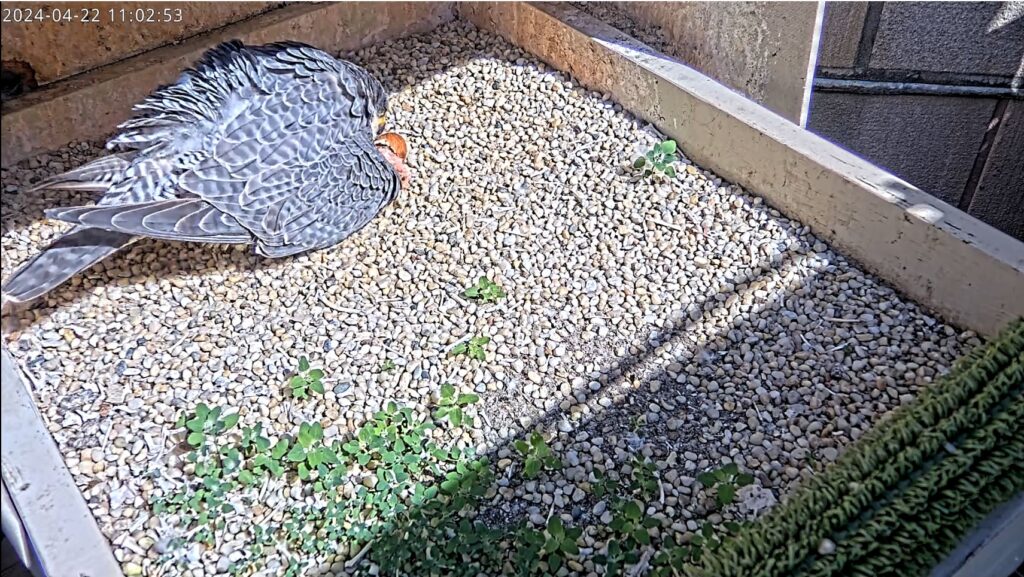
First sight of the hatched peregrine chick and half eggshell, 22 Apr 2024, 11:02am (snapshot from the National Aviary falconcam at Univ of Pittsburgh)
22 April 2024
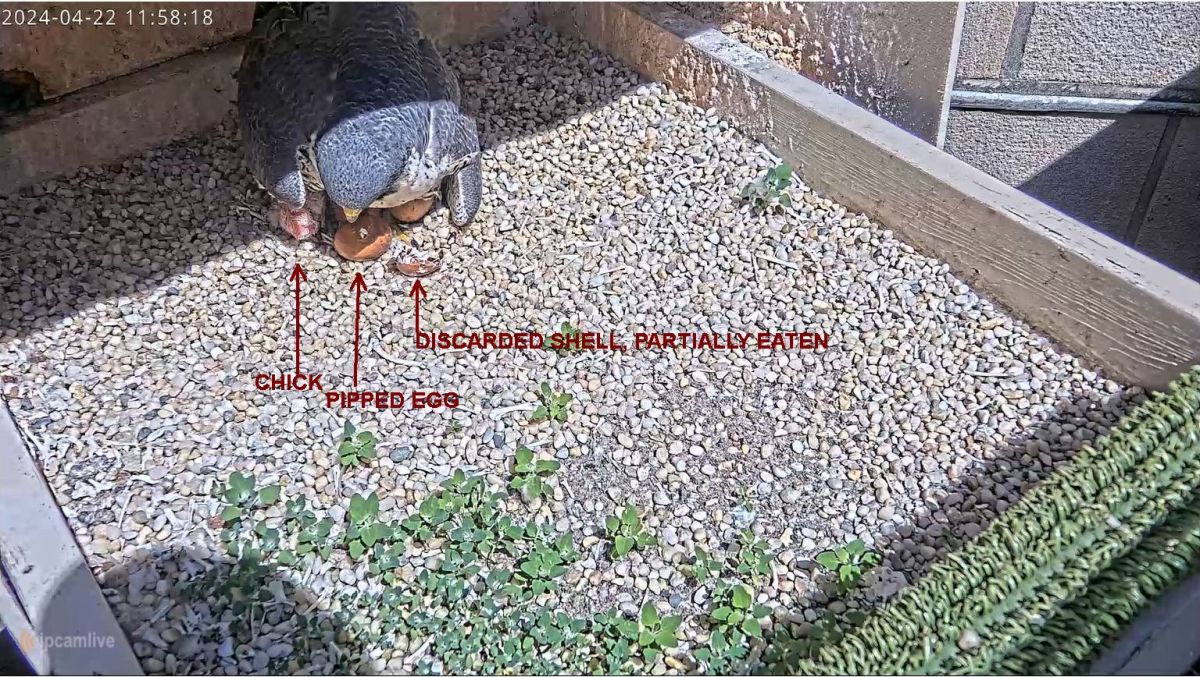
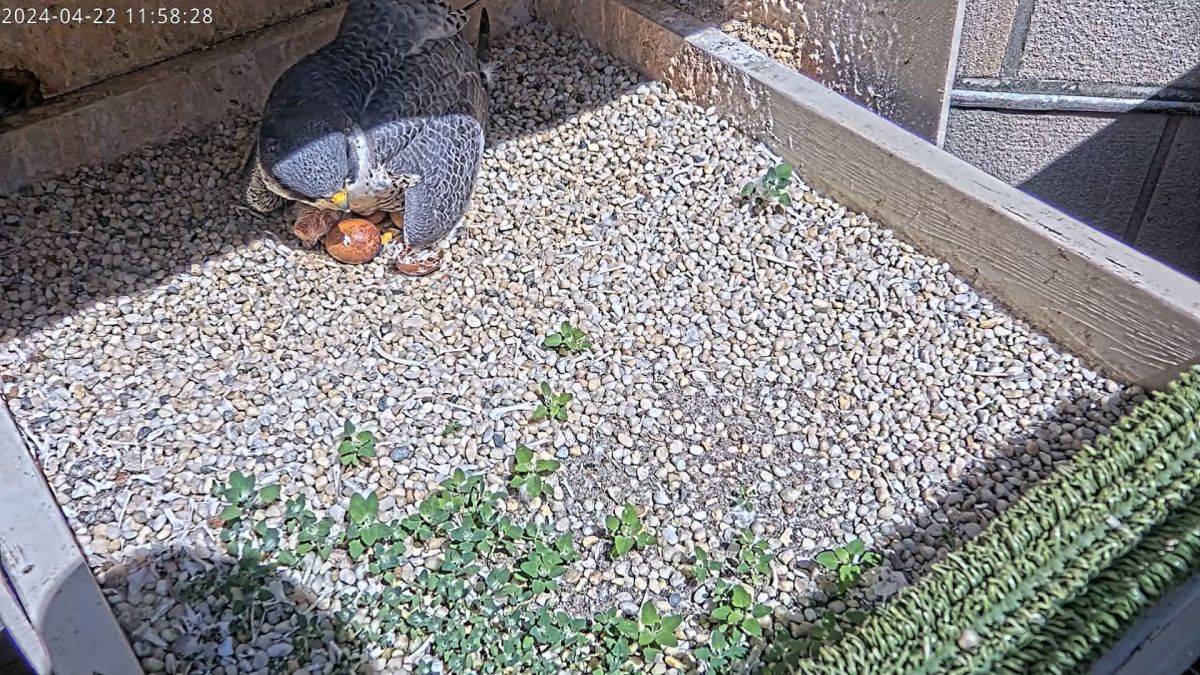
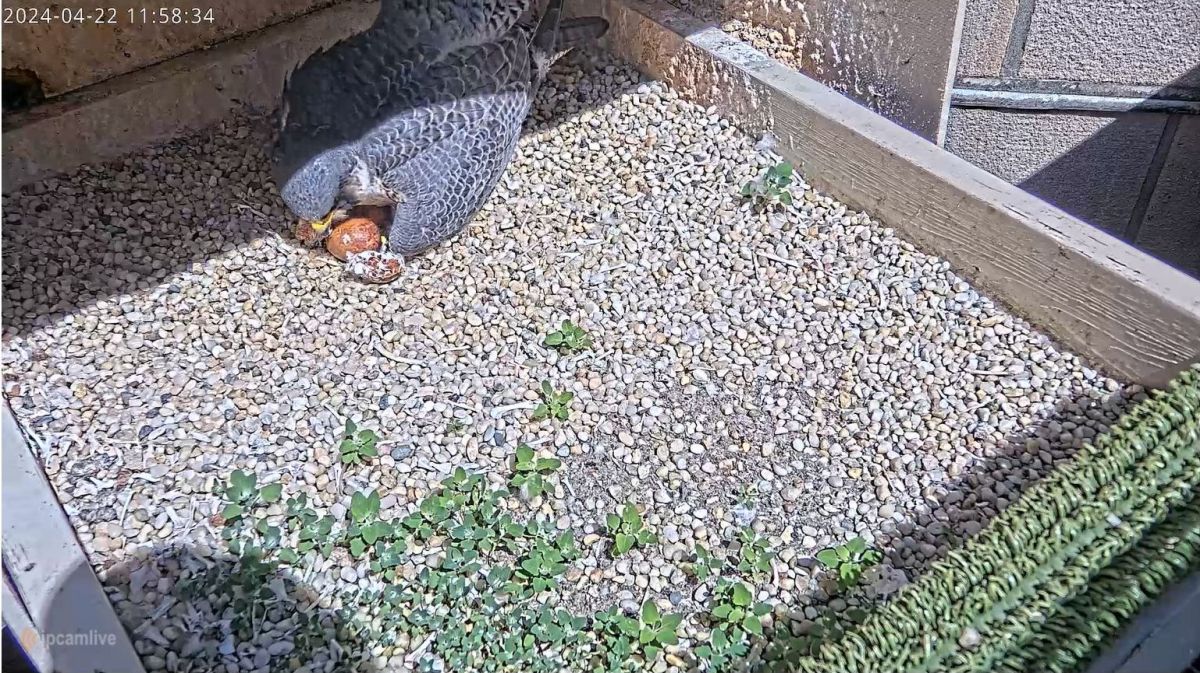
This morning at 11:02am the first of Carla and Ecco’s four eggs hatched at the Cathedral of Learning peregrine nest. Our glimpse was fleeting because Carla kept her back to the camera (above). Later in the hour she turned and we got a better view.
This slideshow from the streaming falconcam contains the best snapshots from the 11:00am hour with one chick, one pipped egg, and an empty eggshell. Carla ate the eggshell to regain the calcium she lost in laying the egg. The shell was nearly gone by noon.
You can see Ecco’s very brief visit at 11:42am in these video highlights.
He made another appearance in the 1:00 o’clock hour but I missed it.
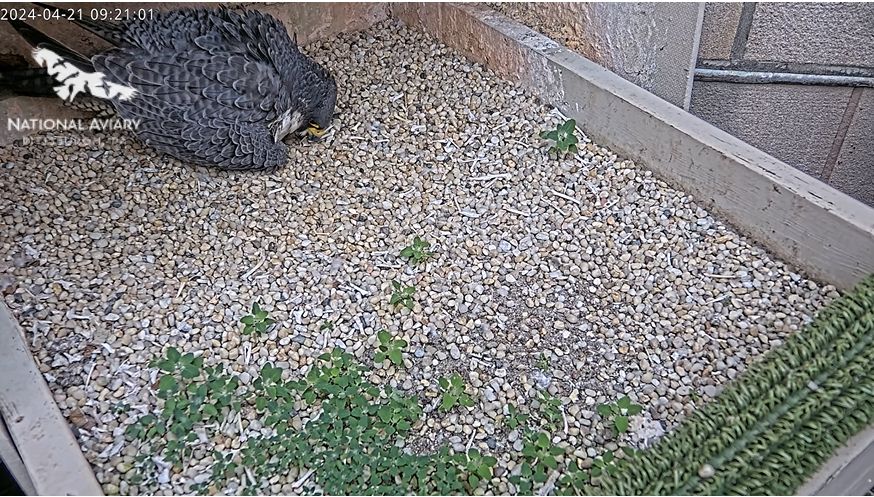
Carla hunches over the eggs and seems to speak to them, 21 April 2024, 9:21am ()
21 April 2024
This morning Carla periodically hunched over the eggs, rocked her body and appeared to vocalize to the eggs. This is typical mother peregrine behavior when she hears a chick hammering on its shell.
While hatching is underway the parent birds can hear the chick peeping inside the egg and can hear it the hammering on the shell. Hatching itself takes many hours but the first step we’ll see is a pip, an air hole that the chick punches to begin the process. Richmond Falconcam FAQ explains how long it takes for the tiny bird to hatch:
Hatching is an energetically demanding process. The young chick uses its egg tooth, a small knob on top of its bill, to hammer a pip (hole) in the egg. It periodically works to break the egg around the pip area, but rests much of the time. The entire process from initial pip to hatch can take up to 72 hours. All the eggs in a Peregrine Falcon clutch generally hatch “synchronously” (within 24–48 hours for a clutch of 4).
Peregrine at Sewickley Bridge, 16 May 2023 (photo by Jeff Cieslak)
14 April 2024
The Sewickley Bridge has hosted single peregrines since 2017 but a pair was not regular there until early 2021. At some point observers noticed that one of the pair is banded but who could read the bands?
Banded male peregrine at Sewickley Bridge, 6 June 2023 (photo by Jeff Cieslak)
And where was this pair nesting on the bridge?
This spring Jeff Cieslak answered both questions. He photographed a nest exchange in which the male took over incubation and the female left the nest.
Peregrine nest exchange at Sewickley Bridge, 25 March 2024 (photo by Jeff Cieslak)
And he got a photo of the male’s bands.
[The male] was on the near tower so I only had to walk half-way across the bridge (so the sun was behind me). As soon as I stopped, he started to scratch his face, and his bands rotated enough and were focused enough that I think I can read them. They’re upside-down, so it’s “black 0 5 (or 6) over green S (or 5) 6.”
Banded male peregrine at Sewickley Bridge (Black/green, 05/S) on 4 Feb 2024 (photo by Jeff Cieslak)
The bands are Black/Green 05/S and he used to nest at the Neville Island I-79 Bridge (a.k.a. the Glenwood Bridge) until it was boarded up for construction in 2020 for more than three years. At Neville Island I-79 he was nicknamed Beau by site monitor Anne Marie Bosnyak.
Beau didn’t move far to find a new nest site and he didn’t move far from his birthplace. He hatched at the Cathedral of Learning in 2010 to parents Dorothy and E2. I know for sure that he is 05/S because his brother 06/S, nicknamed Green Boy, died in the Webster Hall chimney in June 2010.
Beau is now 14 yrs old but he has longevity in his genes. His mother Dorothy lived to be 16 and his grandad Louie from Downtown lived to be 17 and bred successfully at 3rd Ave in his 17th year. (Beau’s father, E2, was hit by a car in 2016 so we’ll never know how long he would have naturally lived.)
Read about the first time we identified Beau, Black/Green 05/S, in this vintage article.
Tarentum Bridge peregrines have two chicks, 11 April 2024 (photo by Dave Brooke)
13 April 2024
On Thursday 11 April, before torrential rain and flash floods hit the Pittsburgh area, Dave Brooke went down to Tarentum to see the peregrine family at the Tarentum Bridge. His video shows the mother peregrine sheltering two chicks.
Not only are the chicks sitting up with their eyes open but their faces are distinct. My guess, based on the clues in Peregrine Chicks Week-to-Week Development, is that these chicks hatched around April 2.
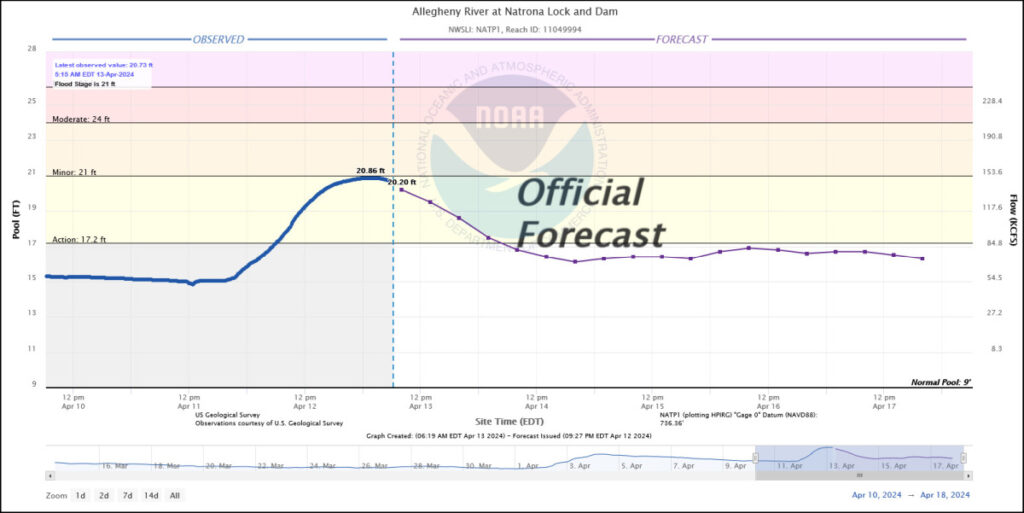
This weekend would be a good time to see the chicks but keep in mind the Allegheny River is in flood because of Thursday’s record-setting rainfall. Here’s the flood stage upstream this morning at Natrona Lock and Dam.
Peregrine news is quiet in early April while all the nests are incubating … or are they? I just did the math and Tarentum Bridge is going to hatch on or before today (see end of article). Here’s the news.
Cathedral of Learning, Univ of Pittsburgh: Yesterday I just happened to be on the roof deck of my apartment building at 6:24pm when I saw a peregrine burst off the Cathedral of Learning and head east over Fifth Avenue using territorial flappy flight. I could hear it kakking while a second peregrine was in the sky over South Craig Street circling up and up and up. The “flappy” peregrine circled up too and dove on the intruder, driving it to the east.
Yesterday’s motion detection photos indicate that the “flappy” peregrine was Carla. Both peregrines were watchful all day, then suddenly at 6:24pm Carla got mad and left the nest quickly, shouting to Ecco to take over incubation. I was very lucky to see the encounter in the air.
p.s. The falconcam is just fine but Ozolio’s stream is funky. You’ll sometimes see an old still shot, then spinning, then another still shot, then eventually the actual live stream. The National Aviary is working with Ozolio tech support to fix it.
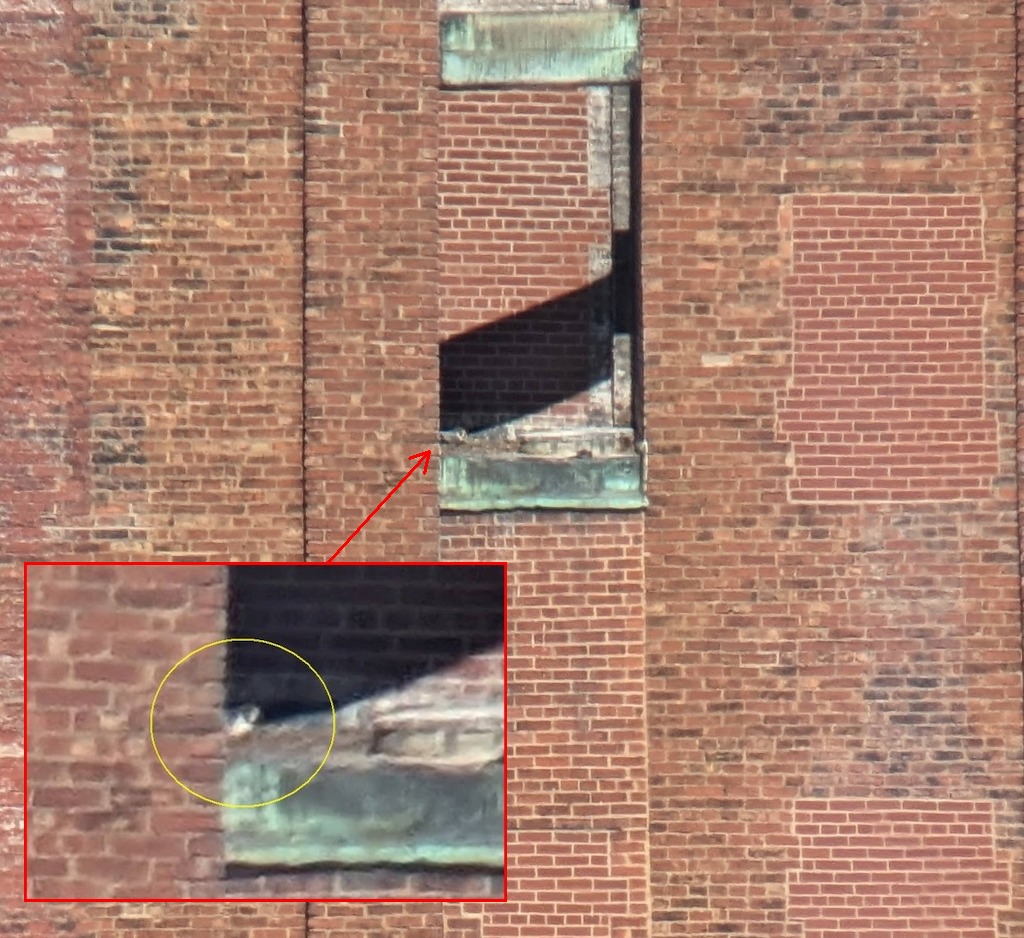
Downtown Pittsburgh: On 28 March 2024 I stood near the Monongahela Incline on Mt Washington and used my scope to peer into the Third Avenue peregrine nest where I saw a peregrine incubating eggs.
Third Ave peregrine nest Downtown as seen via scope from Mt Washington, 28 March 2024 (photo by Kate St. John)
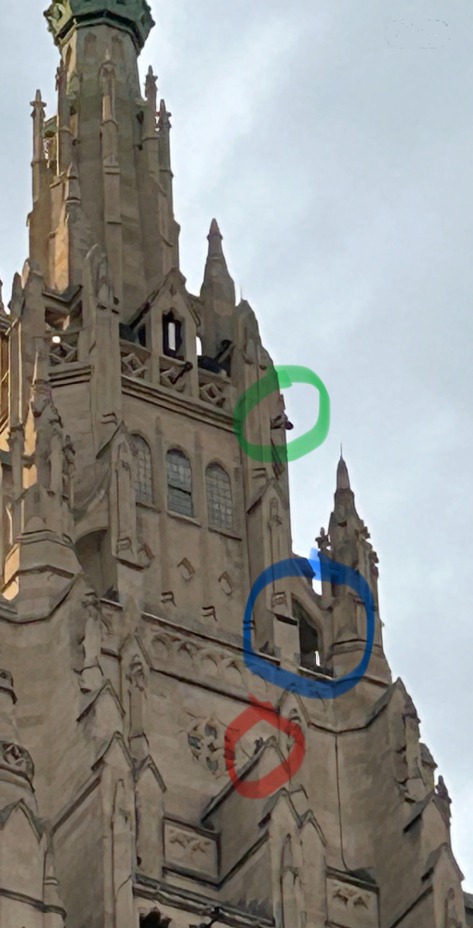
East Liberty Presbyterian Church, Pittsburgh: On 29 March Adam Knoerzer reported that the nest is definitely within the blue circle in his photo below. “The female is always there and never on the exterior except when the male pops in for a shift change.” (I think this on the Highland Avenue side of the steeple.)
East Liberty Presby Church steeple. Look in the blue circle for peregrines to/from the nest (photo by Adam Knoerzer)
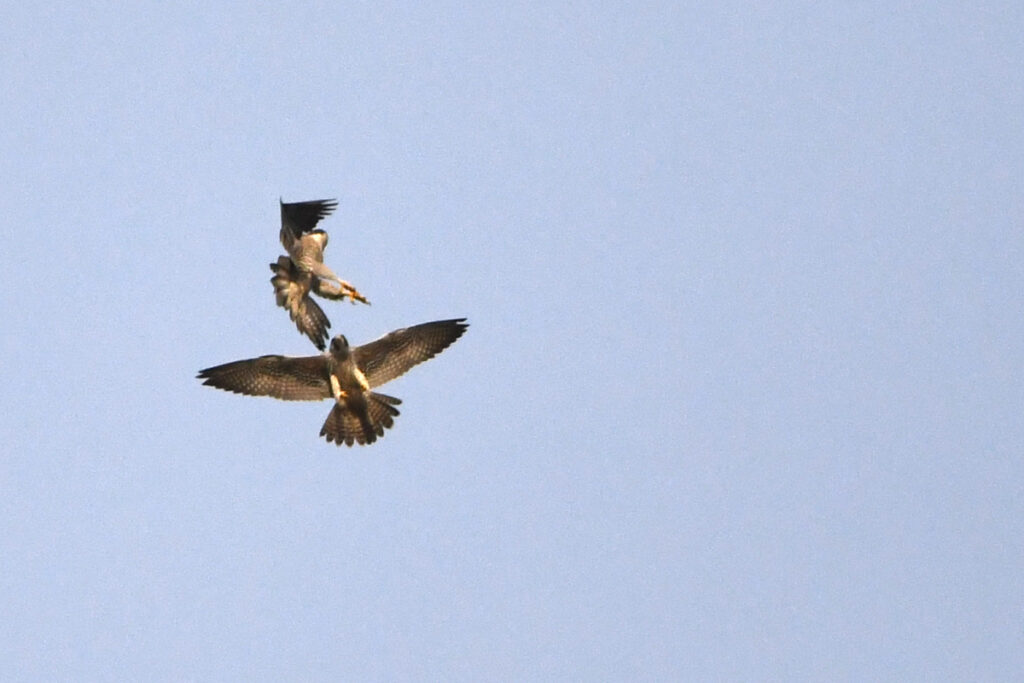
Eckert Street, Ohio River: As of 5 April Jeff Cieslak reports that a peregrine pair is near the Eckert Street nest site but they don’t appear to be nesting there. He says it’s the same female, probably a new male.
Peregrines in flight near Eckert Street, Pittsburgh, 12 March 2024 (photo by Jeff Cieslak)
Sewickley Bridge, Ohio River: Jeff Cieslak reports: “On several visits during March, one or two falcons were fussing around under the bridge, near the far pier. On April 3, two were observed in what appeared to be a nest exchange on a beam near that area. This will be the third year that I’ve witnessed a breeding pair on this bridge, and I have never seen a fledgling.”
Peregrine pair at nest hole on Sewickley Bridge, 25 March 2024 (photo by Jeff Cieslak)
Monaca Railroad Bridge, Ohio River: For a while it looked as if the peregrines would nest but their attempt must have failed. eBird reports from the “Mouth of the Beaver River” hotspot in late March through 2 April indicate that both peregrines are visible simultaneously. Definitely not incubating.
Railroad bridge over the Ohio River from Monaca to Beaver (photo by Kate St.John)
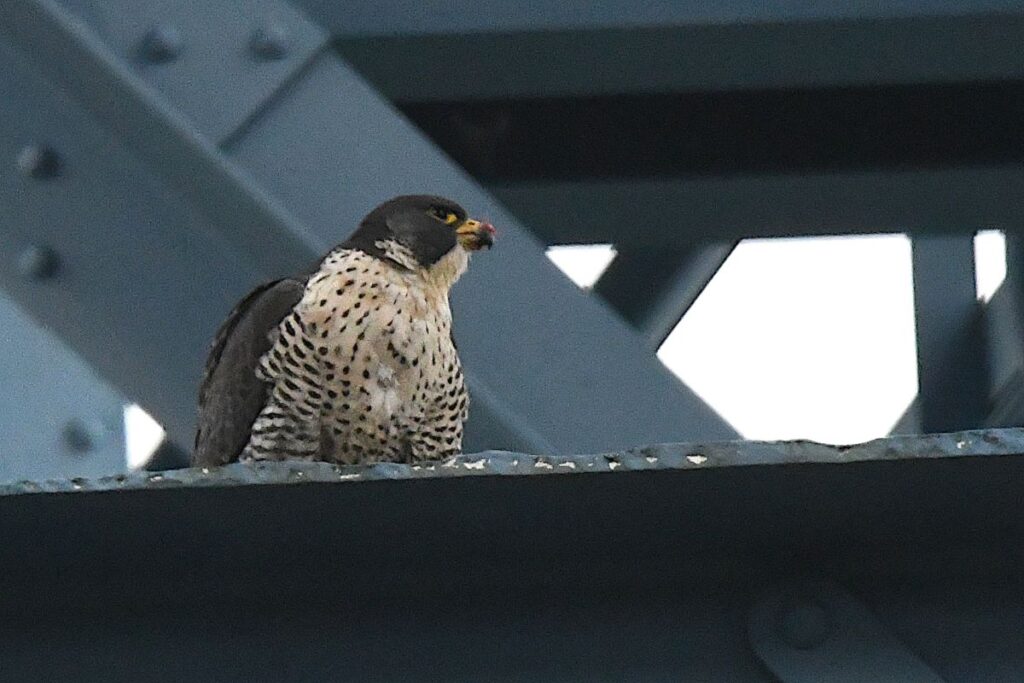
Rt 40 Bridge, West Brownsville, Monongahela River: Fred Kachmarik and Jeff Cieslak both visited this bridge in mid to late March and saw a solo peregrine. Here’s Jeff’s photo from 23 March. Since this site was successful in the past, it looks promising for a family this year.
Peregrine at Rt 40 Bridge, West Brownsville, PA, 23 March 2024 (photo by Jeff Cieslak)
Every potential site is listed below …
and you’re probably wondering …
When will the eggs hatch? … How about TODAY? see below
The usual calculation is “34 days after incubation begins,” though in most cases we don’t know when it started. Of the four nests that seem to be incubating here’s a rough guess.
Cathedral of Learning: Started around 3/19; Hatch approximately 22 April.
Downtown Third Avenue: Your guess is as good as mine. We didn’t know they were incubating until 3/28 because we didn’t look.
Sewickley Bridge: Saw a nest exchange on 4/3; Hatch on or before 7 May … probably before.
Tarentum Bridge: Saw incubation 3/7; Hatch on or before TODAY!UPDATE: Dave Brooke got video today of the two chicks at Tarentum Bridge. They are more than a week old as of 10 April — possibly 9 days old!
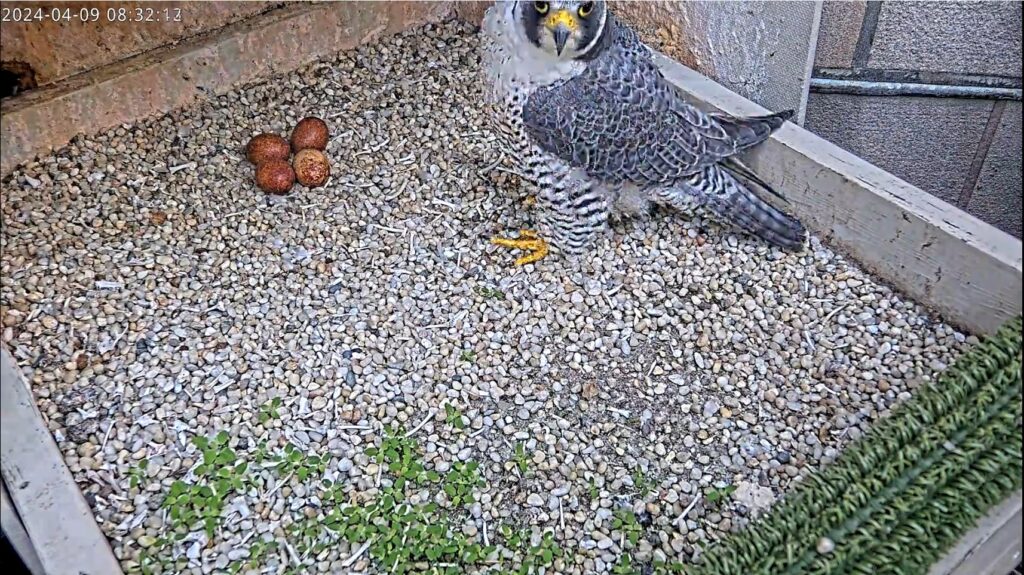
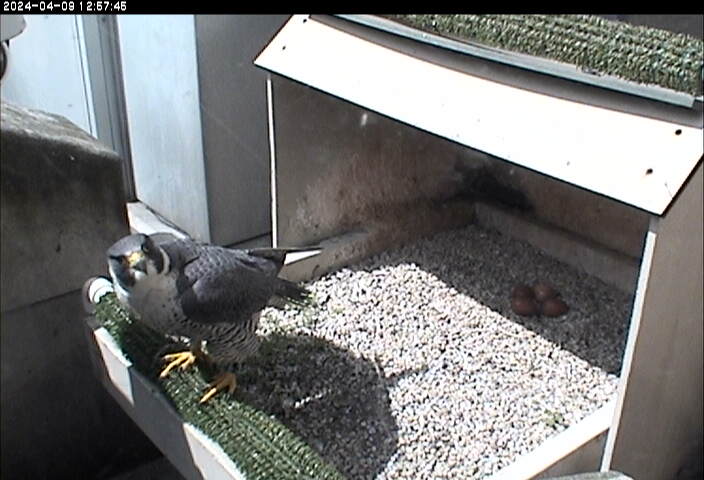
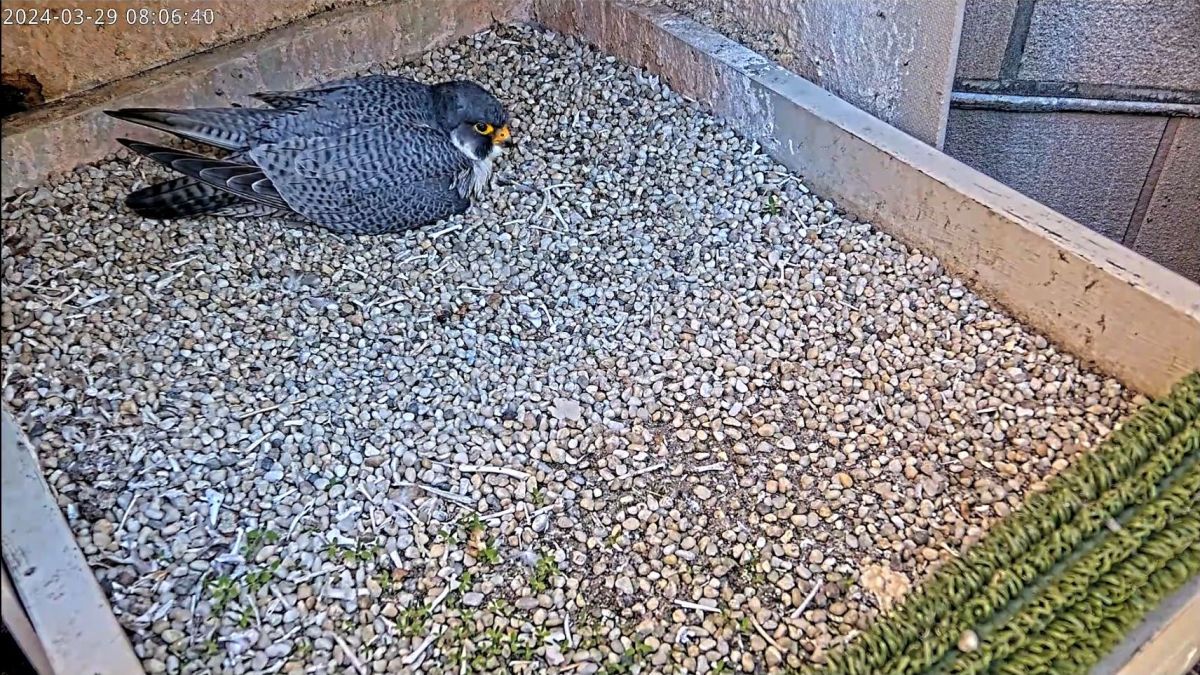
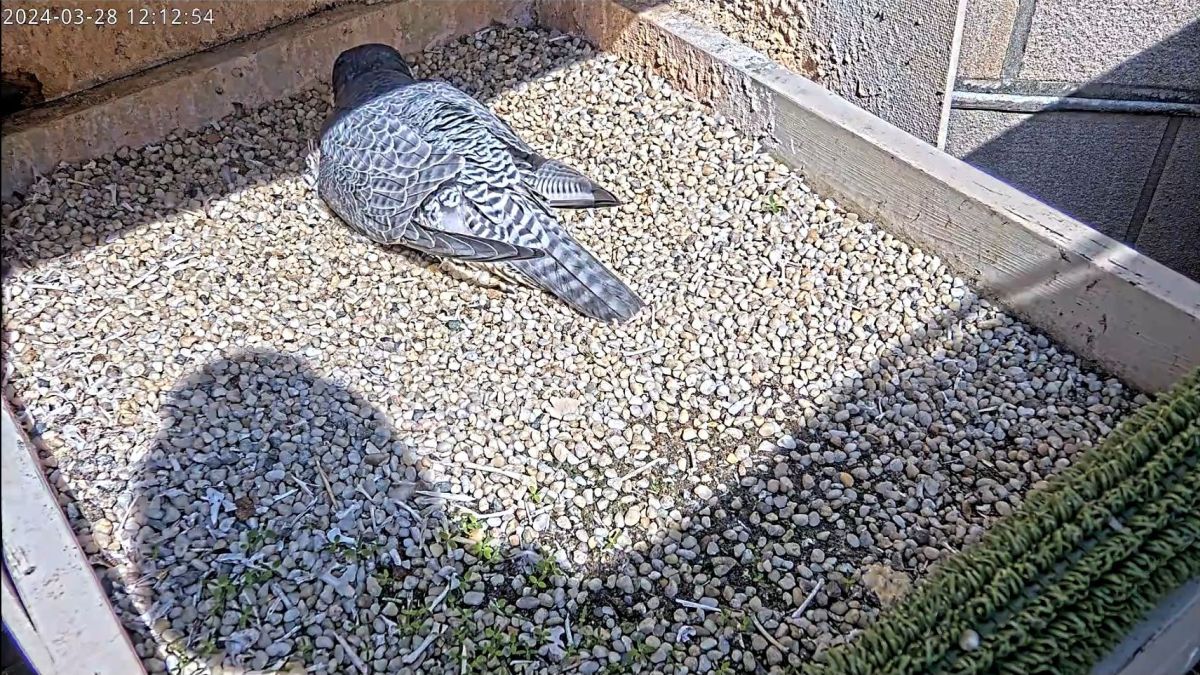
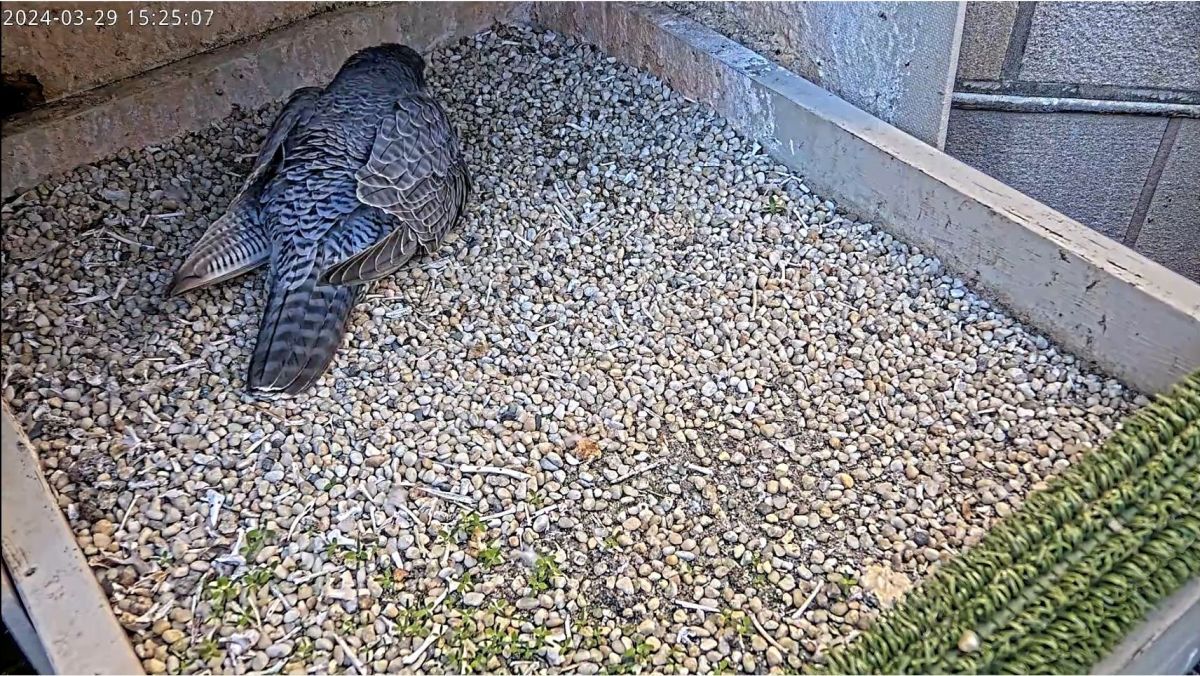
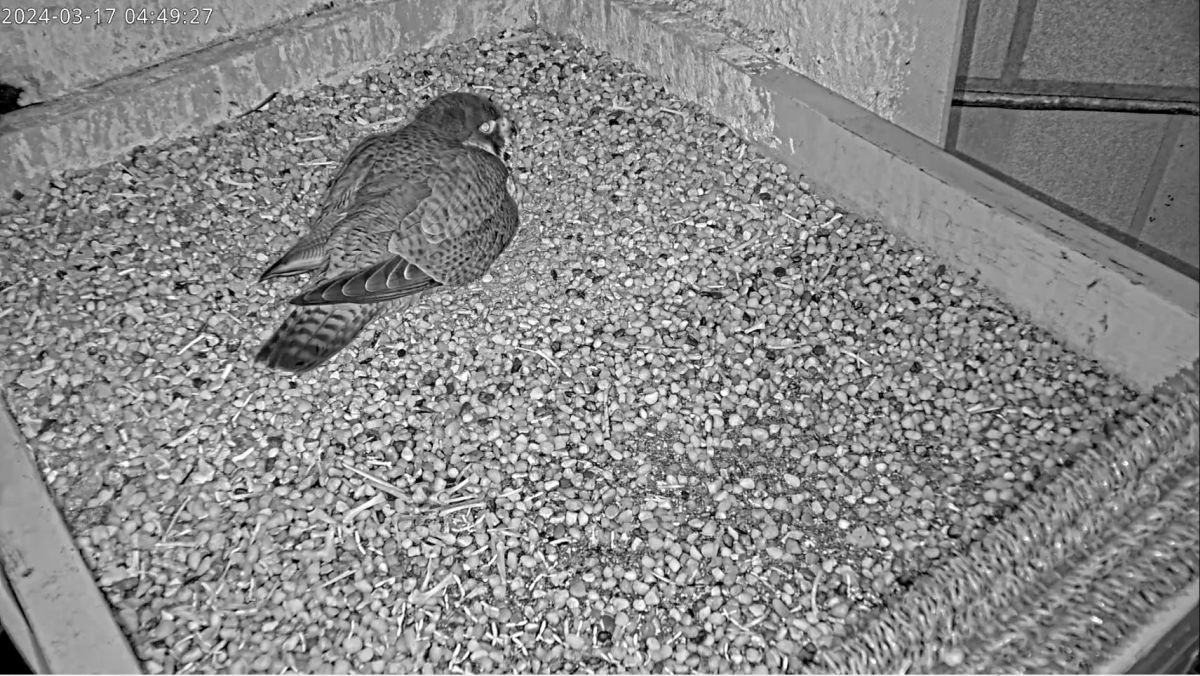
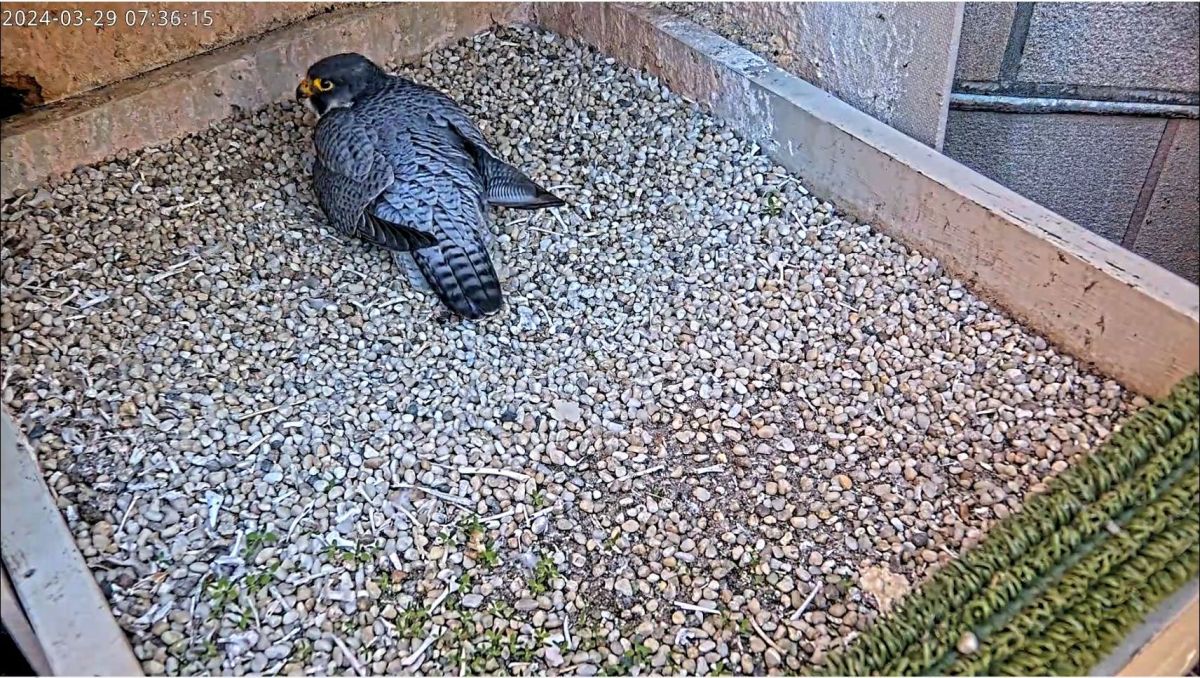
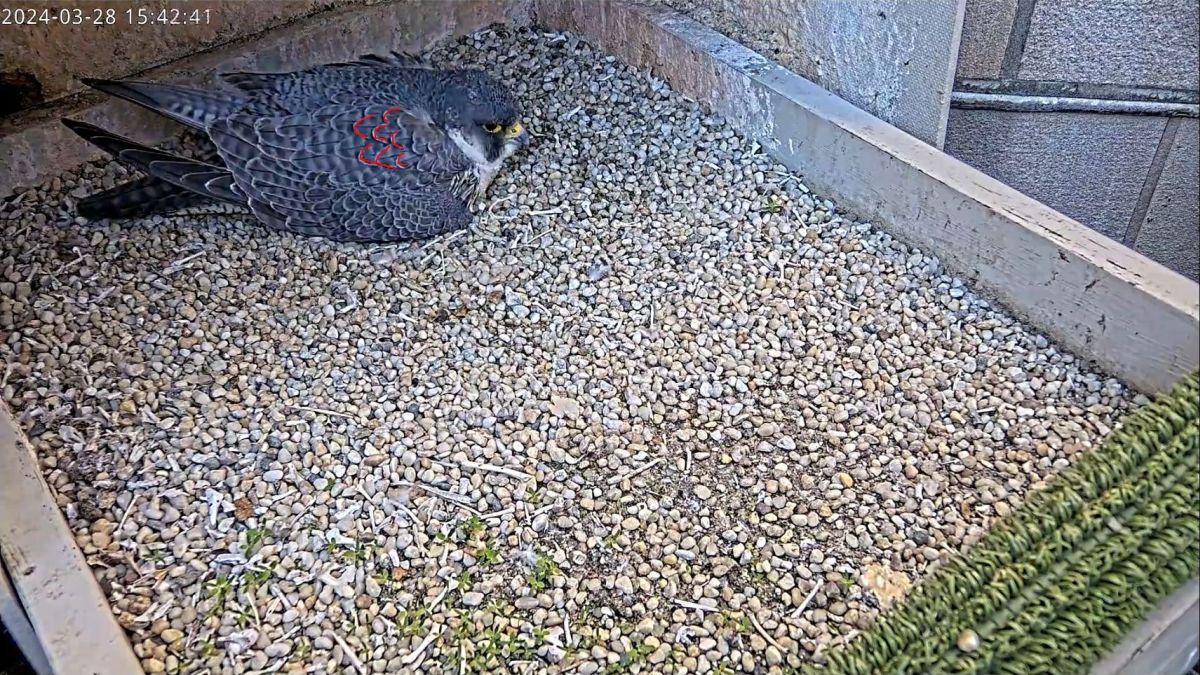
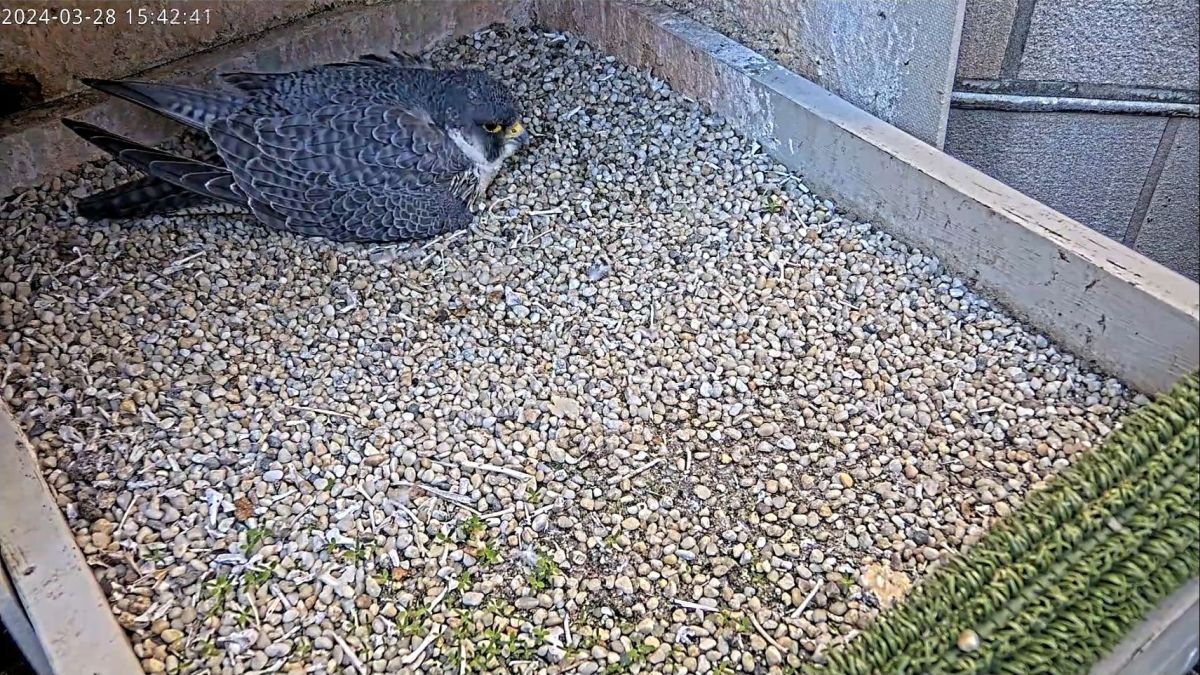
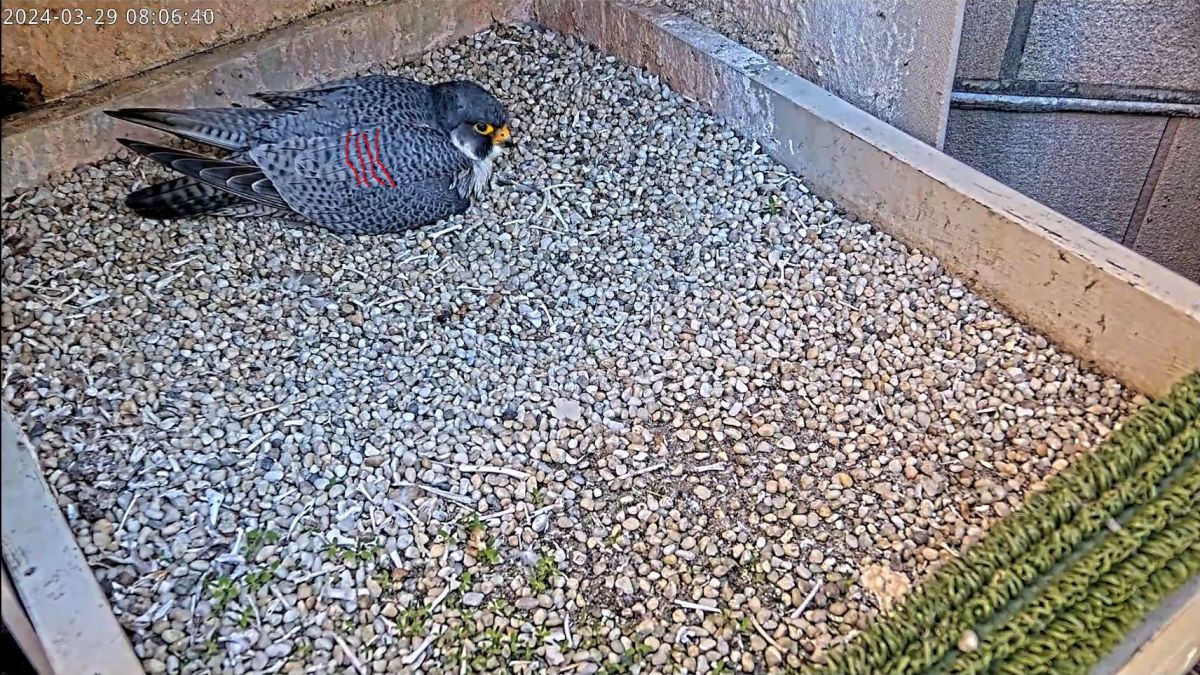
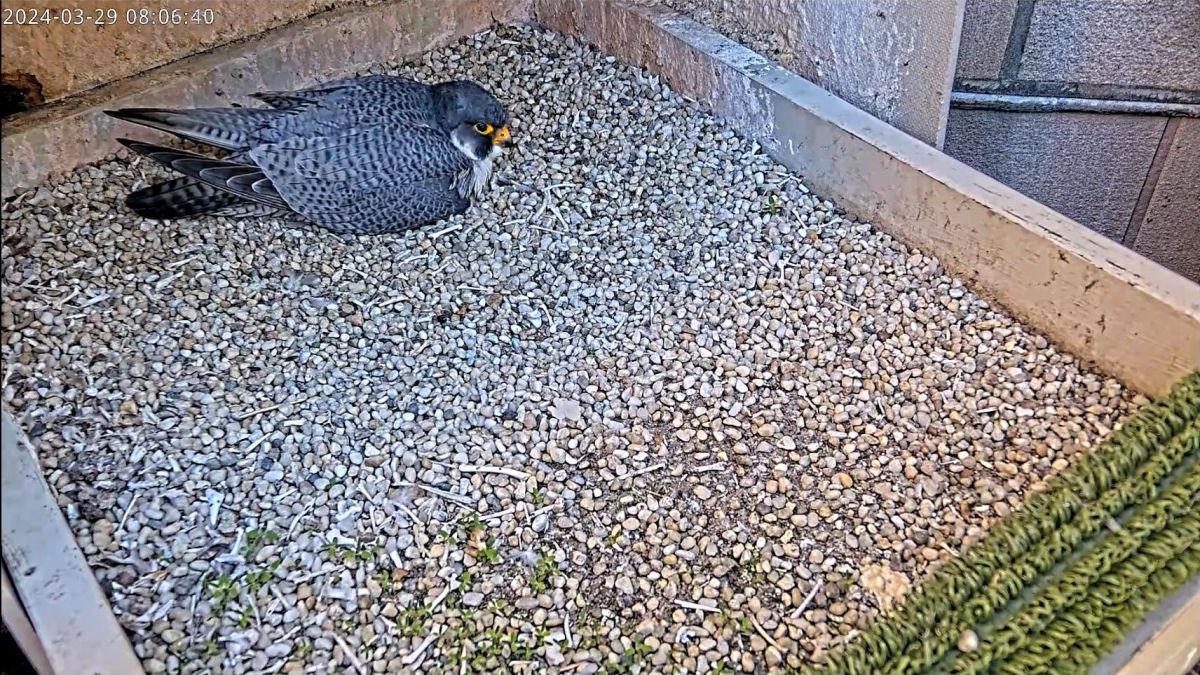
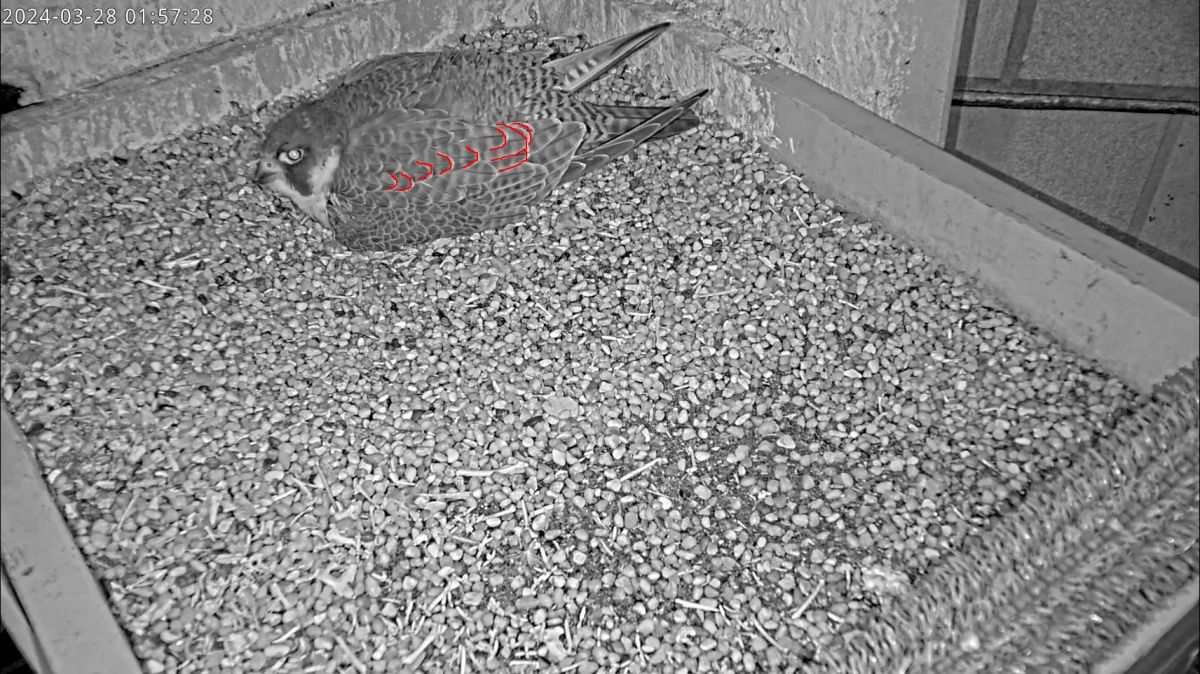
Carla and Ecco have completed nearly two weeks of incubation at the Pitt peregrine nest and have three more to go. As we watch them on the National Aviary falconcam it can be difficult to tell who’s on camera because their appearance is similar. Here are some tips for figuring out which bird is on the nest right now.
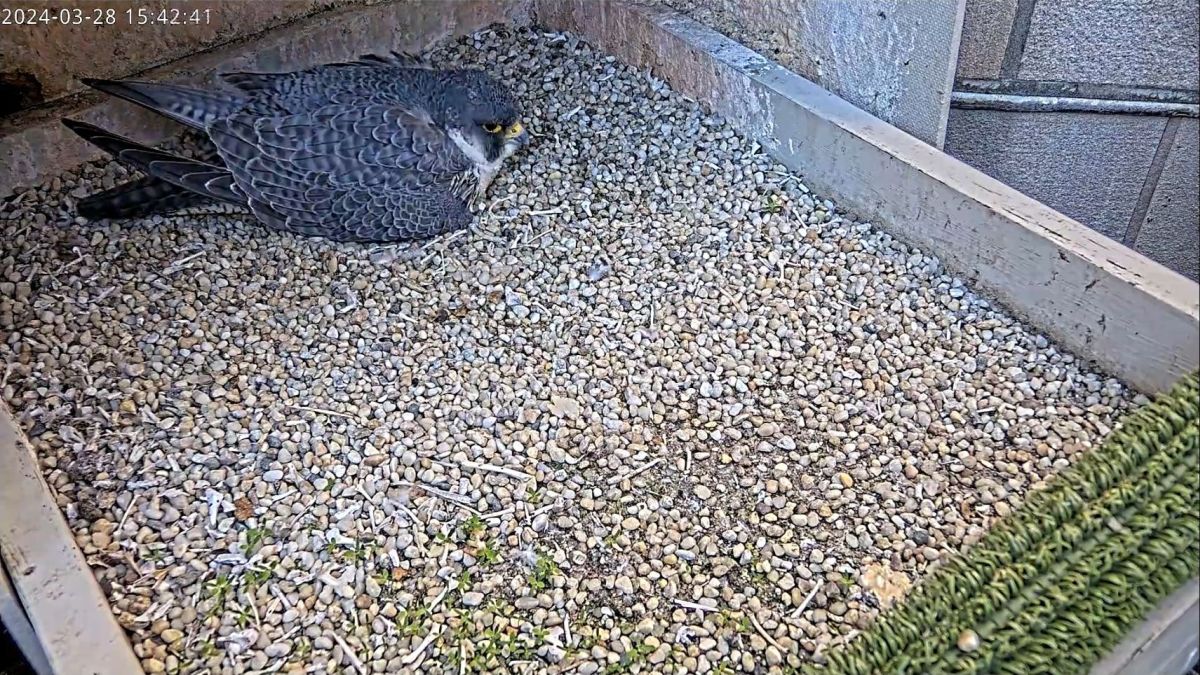
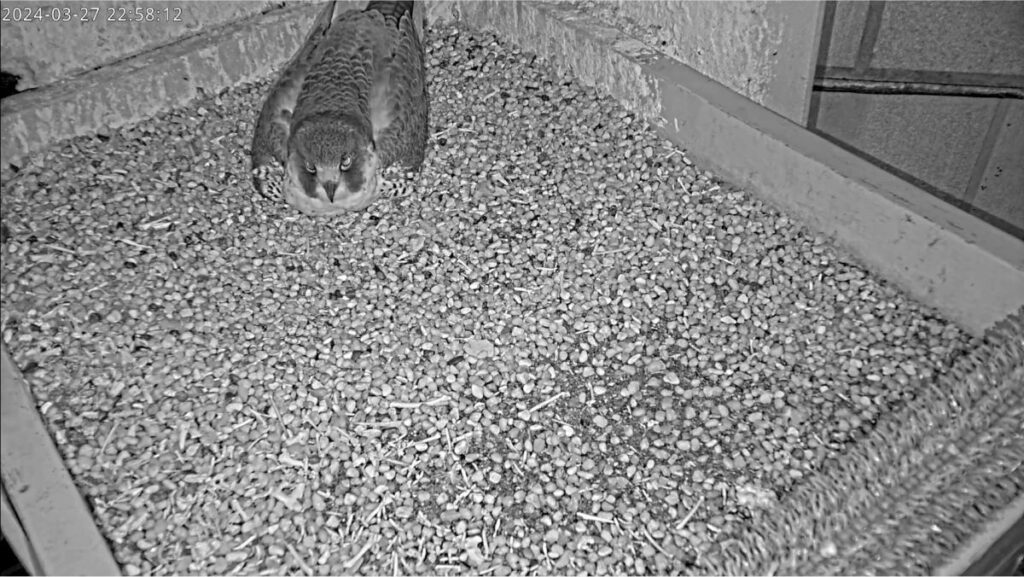
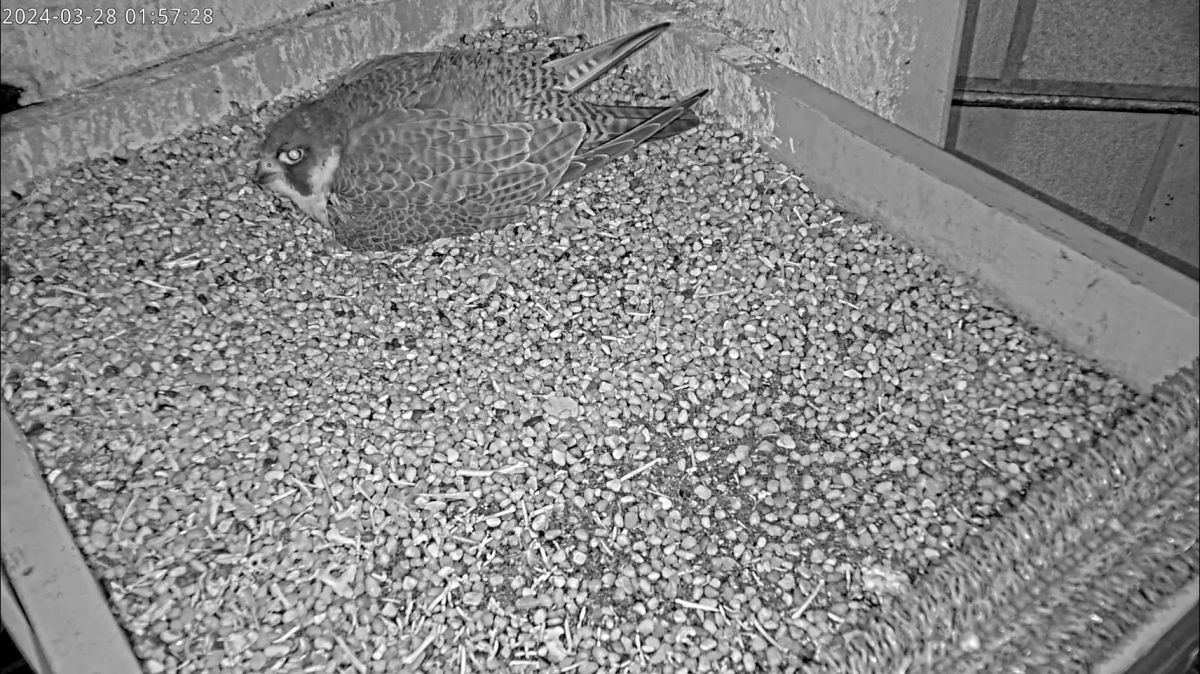
Nighttime incubation? It’s Carla except …
Carla incubating at night, 27 March 2024, 10:58pm
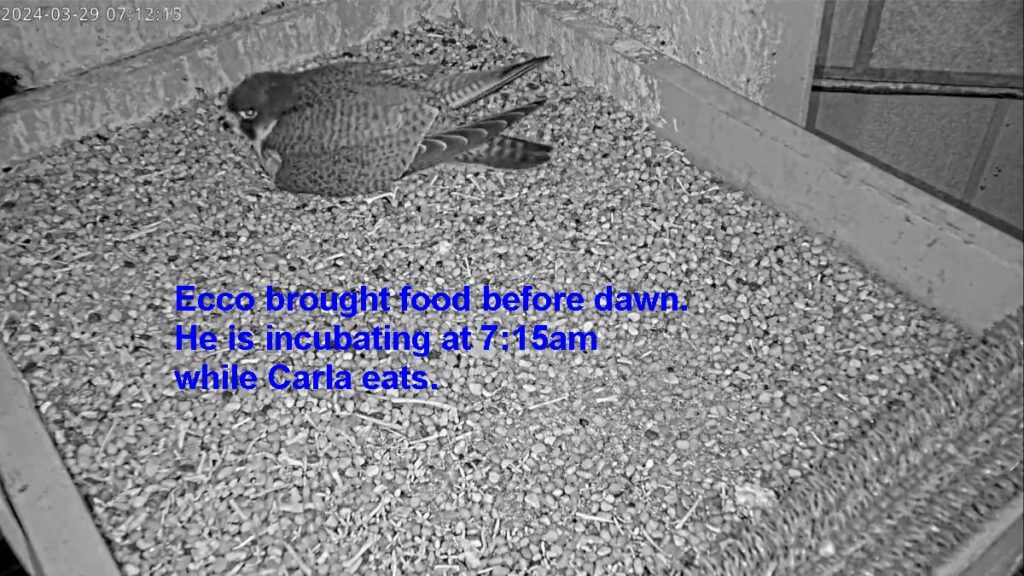
Ecco sometimes brings food before dawn so you may see him on the nest in the early morning while Carla eats.
Ecco on the nest before dawn, 29 March 2024, 7:15am
Whenever you’re in doubt, use these tips.
Size: Carla is larger
Male peregrines are one-third smaller than females so size is the obvious way to tell the difference between the Pitt peregrines (see slideshow at top). However, Carla is not an enormous female and at close quarters on the falconcam with her back turned I have a hard time identifying her by size. The difference is obvious in this slideshow but not when Carla is alone on camera.
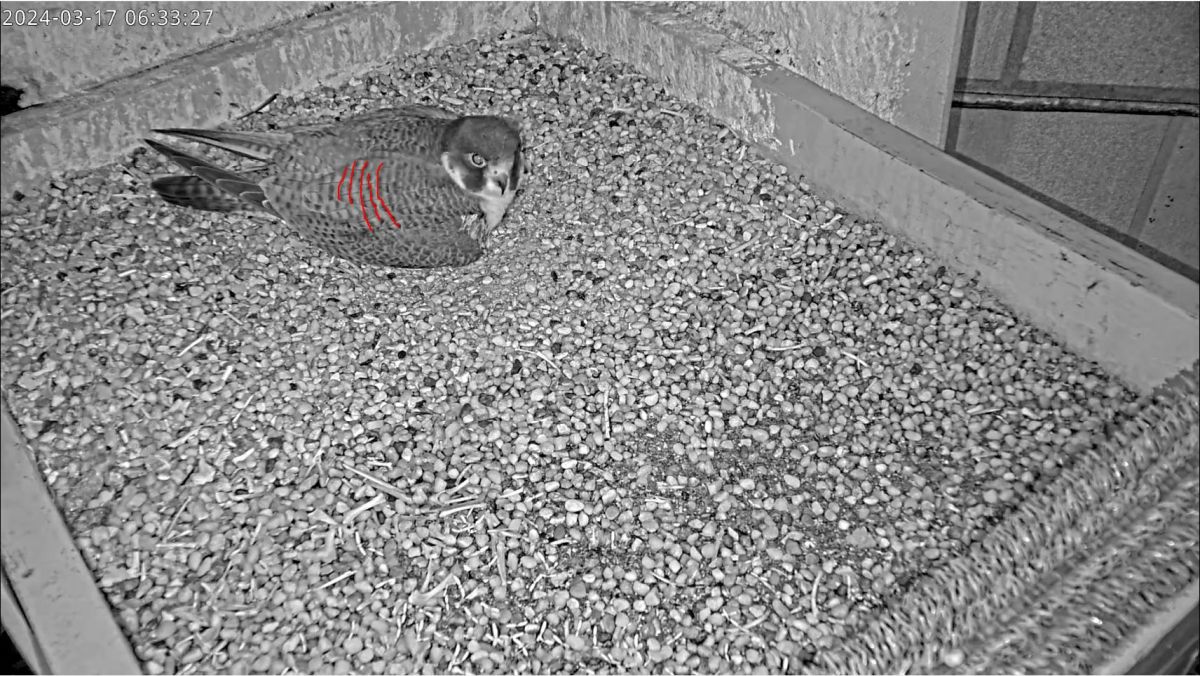
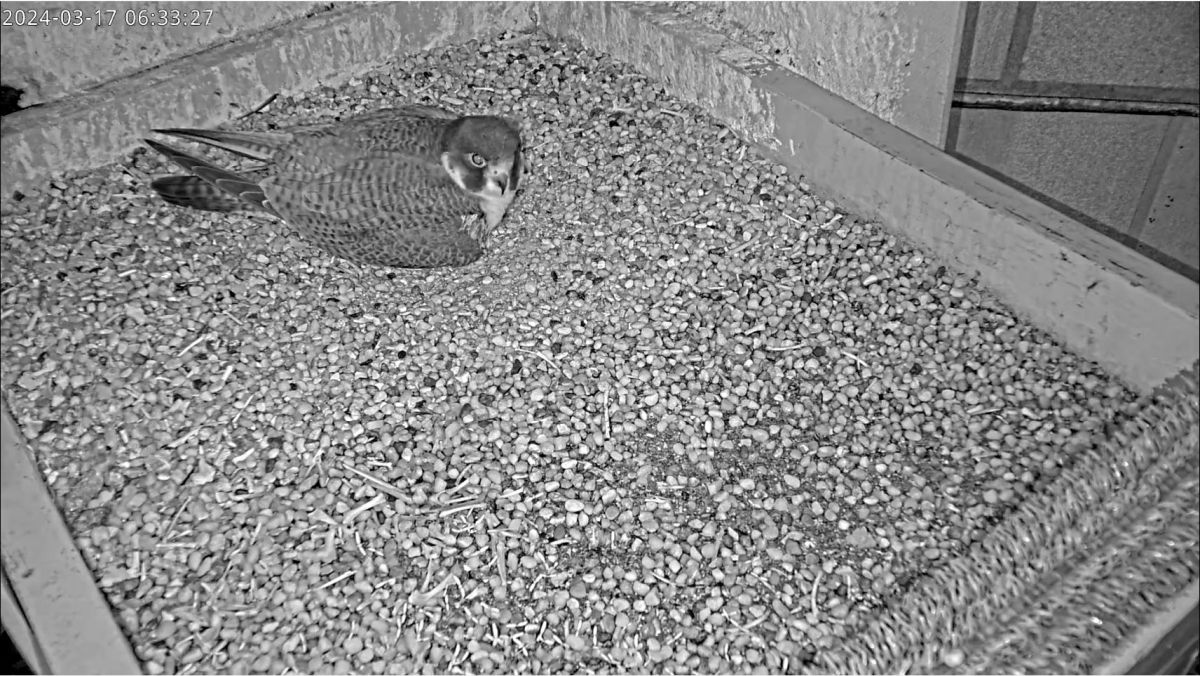
Plumage: Carla is Scalloped, Ecco is Striped
This spring in fresh breeding plumage Carla’s feathers have white tips that make her appearance look scalloped. Ecco’s feathers do not have long white tips so he looks vertically striped with fine black lines. Note that this difference works right now but feathers are dynamic and will not look the same in a few months.
Quiz! Test your skills
Practice recognizing size and plumage differences in this short video that compresses 60 hours into 1:41 minutes. At this speed the size differences between Carla and Ecco are obvious but you’ll have to look at one spot on the screen to notice plumage. Stare at one place and think “Scalloped or Striped?”