Archive for the 'Mammals' Category

May 21 2011

Two Mornings of a Fawn

Published by Kate St. John under Mammals

On Friday Jennie Barker, who lives in the north suburbs of Pittsburgh, sent a series of photos with the subject line, “Why I didn’t cut the grass yesterday.” 

Here’s the story in her own words. 

“I had finished the front yard and moved to the back, when I found…

“We keep a wire fence around this young dogwood to keep the deer from eating it. Last year, a rabbit made a nest within the fence, but crows took all the young. This year, we put bird netting across the top of the fence to protect the rabbits. As I took this photo, a rabbit stood nearby, looking at the intruder in its spot.

“This is why I stopped cutting the grass and put the lawn mower away.

“This morning, the fawn is gone, leaving behind only a depression in the grass.”

That was the first email but within an hour Jennie wrote again and said,

“I didn’t finish today either.  After sending the pics of the fawn under the dogwood, I fired up the lawnmower and headed to the back yard, only to come across . . .”  (the brown spot at the edge of the mulch)

(…again, just a little brown lump…)

(Here it is up close.)

Jenny decided to do the best she could.

“I left a 10-12 foot area unmowed so as not to scare it. A doe watched me from the cover of a large bush as I worked.  I was out of sight of the fawn briefly, and when I returned, it was gone. It is probably tucked away in another safe spot in the yard – there are plenty.  For now, my yard work is done.”

And that’s how a fawn spent two mornings.

(photos and story, thanks to Jennie Barker)

6 responses so far

Apr 05 2011

Ticks Found Here!


Here’s a scary thought:  Bush honeysuckle increases the risk of tick-borne disease. 

It’s not only scary, it’s true!

A team of scientists with tick expert Brian F. Allan from Washington University in St. Louis conducted an extensive study of the relationship between ticks, deer and the invasive plant known as bush honeysuckle

Though the study was done in the suburbs of St. Louis what they learned applies to Pennsylvania as well.  Namely, that in dense stands of bush honeysuckle there are a lot more deer than usual, a lot more ticks than usual, and a higher proportion of the ticks carry disease.

More deer than usual?  The researchers ran deer density counts inside and outside the honeysuckle areas.  In the honeysuckle zone there were 5 times as many deer.

A lot of ticks?  You bet!  One of Brian Allan’s tick traps caught 5,000 nymphal stage ticks in a single location.  Ticks don’t walk far to get a meal — less than 10 feet – so that spot in the honeysuckle was loaded and dangerous.  

Even worse, when they ground up the ticks and tested the mash for bacterial and deer DNA, they discovered that ticks found inside the honeysuckle zone were 10 times more likely to carry bacterial disease than those outside — and they caught it from deer blood. 

So why do deer like honeysuckle so much? 

People used to think that deer liked honeysuckle for its berries but the researchers proved the deer don’t care about the fruit.  Deer hang out in the honeysuckle because it provides great cover.  It’s 18% denser than our native vegetation and it’s first to leaf out in the spring (it’s the only green shrub right now) and it’s last to lose leaves in the fall.  Deer love it.  They sleep there.

The result is that you’re much more likely to catch a tick-borne disease if there’s a lot of bush honeysuckle around.  In Missouri you’ll catch Ehrlichiosis, in Pennsylvania, Lyme disease.

Bush honeysuckle is everywhere, especially in parks and gamelands.

But there’s one positive take-away.  This news may prompt people to try harder to eradicate bush honeysuckle — and that would make our native plants very happy.

Read more about the study in this October 12, 2010 article in Science Daily.  Don’t miss Brian Allan’s description of his tick trap.

(photo of bush honeysuckle leaves in the Spring by Marcy Cunkelman)

6 responses so far

Feb 10 2011

Famous?

Published by Kate St. John under Mammals


Last week groundhogs had their day.  This week possums are vying for the spotlight. 

Possums have come up five times in the last seven days and the more I’ve looked into them, the more intrigued I’ve become.  Did you know that….?

  • Virginia opossums (Didelphis virginiana) are North America’s only marsupial. 
  • Their ancestors were from South America but they split from them during the Cretaceous (age of the dinosaurs) and started moving north.  They are still moving north and have now reached southern Canada.
  • Possums are the size of a large housecat with a pointed snout, shaggy fur and a naked prehensile (grasping) tail.  This one looks so cute because his ugliest features are not accentuated in his portrait.  It helps that he didn’t smile for the camera.
  • Possums have 50 teeth in their little mouths and look especially grisly when they smile.  (Adult humans have 32 teeth.)
  • They often smile where they’re afraid and always smile when they “play possum” in which they pretend to be dead by rolling over, drolling with an ugly smile, tongue hanging out, eyes closed and a slowed heartbeat.  They can be catatonic like this for four to six hours!
  • Possums will eat just about anything and become ill if they don’t have an extremely diverse diet. 
  • They are prolific.  The female’s pouch has 13 nipples for up to 13 live young.  This makes up for their survival disadvantages which are…
  • Possums have very low intelligence, poor eyesight (nearsighted), poor hearing and a slow bumbling gait.  Any possum who decides to eat roadkill easily becomes roadkill himself.
  • Possums are normally nocturnal but in times of short food supply you may see them foraging during the day.  That’s when Cris Hamilton found this one on her deck eating fallen bird seed.
  • Their thin ears and naked tail are especially prone to frostbite.  Joan Silagy saw a frostbitten possum at Blue Marsh last week.
  • Possums can live well in the city.  Last Saturday night I saw a one on my city street just after hearing how possums invaded someone’s home (inside the walls!) in New Orleans after Hurricane Katrina.  That double-whammy started my possum streak.
  • Virginia opossums live only about two years in the wild because they face so many predators and the challenge of winter.  The ARL Wildlife Rehabilitation Center has a possum missing an ear and half its tail because a dog attacked it.  (See his thank-you card here which you receive after sponsoring him here.)
  • The possum’s enemies expanded his range.  Southerners who liked possum stew took them to California for food during the Great Depression. 

I could go on and on about possums but I’ll leave you with this Possum Celebrity Moment:  A cross-eyed possum at the Leipzig Zoo has so captured the hearts of the German public that the zoo has had to improve her display so that more people can see her — and she’s not even on display yet!

(photo by Cris Hamilton)

8 responses so far

Dec 21 2010

Quiz: Where do rabbits go in the winter?

Published by Kate St. John under Mammals,Quiz


Today’s quiz is something I’ve been wondering about.

In spring, summer and fall rabbits were everywhere and easy to find.  Now that the ground is snow covered, I haven’t seen any and I’ve found only one set of tracks in all my travels. 

So where did the rabbits go?  Are they hiding?  Or sleeping? 

My reference guides make it sound like the winter life of rabbits is barely different from summer’s except that they change their diet from leaves to twigs.  I find it hard to believe that that’s the only difference.

If you know what rabbits do and where they go in the winter, please leave a comment to let me know. 

I’m sure many of us will learn from it!

(photo by D. Gordon E. Robertson from Wikipedia. Click on the photo to see the original.)

23 responses so far

Dec 04 2010

Hey! Back Off!

Published by Kate St. John under Birds of Prey,Mammals


Red-tailed hawks eat squirrels but red-shouldered hawks, like this one, are a little too small to make squirrels a normal part of their diet.  Perhaps this squirrel knew that.

A few years ago Steve Gosser saw an immature red-shouldered hawk perched quietly in his parents backyard.  While he watched, a gray squirrel climbed the tree and made a beeline for the hawk.  Did the squirrel want to challenge the hawk?   Who would win?

When the squirrel got too close, the hawk puffed open his wings. 

Hey!  Back off!

The squirrel got the message and left the tree.

(photo by Steve Gosser)

4 responses so far

Nov 20 2010

Acrobat

Published by Kate St. John under Mammals


The last time we saw Marcy’s bird feeder there was a cute black-capped chickadee on it.

I thought her feeder was squirrel proof because it hangs from a slender hook far from the pole, but those barriers aren’t a problem for this acrobat.

Look how this squirrel uses his back feet!  Look at his thumbs!

…At least he isn’t a bear.  ;)

(photo by Marcy Cunkelman)

4 responses so far

Nov 08 2010

This is a Gray Squirrel

Published by Kate St. John under Mammals


Yes, really.

Black squirrels are not a new species, they’re just a common melanistic color phase of the eastern gray squirrel (Sciurus carolinensis).

“Melanistic” comes from the Greek word for black, melanos, and is caused by melanin, the brown or black pigment that gives hair, skin and eyes a dark color.  Melanin can be inherited for a permanent dark color as in this squirrel, or it can be produced in greater quantities during tanning or in some diseases.

Melanism can confer a biological advantage when it provides better camouflage.  There’s even an effect called “industrial melanism” in which the majority of a species living in a dirty, industrial zone are darker than those who live in a cleaner environment.  This was famously documented among peppered moths in Britian during the sooty, late-1800s.

Who knows why Pittsburgh has black squirrels (we haven’t been sooty for half a century) but if you want to see them come on over to the area of Schenley Park that borders — you guessed it — Squirrel Hill.

(photo by D. Gordon E. Roberston from Wikimedia Commons.  Click on the photo to see the original)

7 responses so far

Oct 28 2010

Why the Leopard Got His Spots

Published by Kate St. John under Mammals


In 1902 Rudyard Kipling answered How the Leopard Got His Spots.

According to Kipling, the Ethiopian and the Leopard originally hunted on the High Veldt where they and their prey matched the plain, sandy landscape.  Their prey moved to the forest but when the Ethiopian and Leopard followed them there, the animals they hunted were camouflaged while they “show[ed] up in this dark place like a bar of soap in a coal-scuttle.”  They couldn’t catch a thing.

“The long and the little of it is that we don’t match our backgrounds” said the Ethiopian, so he changed the color of his skin and offered to help Leopard change too. ”The Ethiopian put his five fingers close together (there was plenty of black left on his new skin still) and pressed them all over the Leopard, and wherever the five fingers touched they left five little black marks, all close together.” 

So, says Kipling, that’s how the Leopard got his irregular spots.  And why?  He needed camouflage in the forest.

More than 100 years have passed.  Can science support this story?

Last week the BBC reported on a new study that confirmed Kipling’s “why,” but not his “how.” 

Using mathematical models, scientists analyzed the pattern complexities of wild cats’ coats and correlated the complexity levels to the cats’ lifestyles.

Do wild cats have spots and stripes for social reasons?  Do the patterns attract mates or repel rivals?  No.  The models showed that cats living in trees and at low light levels are the most likely to have complex and irregular coat patterns.  Notice how the tree-dwelling leopard’s spots are similar to the dappled leaves behind him.

Which brings me to a cat I know very well.  She is not wild, she does not live in trees, and she doesn’t have to operate at low light levels.  Nevertheless Emmalina has four colors on her coat (white, beige, taupe and black) in an irregular pattern of blotches and stripes. 

In our house we’ve learned this pattern makes her disappear when crouched on the kitchen counter, an amazing adaptation for modern life.

(leopard photo from Wikimedia Commons.  Emmalina’s photo by Kate St. John.)

4 responses so far

Oct 24 2010

Turning gray

Published by Kate St. John under Mammals


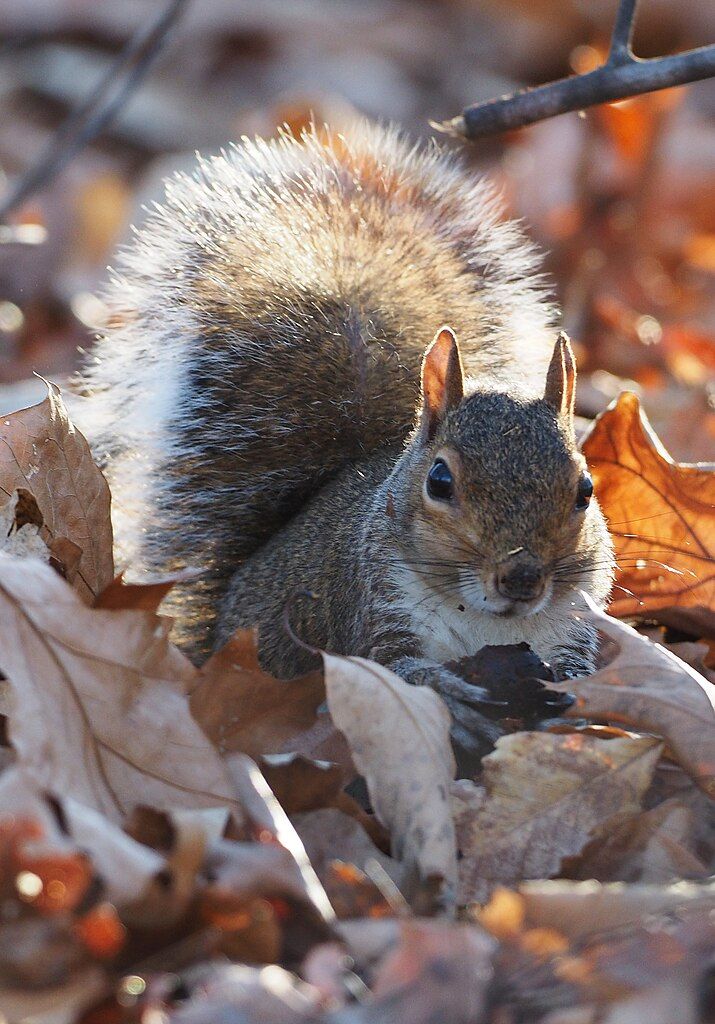
Gray squirrels are, of course, gray — that’s how they got their name — but did you ever notice that in the summer they’re actually rather brown?

From March through June gray squirrels molt into a brown or tawny pelage that blends well with their summertime surroundings.  Then in September and October they molt again, this time into paler, grayer winter coats so they’re ready when the cold winds blow.  My backyard squirrels are making this change but their faces and ears are still brown. 

Lately I’ve seen the squirrels on frequent caching expeditions up and down the street because my neighbor has a prolific black walnut tree.  I’m sure the squirrels are burying walnuts but I only see evidence that they’re eating them.  They leave behind little piles of broken shells and a permanent black stain on the cement.

I wish they wouldn’t pick my front steps for their walnut feasts but I can understand their urgency. 

Winter’s coming.  It’s enough to turn a squirrel’s hair gray.

(photo from Wikimedia Commons.  Click the photo to see the original.)

10 responses so far

Sep 19 2010

They’re Everywhere

Published by Kate St. John under Mammals


Yesterday afternoon I took a walk in Schenley Park to see what I could find. 

There weren’t many birds – just a flock of robins, some grackles and blue jays, one brown creeper, and a single confusing fall warbler – but what was lacking in birds was made up by this very cute mammal. 

Chipmunks were everywhere, scrabbling through dead leaves, cramming nuts in their cheeks and shouting as they ran to escape my approach.  My goodness they were busy!

Despite their apparent playfulness chipmunks are actually very territorial.  Except when they’re babies they live alone, one per burrow, and defend that burrow against all chipmunks.  They threaten, they shout, they chase each other everywhere.  And they look so cute while they’re doing it.

By the end of my walk I was sorry I hadn’t counted chipmunks, just for fun. 

Was it an illusion or were there more chipmunks than birds?

(photo by Brian Herman)

6 responses so far

« Prev - Next »

Bird Stories from OnQ