Archive for the 'Birds of Prey' Category

Jan 24 2008

No, they won’t eat corn

Immature Coopers Hawk (photo by Chuck Tague)An animal-lover friend of mine began to feed the birds and was shocked when a coopers hawk killed a mourning dove at her feeder.  She does not eat meat and wanted to know if she could train the coopers not to eat meat either.  “If I put out more corn, will he eat the corn and not the doves?”

“No,” I said, “he will not eat corn.  He’s a carnivore.  That’s just how it is.”

Because humans are omnivores and we grow our own food, we find it hard to imagine the lives of creatures who must hunt to live.  If a coopers hawk is not an efficient hunter, if it does not kill birds, it will die.  It would be cruel to the hawk if it could not hunt. 

But what about the prey species?  Is it cruel to them that they are hunted? 

There is a beautiful poem by James Dickey in which he describes the heaven where wild animals go.  Called The Heaven of Animals he describes the predators in their heaven crouched on the limbs of trees and writes,

“And those that are hunted
Know this as their life,
Their reward: to walk

Under such trees in full knowledge
Of what is in glory above them,
And to feel no fear,
But acceptance, compliance.”

The universe is structured so that everything is eaten by something - in the grave, if not before. What an amazing cycle.

That’s just how it is.

3 responses so far

Dec 29 2007

Christmas Bird Count

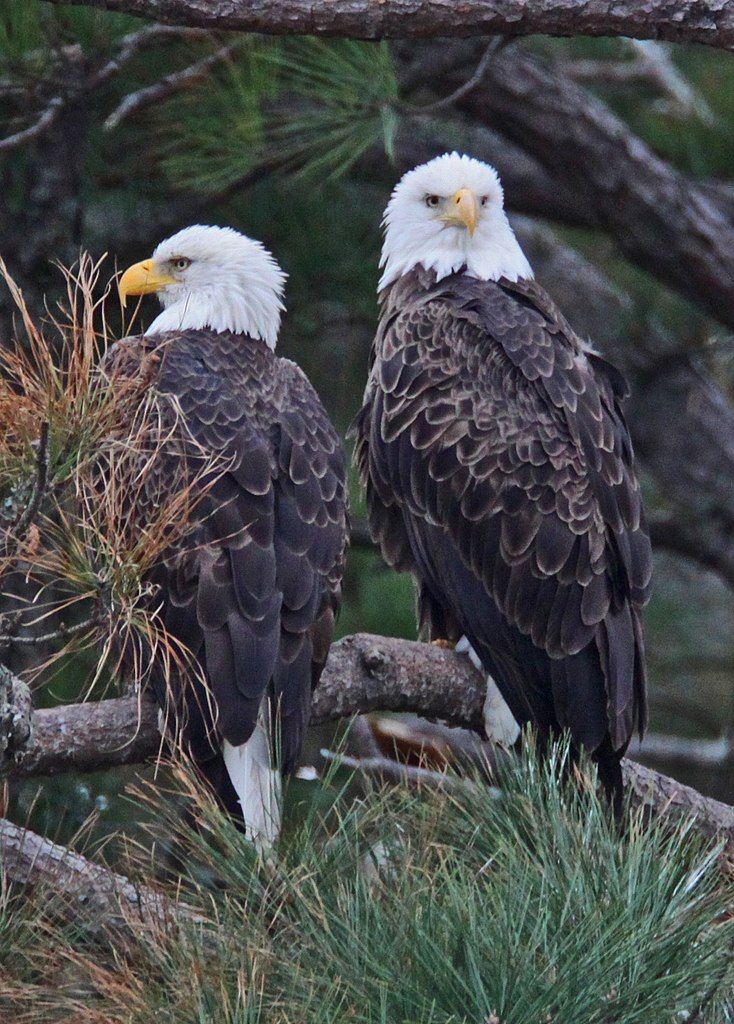
Bald eagle (photo by Chuck Tague)Today was Pittsburgh’s Christmas Bird Count, always held on the Saturday after Christmas.  I counted birds from my attic window during dawn “rush hour,” then walked my neighborhood on a route I’ve done for the past few years.  It was interesting to compare this year’s species and weather to the counts I’ve done in prior years.

You might be wondering, what is a Christmas bird count and how can it be accurate? 

The Christmas bird count began in 1900 when Frank Chapman of the newly formed Audubon Society decided that counting birds was a far better activity than the Christmas “side hunts” in which people killed as many birds as possible.   Each Christmas Count is held within a 15-mile diameter circle and on a single day between December 14 and January 5.  Volunteers organize their routes so they don’t overlap.  They tally the number of birds seen per species and record the weather conditions, the number of participants, hours spent and miles travelled. 

It’s impossible to be absolutely accurate counting large flocks or skulking birds, but over a span of 100+ years the counts are accurate enough to indicate trends in bird populations.  The main thing is that we do the same thing at the same time every year and allow for changes in number of participants, hours spent, etc.

This year was different for me in a few significant ways.  First, the weather was sunny and windy in the morning - it’s usually overcast.  Then, a few of the bird feeder locations were missing or empty, so no birds there.  On the other hand I found more birds than usual and it was an excellent day for raptors.  I saw a pair of red-tailed hawks in courtship flight, counted three Coopers hawks and stopped by University of Pittsburgh to tally the resident peregrine pair. 

And my absolute Best Bird was an adult bald eagle flying along the crest of the hill overlooking the Monongahela River.  It can’t get much better than having a bald eagle in my city neighborhood.  Wow.

(Chuck Tague took this picture in Florida but the eagle I saw looked much the same - just a little further away.)

No responses yet

Dec 28 2007

Conowingo Eagles

Published by Kate St. John under Birds of Prey, Travel

Conowingo Dam, Susquehanna River, 12/26/07Since I was already near Harrisburg for Christmas with my husband’s family, I took the opportunity last Wednesday to visit the lower Susquehanna River with Scott Gregg and his daughter Karena, two birding friends from Beaver Falls. Our goal was to see bald eagles.

Our main stop was Conowingo, a hydro-electric dam in Maryland and the last dam before Chesapeake Bay. The river was so high that the floodgates were open and sirens were wailing to warn boaters of the flood and turbulence. Spray rose from the dam’s waterfall and hundreds of gulls wheeled through the mist. Black vultures hunched on the dam and in nearby trees. Great-blue herons waited out the flood on a rocky downstream island.

Bald Eagle (photo by Chuck Tague)We saw more than a dozen bald eagles but it was hard to count in the misty air. Some perched on the power towers, some circled above the electric lines. There were more immature eagles than adults. The immatures are mottled brown like a huge hawk without the white head and tail until their fourth or fifth year. Chuck Tague’s picture shows an adult eagle in Florida (that’s why the sky is blue!).

Bald eagles are in the genus of sea eagles. They always live near water and eat mostly fish. During the breeding season they claim a territory and keep other eagles away but in winter they congregate in large numbers where there is open water and lots of fish. The dams along the lower Susquehanna are just such a place.

Apparently the fishing was easy at Conowingo. With the river rushing through the floodgates, the fish were taking a beating. No wonder we saw so many gulls, black vultures … and bald eagles.

No responses yet

Dec 06 2007

Finding Out Where the Eagles Fly

Published by Kate St. John under Birds of Prey, Migration

Golden Eagle (photo by Todd Katzner)Last night I went to Three Rivers Birding Club to hear Dr. Todd Katzner of the National Aviary give an excellent presentation on “Migrating Eagles and Wind Turbines: Resolving Conflict in an Information Void.”   The project is a multi-year study of the migratory paths of eastern golden eagles.  Its goal is to provide information so that wind turbines can be sited properly and not cause bird mortality.

Wind energy is being heavily promoted and developed in Pennsylvania.  I’m sure you’ve seen windmills if you’ve driven east on the Turnpike.  Many more wind farms are planned.

Some wind turbines are highly lethal to birds.  Some don’t kill any.  It turns out that turbine placement is the key.  If we find out where the birds usually fly, the turbines can be placed outside that path.  Sometimes only a few hundred feet makes all the difference.

The coolest part of the project is the telemetry data and maps.  It’s impressive how far golden eagles travel in a day (more than 200 miles) and how fast they go when the wind is good (60 miles per hour!).  On the Aviary website you can see where all seven eagles have been and you can watch the day-by-day movements of each eagle

The project needs to tag more eagles with telemetry units but the units are expensive.   The Aviary and their partners are working at raising funds to buy telemetry units.  Contact Dr. Todd Katzner at the National Aviary if you wish to help.

One response so far

Nov 30 2007

A Two Coopers Day

Published by Kate St. John under Birds of Prey

Coopers Hawk at backyard feeder (photo by William Parker)It seems like all I write about are birds of prey, but they’re the big, splashy birds of winter.  Most of the songbirds have left town so at my house we’re down to starlings, house sparrows, mourning doves, crows, pigeons and a variety of hawks.

Yesterday as I walked to work I saw two coopers hawks fly over, one right after the other.  They’re searching for food and hanging out at backyard feeders, as seen in this photo by Bill Parker. 

Coopers hawks aren’t at the feeders for the seeds.  They eat birds for a living, so they’re trying to catch an unsuspecting seed-eater.  Entire flocks fall silent when this hawk is near.  Starlings warn each other by making a high-pitched spitting sound.  Everyone ducks for cover. 

Coopers hawks are known to be jumpy and high strung.  Unlike red-tailed hawks, they are always on the move - and they move fast.  They can fly quickly through a forest and accurately catch prey with their talons. 

At my grocery store’s parking lot I once saw a coopers hawk cut a single pigeon out of the flock and grab it from behind in mid-air.  It was awe inspiring and it made me very glad I’m not something a coopers hawk wants to eat.


2 responses so far

Nov 24 2007

Bald Eagle Comeback

Published by Kate St. John under Birds of Prey

Bald eagle pair building nest at Moraine State Park (photo by Steve Gosser)Bald eagle pair at Moraine (photo by Chuck Tague)The resurgence of the bald eagle in western Pennsylvania is a beautiful thing.  Nothing confirms it so well as seeing our newest pair of eagles flying together at Moraine State Park in Butler County.  In the photos above, Chuck Tague caught them flying together in a blue sky on November 1 and Steve Gosser captured them building a nest on November 23.  They won’t be laying eggs any time soon but they are housekeeping.  It looks like this pair will make the lake their home.

As recently as 25 years ago it was almost impossible to find a bald eagle in Pennsylvania.  In 1980 there were only three nesting pairs in the entire state - all of them at Pymatuning.  Pesticides, especially DDT, accumulated in the eagles’ bodies and made their eggs crack and fail.  With no young eagles reaching adulthood, the population declined as the adults died off.  It didn’t help that water pollution during that era reduced fish populations, the eagle’s staple food.

In the mid-1980s the PA Game Commission conducted a bald eagle reintroduction program.  This year they counted at least 120 nesting pairs in the state.  What a great success! 

If you want to see these birds, drive the south shore loop of Moraine State Park (park office toward Pleasant Valley) and look for a large dark bird with white head and tail.  It helps to have binoculars and patience.  It’s a big lake and they could be anywhere.

6 responses so far

Nov 20 2007

Clash of the Titans

Red-tailed hawk (photo by Chuck Tague)Peregrine falcon (photo by Chuck Tague)As I logged into my computer this morning I glanced out my office window and saw a red-tailed hawk zoom by hotly pursued by a peregrine falcon. 


Apparently the peregrines at University of Pittsburgh are beginning to feel territorial.  The peregrine won, of course.

Today at lunchtime the peregrine pair did some courtship flying, then landed at the nest area.  The pigeons ran for cover.

>>> December 21, 2007 >>>
At lunchtime I was standing on the corner of Neville and Winthrop waiting to cross the street when I saw a red-tailed hawk suddenly dip low over my head. A peregrine was attacking it!

Neither bird made a sound. This show of strength was completely understood by the red-tail. The peregrine dove again with talons out, then left for the Cathedral of Learning. The red-tail continued flying toward Central Catholic.

When I returned after lunch the peregrine was on the antenna on top of the Cathedral of Learning and the red-tail was perched on the cross on top of Central Catholic. Everyone in their rightful place.

>>> January 30, 2008 >>>
I was talking on the phone and looking out the hall window toward the Cathedral of Learning when I noticed a red-tailed hawk had just perched on the side of the Central Catholic steeple. He was having a hard time staying upright - kept ruffling his feathers and rocking - because of the wind.

Then I saw a dot come off the Cathderal of Learning and grow in size as it approached Central Catholic. I knew it was a peregrine.

Erie flew in with the wind behind him, flipped over and dove at the red-tail, even though the red-tail was still perched on the downwind side of the narrow steeple. Erie did this twice, swinging back and forth in the wind, alarming the hawk. On the third try the red-tail left the steeple with Erie in pursuit and they flew out of sight.

Totally cool! (Needless to say, I couldn’t keep up my end of the phone conversation while this was happening .)

2 responses so far

Nov 17 2007

The Night Visitor

Published by Kate St. John under Birds of Prey

Eastern Screech-owl close up (photo by Chuck Tague)My husband started to rake leaves in our backyard at about 4:15 this afternoon.  It started to rain and the sun set before he finished so I put on a yellow rain slicker and went out in the dark to help him load the garbage bags. 

By the time we were loading the second bag the rain was serious.  Bent over with my hood up I heard a trill like a cell phone.  I froze in place.  ‘He’s here!  But where?’

My husband isn’t a bird watcher but he knows that sound.  He paused too.  We were getting wetter by the minute and the call did not repeat.  My husband said, ‘Well, if he’s here, he’ll call again.’   Sure enough, he did.

Our eastern screech-owl is back.  We think of him as ours only because we listen for him and have seen him a few times.  In the winter he roosts in my neighbor’s spruce trees and hunts for critters beneath our bird feeders.  He usually begins calling in the autumn and is quite vocal into January.   Once in early spring I saw him perched on my neighbor’s telephone wire with his mate. 

Tonight our owl decided to say something.  Perhaps he was commenting on how silly people can be, messing with wet leaves in the dark.

(p.s. the call he made was the ‘A-song’ at this link.)

(p.p.s.  Tues 11/20:  Tonight the screech-owl gave the whinny call.  It’s the ‘B-song’ at the link above.)

2 responses so far

Nov 14 2007

‘Your bird is out there above the dumpsters.’

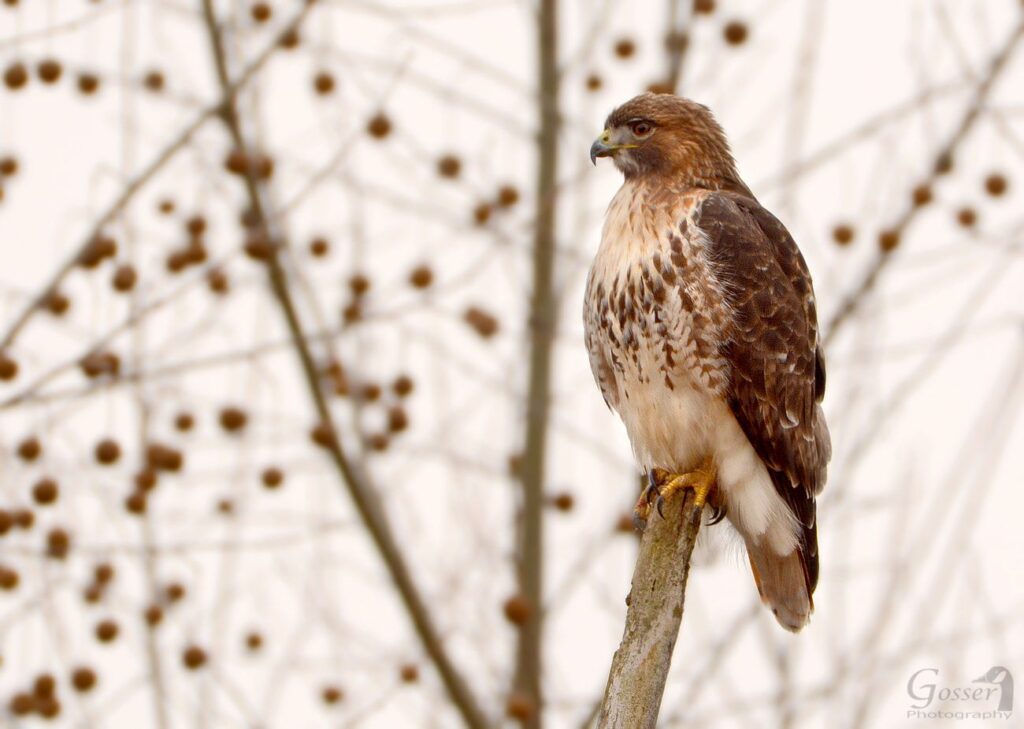
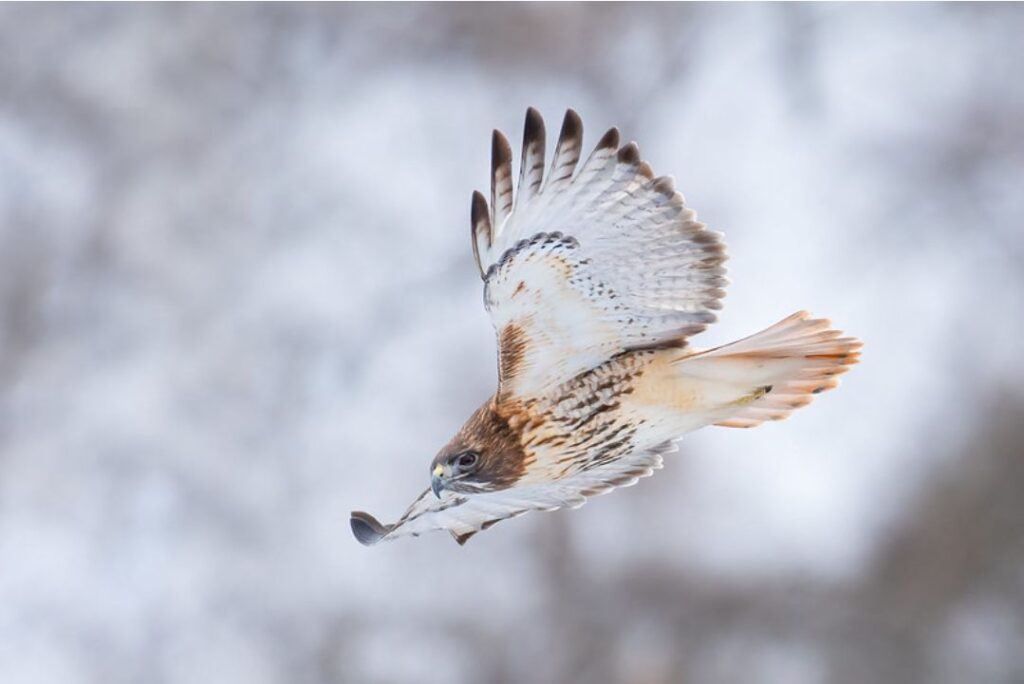
Red-tailed Hawk soaring (photo by Chuck Tague)That’s what Cliff tells me at least once a week at WQED. 

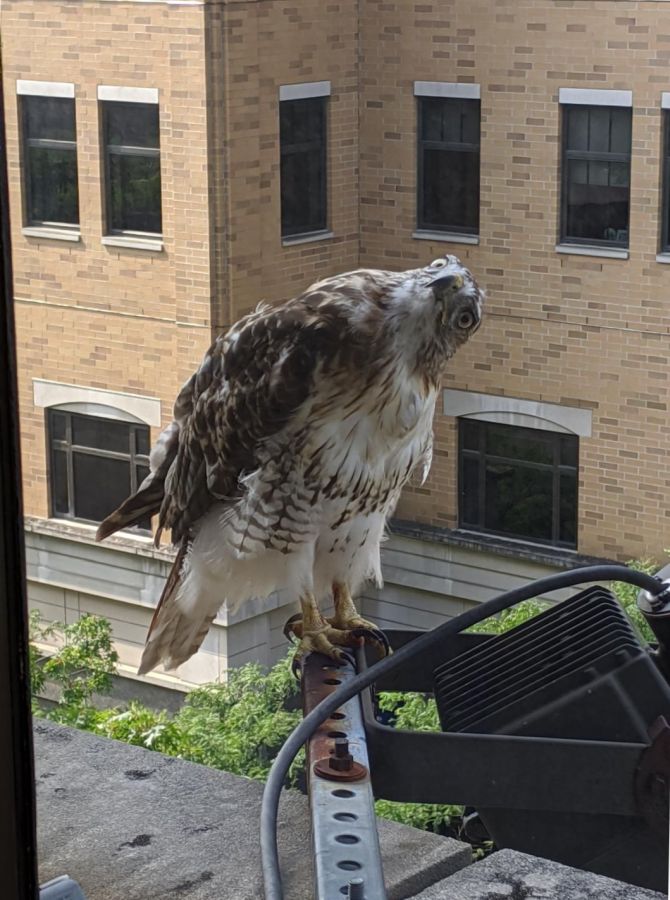
Many people at work know that I’m interested in birds and the two most interesting birds at work are the pair of red-tailed hawks who’ve claimed the territory around WQED in the Oakland section of Pittsburgh.  I am sure to hear when they’re nearby.

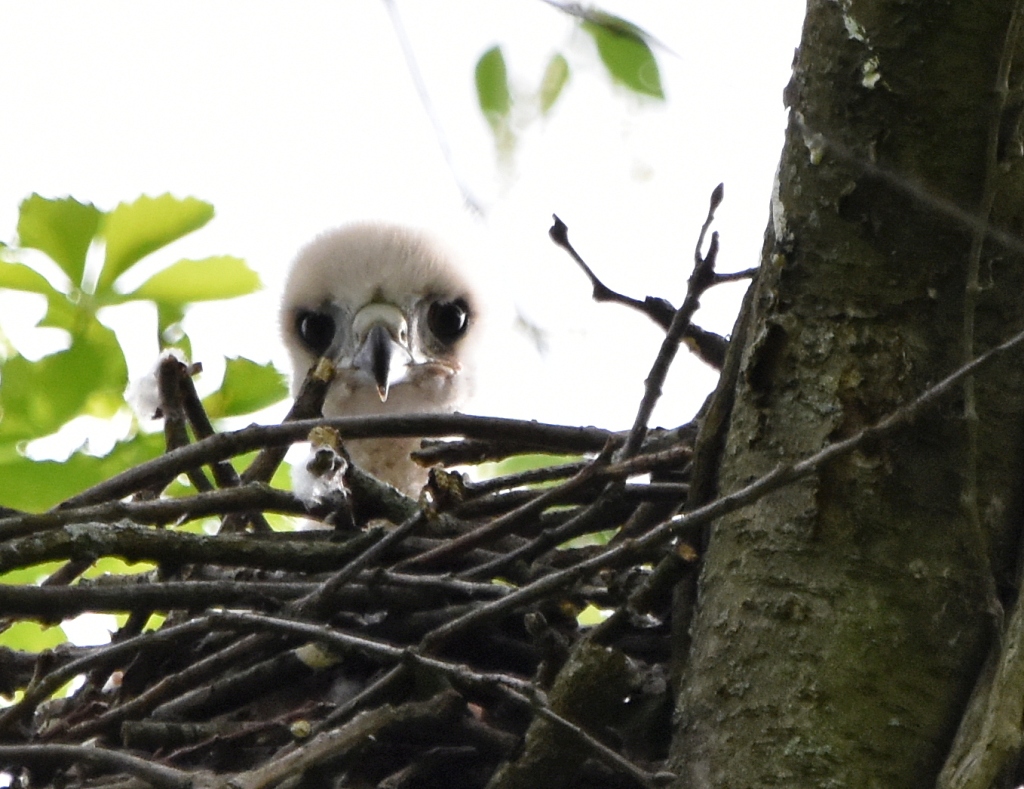
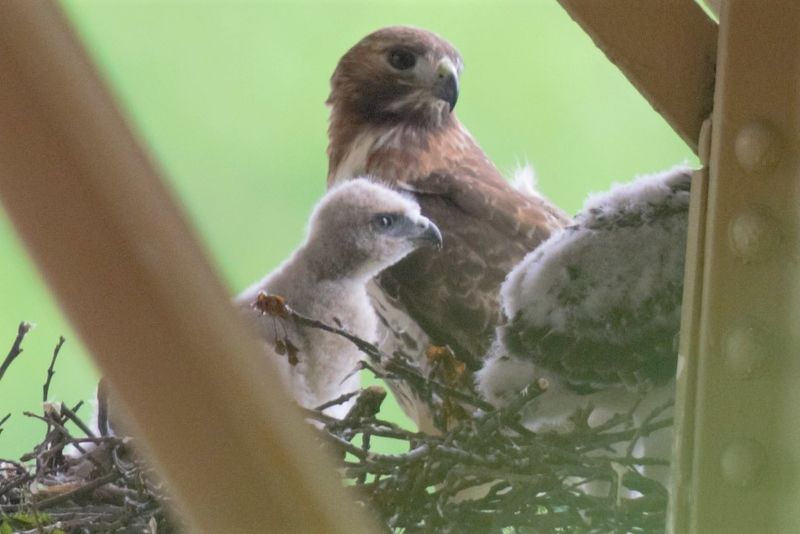
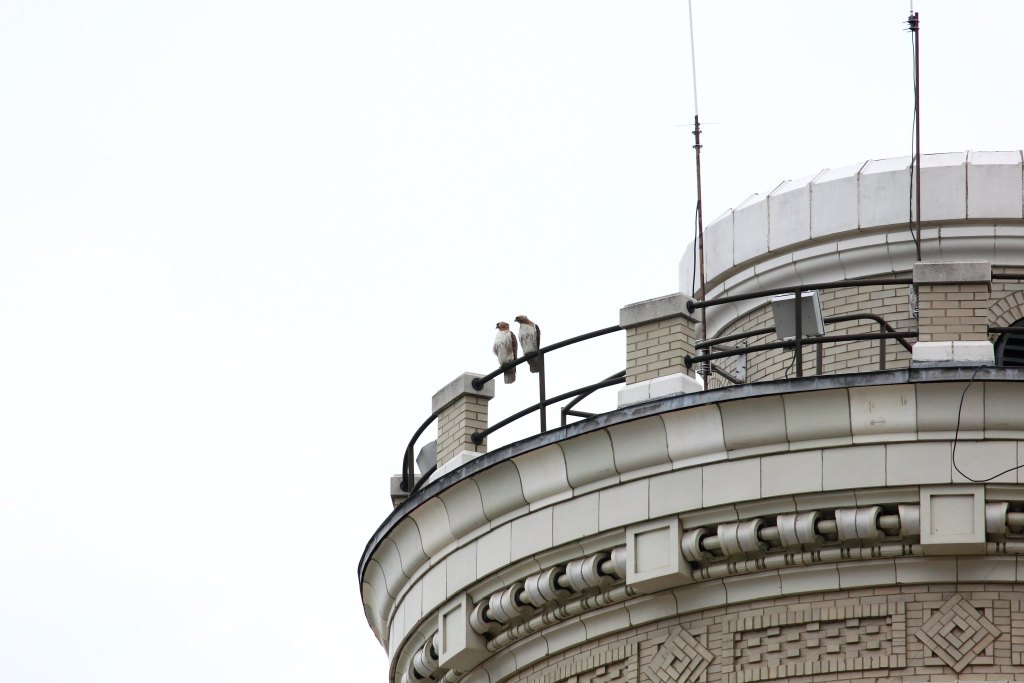
This pair has made themselves famous by hunting for rodents behind the dumpster (good job!), for soaring together over Central Catholic High School and mating on the parapets, for eating a rabbit - outside the third floor windows - in the tree in front of our building, and for ignoring their loudly whining youngsters who are too old to be begging from mom and dad.

And they look just plain huge when perched.  

The red-tails have generated a lot of questions over the years.  Some of the answers are…   

  • They live in the city because there’s enough to eat and they aren’t harassed. 
  • They eat rabbits, chipmunks, squirrels, mice, rats and pigeons (if they can catch one on the ground) among other things.  I am especially glad they eat rats.
  • They won’t try to eat something that will put up a dangerous fight because they can’t afford to get hurt trying to catch dinner.  They are very, very unlikely to attack a small dog or cat.
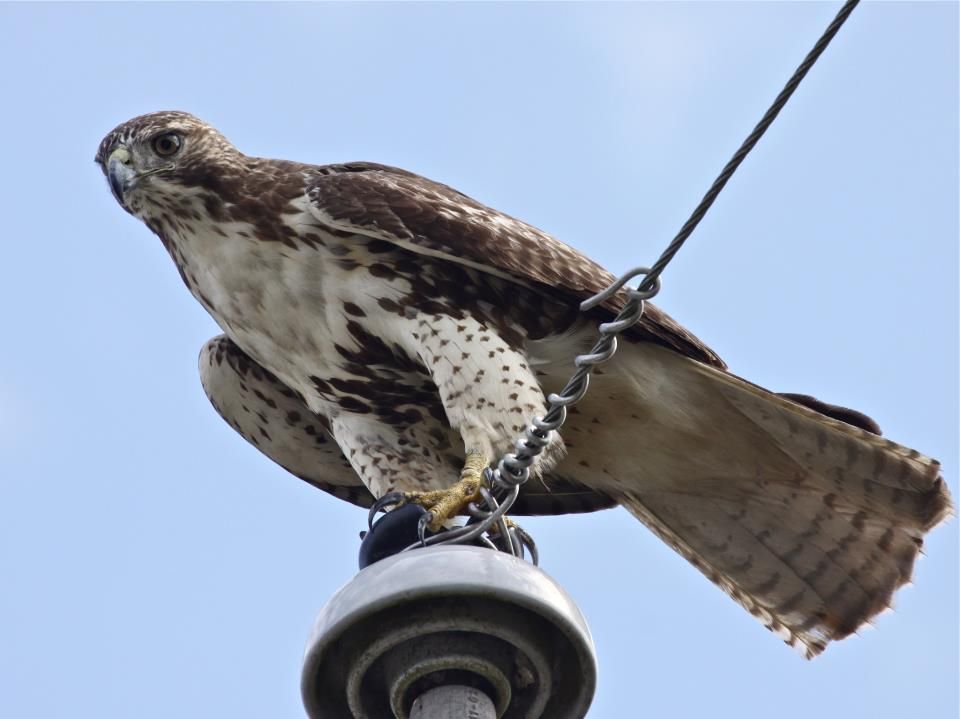
  • Because they pounce on their prey from above, red-tails like to perch on tall dead trees.  To a red-tail, light posts on the Parkway look like tall dead trees.
  • Yes, they have a nest somewhere near here but only in spring.  Their nest is the babies’ bed.  The adults don’t live in the nest themselves. 
  • It is actually courtship when the male brings a dead chipmunk to his mate.
  • They are ignoring that loud, whining red-tailed hawk because he’s their kid.  He has to learn to hunt and if they feed him he will never learn.  He thinks begging will break their resolve. 
  • If two red-tails are perched next to each other, they are either mates or parent and child.  Red-tails don’t make friends with other red-tails as a general rule.

Today the red-tails were busy, busy.  Hunting.  A cold front is coming tonight and they had to eat today because they don’t know how long the bad weather will last.  Better face the storm with a full stomach.   In winter it’s a matter of life and death.

5 responses so far

« Prev

Bird Stories from OnQ