Apr
03
2013

Imagine seeing this outside your window!
On June 12, 2009 the International Space Station was flying over the Kuril Island chain in the northwestern Pacific when they witnessed the eruption of Sarychev peak, an active volcano on Russia’s Matua Island.
Because the eruption had just begun, brown ash and steam was still rising in a mushroom cloud that had punched a hole in the cloud cover above it. Meanwhile, dark brown ash rolled low to the ground, probably a pyroclastic flow of hot gas and rock up to 1,850oF (1000oC) and traveling at 450 mph!
The ash had just begun to spread out in the sky (light brown at top left and right). Soon commercial air traffic was diverted to avoid engine failure from this abrasive particulate in the upper atmosphere.
The astronauts were lucky to see this eruption as it began.
Nature makes an impressive mushroom cloud.
(photo from the International Space Station, NASA)
Mar
26
2013

This beautiful small goose is heading toward extinction.
The red-breasted goose (Branta ruficollis) breeds in arctic Russia and winters at only five sites along the Black Sea in Bulgaria, Romania and Ukraine. Though protected by law it faces many challenges, from land use changes to illegal hunting.
It was already listed as threatened when suddenly, 10 years ago, half the population simply disappeared. 50,000 birds. Gone. No one knows what happened. Did they forsake the Black Sea for a new winter home? Did something go radically wrong where they breed?
Now listed as endangered on the IUCN Red List, the red-breasted goose population continues to decline. Another such disappearance would mean the end so researchers from Britain’s Wildfowl & Wetlands Trust and the Bulgarian Society for the Protection of Birds have fitted 11 red-breasted geese with tags to track their movements.
Nine geese received GPS data packs that will log their winter locations at the Black Sea. Two received satellite tags that will track their migration from Bulgaria to the breeding grounds in Siberia.
Perhaps the data will reveal the mystery.
Read more about the study here.
(photo from Wikimedia Commons. Click on the image to see the original)
Mar
13
2013

We’ve all heard the story that storks bring babies. It was Grandma’s easy to answer to “Where do babies come from?”
The legend began where white storks nest in northern Europe, often in close proximity to humans. Their care for their young made them symbols of parental devotion. Slavic folklore held that storks brought unborn souls from paradise to earth in the spring and summer. That’s when the storks returned to northern Europe from their long migration to Africa.

But in the past 30 years many of them have stopped migrating. Large numbers are hanging out in Spain and Portugal. In 1995 there were 1,108 winter storks in Portugal. By 2008 there were 10,000. The number keeps growing and some of them never leave. Many stay year-round to raise their families.
The obvious attraction is Portugal’s landfills. Though white storks are carnivores, they love hanging out at the dump for an easy meal. Do the landfill storks merely visit for the winter? Do they move to other places in Portugal for the breeding season? And where would that be?
Researchers from the University of East Anglia have begun a one year study of stork migration. They’ve captured and tagged 15 adult white storks with satellite monitors to transmit each stork’s location and activity five times per day. The tags are smart enough to record whether the stork’s head is down in a feeding position.
The study is coming at a good time for the birds. In the 20th century white storks declined so badly that they had to be reintroduced in some countries. Now they’ve made a comeback at the dumps but Portugal is slowly replacing its open landfills with covered facilities to process waste food. Where will the storks go?
The study is important for Grandma, too. If the storks don’t leave Portugal, they won’t be bringing babies to Northern Europe anymore. Uh oh!
Read more about the stork study in this Science Daily article.
(image of a stork carrying baby from Shutterstock. Photo of a white stork by Andreas Trepte, www.photo-natur.de. Click on the photo to see the original on Wikimedia Commons)
Mar
10
2013

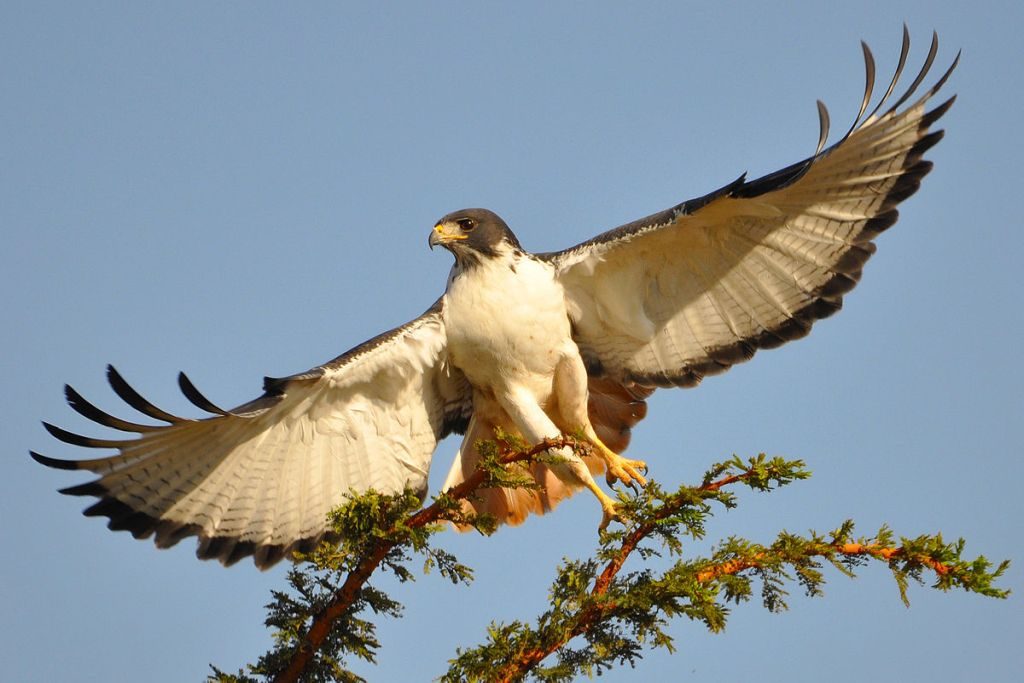
Here’s a big hawk that I’d love to see some day. He’s a native of the western U.S. and fond of open country.
The ferruginous hawk comes in two color schemes: a dark version (click here to see) and this beautiful light color. All of them have rust-colored wings, back, and legs that give them their ferruginous name.
When they fly their shape is similar to red-tailed hawks but these birds are much larger. Their scientific name, Buteo regalis, means “regal buteo.”
Here he is from below. Look how his tail appears to be outlined in rust. That’s actually his legs.

If I want to see this bird, I’ll have to travel west again. Steve Valasek took these pictures in New Mexico.
(photos by Steve Valasek)
Mar
06
2013

Here are two Life Birds who were hardest and easiest to see when I was in San Diego.
The surfbird, on the left, was hard! He walks on seaside rocks and lets the surf break over him. The best place to find him is on the breakwater at Mission Bay’s entrance but the day we were there the bird was way down the jetty out of sight.
A few intrepid birders walked the jetty and pointed to the bird. For this particular Life Bird I was willing to walk the jetty but I didn’t count on how hard it would be. Without my walking stick I literally crawled over the uneven rocks. Not fun! I turned back without seeing the bird and waited onshore for him to pop into someone’s scope. Fortunately he appeared at a distance. Even through the scope I felt like I earned him.
The black turnstone was easy. He also lives on rocky shores but there were many more black turnstones and they were easy to see at La Jolla while walking the beautiful seaside path.
For some reason the surfbird feels more valuable.
(photo by Dick Daniels on Wikimedia Commons. Click on the image to see the original.)
Mar
03
2013

When I registered at the San Diego Bird Festival I asked to exchange one of my pre-scheduled bird tours because I was desperate to see this Life Bird, the white-tailed kite.
The trip I wanted was full but David Kimball introduced me to local bird leader Susan Breisch who knows the county well.
Susan was so helpful! She asked to see both my target bird list and my tour schedule, told me the likelihood of seeing my target birds, and suggested places to find them during my unscheduled time.
As usual some species are a challenge, others are surprisingly easy. For instance…
I would love to see a mountain bluebird but they travel in flocks that move around a lot. Their reported location one day may be different the next. This behavior reminds me of the white-winged crossbills visiting Pittsburgh this winter whom I’ve been unable to find. Hmmmm!
The ferruginous hawk is on my wish list, too, but it only visits the grasslands in winter and even then it’s not plentiful. Again, you have to be at the right place at the right time and you have to get lucky.
However, white-tailed kites are easy! They hang out in river valleys and can be found year-round in Rose Canyon where they nest. In fact, I might even see one on a walk from my hotel.
Oh boy!
p.s. The San Diego Bird Festival is great! Excellent tours, helpful friendly people, unbeatable weather. I highly recommend it!
(photo by William Parker)
Mar
02
2013

To my untrained East Coast eyes this bird looked like an odd double-crested cormorant, but it’s actually a Brandt’s cormorant, a common bird of the Pacific coast.
This weekend I’m in the bottom left corner of the United States at the San Diego Bird Festival held in one of the two “Birdiest Counties” in the continental U.S. (Los Angeles County is the other.)
According to San Diego Audubon, “the County boasts the largest bird list of any similarly sized area in the United States at almost 500 species.” With this honor also comes the distinction of having “the greatest number of endangered, threatened, and sensitive species than any comparable land area in the continental United States.”
San Diego is able to set these records because it has at least 11 habitat zones including coastal scrub, desert, mountains, salt marshes, wetlands and ocean, far outranking my land-locked home in Pittsburgh.
In my first hour of birding — just walking near the hotel — I saw long-billed curlew’s, marbled godwits, an orange-crowned warbler (singing!), Anna’s hummingbirds, black-crowned night-herons, and Heerman’s gulls. By now I’ve seen 94 species including this life bird, Brandt’s cormorant.
When you compare San Diego’s checklist of 501 birds to Allegheny County’s 316 species (including vagrants), I know I’ll find a “lifer” around every corner.
(photo from Wikimedia Commons. Click on the image to see the original.
Quotes are from the San Diego Audubon Society website.)
Feb
24
2013

Speaking of owls, as I did on Thursday, here’s a portrait of one of the world’s largest owls, the Eurasian eagle-owl.
Bigger than a snowy owl he is slightly outweighed by the endangered Blakiston’s fish-owl of Asia and has a slightly shorter wing span than the great gray owl.
Despite these technicalities he is virtually the world’s largest owl. With females weighing up to 9.3 pounds they are bigger than our great horned owl (up to 5.7 pounds), the eastern screech-owl (weighing up to 1/2 pound), and the northern saw-whet owl (weighing only as much as 1/3 pound). The two smaller owls are dinner for the great horned owl. Imagine what a Eurasian eagle-owl eats!
To get an idea of owl sizes, visit the National Aviary to see the eagle-owl and others up close.
(photo from Wikimedia Commons. Click on the image to see the original)
Feb
23
2013

Except for the beak this bird looks like a scruffy character from a Dickens novel.
The Marabou stork is not improved by close approach. I’ve seen one at a zoo: five feet tall and surprisingly ugly with rusty feathers, skinny legs, fuzzy bare head, and a dirty-looking bill.
His bill doesn’t just look dirty. It is dirty because he eats carrion and garbage.
In Africa this stork follows vultures to dead animals and stands hunched waiting for the vultures to rip open the carcass and make an opening so the stork can dine.
He’s aptly named the Undertaker Bird.
(photo by Muhammad Mahdi Karim via Wikipedia. Click on the image to see the original)
Feb
17
2013

Something strange happened in the North Atlantic this fall that prompted thousands of seabirds to migrate much further south than normal.
This juvenile black-legged kittiwake is one of them, photographed by Dan Irizarry on February 6 in Manatee County, Florida.
Hatched somewhere in Canada or Greenland, this bird normally would have spent the winter offshore between Newfoundland and North Carolina. Instead he’s foraging at Tampa Bay.
His bold black M pattern shouts out that he’s a kittiwake.
Not only is he rare, but he really stands out.
(photo by Dan Irizarry)