Dear Readers,
A question has been puzzling me for a long time and the answers I’ve found on the Internet are unsatisfactory, so I’m asking you.
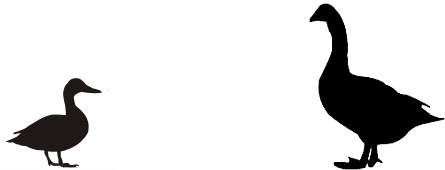
What is the difference between a duck and a goose?
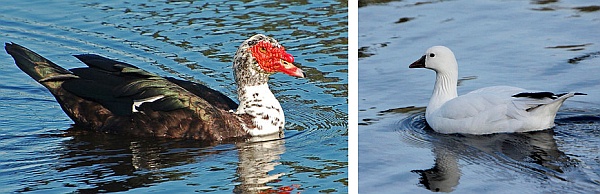
Is a duck smaller than a goose? Not always. The Muscovy duck is much larger than a Ross’s goose.
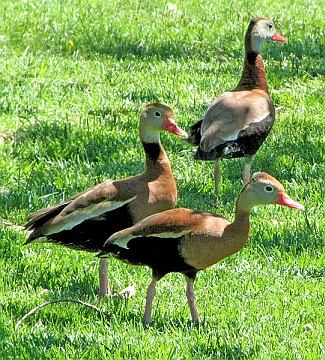
Does a goose have a longer neck or legs? Not always. Consider these black-bellied whistling ducks.
When we see a duck or a goose, intuitively we are able to say, “That’s a duck” or “That’s a goose.”
But how do we know the difference?
Please let me know by posting a comment.
(Credits: mallard silhouette by Vlado on Freedigitalphotos.net, goose silhouette from Shutterstock, Muscovy duck by B.Walker on Wikimedia Commons, Ross’s goose by Alan Vernon on Wikimedia Commons, Black-bellied whistling ducks by Sultry on Wikimedia Commons)
UPDATE: Chuck Tague wrote in the comments: “The difference is social structure. Ducks are seasonally monogamous and form a bond that lasts only through courtship and the initiation of incubation. The male takes no role in raising the young. Geese and swans form strong bonds that last for many seasons (or life) and maintain family units through migration. Whistling ducks are closer to geese than ducks.”
See the other comments, too! Lots of great information.
The difference is social structure. Ducks are seasonally monogamous and form a bond that lasts only through courtship and the initiation of incubation. The male takes no role in raising the young. Geese and swans form strong bonds that last for many seasons (or life) and maintain family units through migration. Whistling ducks are closer to geese than ducks.
Head shape? Geese tend to have a higher forehead and shorter bill. And do all Geese honk?
Hi Kate,
As a geneticist (of bacteria), I was curious about the answers to your question. I found this article on Google Scholar on the systematics of waterfowl http://link.springer.com/article/10.1007%2FBF02424410?LI=true. From their detailed introduction, waterfowl have been classified based on morphology and behavior. DNA analysis is now being used. I haven’t found any discussion of one specific feature that is used so my bet is that there are a number that are used. Several of the articles I found indicated that there is significant cross breeding and not any huge barrier to it. Hope that helps and I really enjoy reading your blog!
Nancy
I always look at the beak. If the beak and the forehead seem to be all one slope, or close to being all one slope, it’s a goose. This make the beak look thick. If there iis a change of angle between the beak and the forehead – this make the beak look thinner – it’s a duck. That’s how I tell ducks from geese. i don’t know if that’s the scientific method, but it works for me.
A goose has a smaller head and shorter bill than a duck relative to its body size. The goose has a longer neck and that protruding kind of lump around vent.
As a long-time exotic waterfowl breeder/bird watcher/science major, I became interested in the duck vs goose question while raising several types of whistling ducks. They clearly were different from other ducks. Taxonomy classification put ducks, geese, and swans all in the same family, where they were initially divided up into groups by physical traits. Typically, ducks have short necks, their tails point up while standing on land, and have short wide-set legs which cause them to waddle. Geese typically have long necks, their tails point down while standing, and have longer and closer-set legs which allow them to walk rather than waddle. Based on these criteria, whistling ducks are clearly geese and not ducks. However, whistlers also posses some traits that are not typical of ducks OR geese. Also, taxonomy classification is an evolving field, and species get reclassified every year based on new or updated information. The whistling ducks now have their own classification within the family, so the answer to the question is “neither duck nor goose nor swan”. Also complicating the taxonomy classifications is the ever expanding field of DNA research — many species of animals are likely to be reclassified as time goes on and more species have their DNA mapped. Whatever whistling ducks are, I’m a big fan — one of my all-time favorite birds — they are beautiful, elegant, and have sweet personalities as pets — and each species has a different whistle.
Lia, thank you for the great information on whistling ducks. …Neither duck nor goose… very cool.