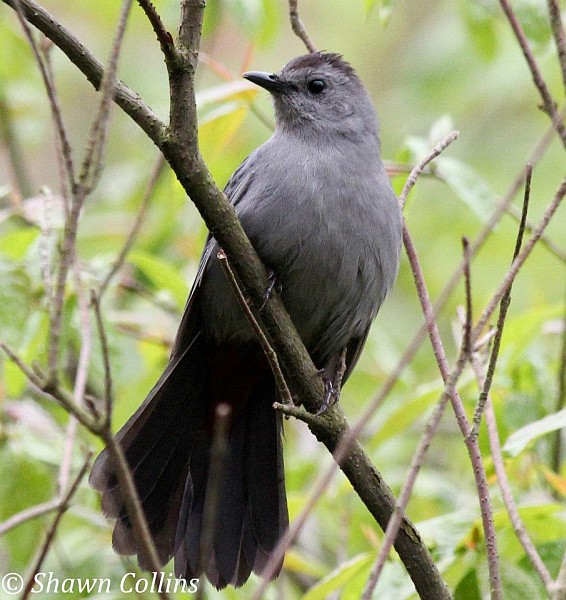
Gray catbirds are mimics who sing whistles and squeaks and fragments of other birds’ songs. Their phrases are short syllables and single notes punctuated by uneven pauses and mewing cat sounds.
Catbirds are not good singers. However…
This month in Schenley Park there’s a catbird who must have taken singing lessons. His delivery is loud and confident. His phrases are longer and identifiable as bird song. I’ve heard him give good imitations of cardinals, robins, blue jays, eastern towhees, Carolina wrens and song sparrows. Song sparrows are hard for catbirds to mimic. I am amazed.
Ornithologists would be amazed too. Cornell’s Birds of North America says, “Laboratory evidence indicates that male [gray catbird] song results mostly from improvisation and invention, not via imitation.”
In other words, catbirds are jazz singers. But this particular bird is trying out for an opera career. He is so good I thought he was a brown thrasher until he sang from an exposed perch.
Many of us are know that peregrines are great hunters but we don’t often get to see the amazing fishing skills of ospreys.
This video from Arkive.org is certain to impress you. Just look at the size of that last fish!
And, did you know…?
At the coast osprey nests are often within sight of each other. Like a loosely organized colony, they watch each other to see who returns with a fish and follow the successful hunters out to hunt the same area.
Osprey can even identify the fishes held by others and are more likely to follow a neighbor who returns with a fish that lives in schools. Schooling fish are never alone. There’s more where that came from!
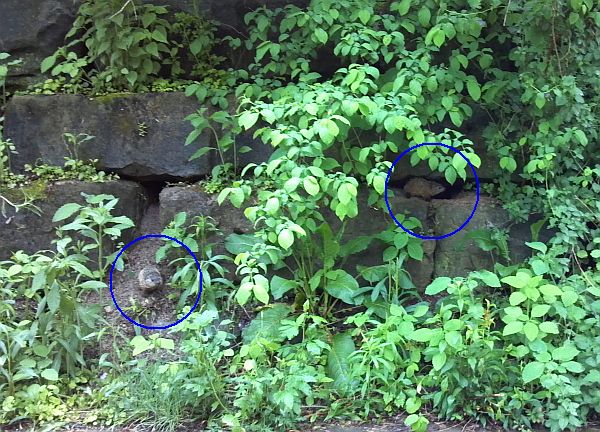
I walked home through Schenley Park on Tuesday hoping to see a lot of birds after the rain. As usual the birds were not very active in the evening but I found something so cute it made me laugh: two baby woodchucks!
I call them woodchucks because the word “groundhog” doesn’t fit something so cute. They were compact and furry, the size of large guinea pigs and very naive.
At first they were oblivious to my presence but when I paused to watch they froze. I moved again and they retreated into their den but they were so anxious to come out and play that they didn’t wait long enough for me to leave. I took their picture with my cellphone when they came out again.
Extremely cute! But they’ll have to learn to avoid predators or they’ll become breakfast for the red-tail babies.
(photo by Kate St. John)
p.s. I went back on Wednesday with a nicer camera but the woodchucks didn’t make an appearance.
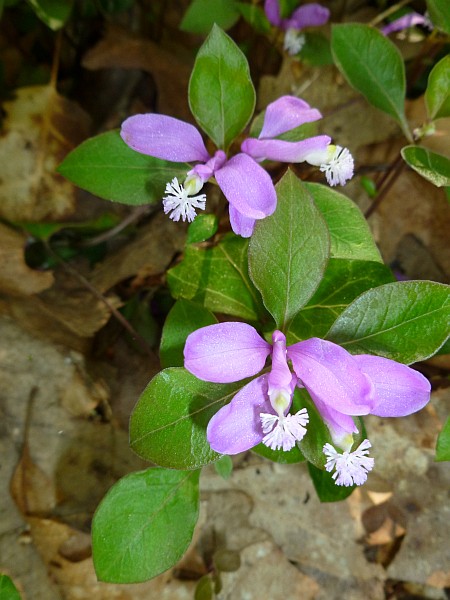
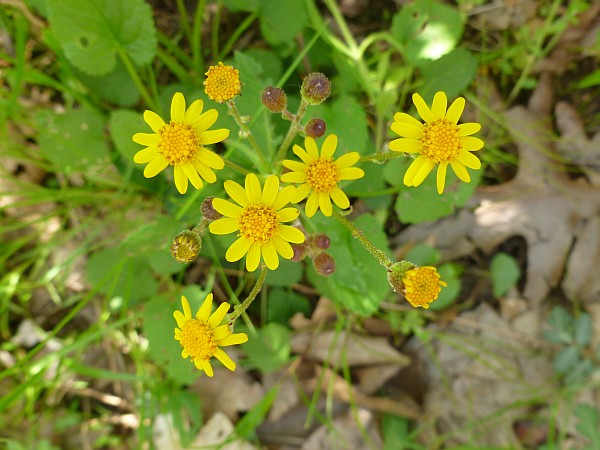
The big splash of spring wildflowers is over but there are some treats out there if you know where to look.
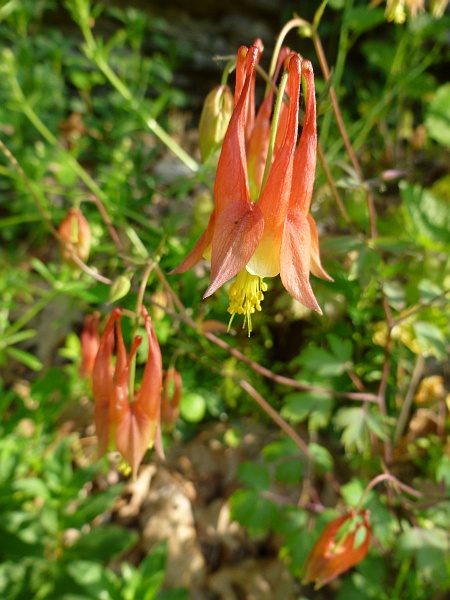
Last weekend Dianne Machesney visited the Butler-Freeport Trail and found wild columbine blooming. It’s also blooming at the Magee Marsh boardwalk in northwestern Ohio, the first time I’ve ever seen it there.
The hot weather in March put the plants ahead of schedule in Ohio just as they are here. Maybe I’ve finally seen what Magee Marsh vegetation looks like just after the warblers — and birders — are gone.
Back in the 1990′s when I attended the Rachel Carson Institute I learned that an important part of nature observation is to make a list of the species I encounter. This creates a good historical record of those present and can be compared over time to discover which species disappeared.
During birding vacations list-making morphs into a challenge. How many species did I see? Did I miss an easy one?
At the Biggest Week in American Birding peregrine falcons aren’t easy to tally because they’re random fly-bys but before I left for northwestern Ohio I did my homework. If I didn’t see a peregrine in the marshes I knew where to find one.
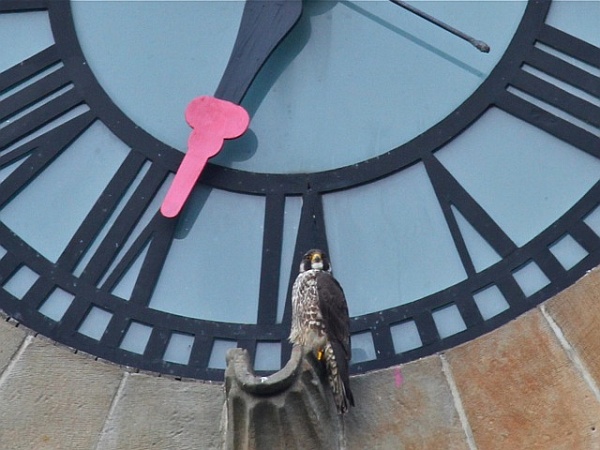
Sure enough by Sunday night I still hadn’t seen a peregrine and I was leaving Monday without birding so I stopped by the Ottawa County Courthouse in Port Clinton. I had read that a pair is present this spring. To be honest, I would have stopped there anyway because I can’t resist the opportunity to see a peregrine.
And here she is, perched below the courthouse clock. She looks like a sub-adult to me. Maybe she’ll raise a family next year in the nestbox provided on the south face.
I tipped off my friends Chuck & Joan Tague and Margie Kern so they could tally a peregrine too. Thanks to Chuck for the photo.
Since I witnessed an aerial dog fight on Wednesday and saw two wing feathers askew on one of the Pitt peregrines I wondered whose wing was hit and if the intruder was still present.
Thursday and Friday Peter Bell and John English stopped by the area and reported on peregrine activity — or lack of it. Saturday afternoon Donna Memon and Mary DeVaughn watched the Cathedral pair from Schenley Plaza.
They report that E2 has the odd wing feather but it doesn’t seem to be hampering him. No intruder was present, so maybe that third peregrine is gone forever.
As @PittPeregrines says on Twitter, “Talons crossed!”
UPDATE, 7 May 2012, 7:00am:
On Sunday John English and Anne Marie Bosnyak watched at the Cathedral of Learning. The weather was good and they saw both adults flying. Notice the blip on the antenna. That’s Dorothy!
John wrote, “Some nice aerial maneuvers. No prey drops or intruders. A great day to be a falcon!”