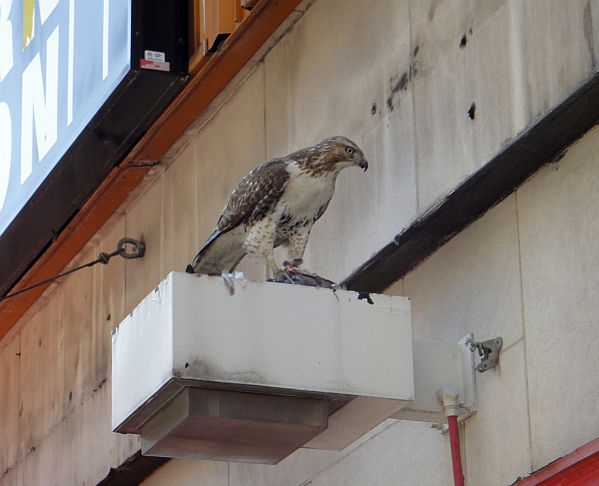
Last Thursday at lunchtime a bird of prey caused quite a stir in downtown Pittsburgh when it perched on a light fixture and very publicly ate a pigeon.
Katie Cunningham sent me photographs of the bird and asked, “Is this a falcon or a hawk?” She guessed it was a hawk and she was right (it’s an immature red-tailed hawk). How could she be sure it’s not a peregrine?
Telling the difference between a falcon and a hawk is a common identification problem, so common that people often ask me for help.
Today I’ll tell you how to identify the birds yourself.
Right off the bat I’m going to narrow the scope. In western Pennsylvania you can see up to nine hawk and three falcon species depending on time of year and habitat. To make this manageable I’ll address the most common identification question faced by city folks: Is this bird a peregrine falcon or a red-tailed hawk?
First, ask yourself several key questions.
Is it a bird of prey? Birds of prey eat meat so they have hooked beaks (see the tip of the beak) and talons (big claws). If the bird does not have these features it’s neither a falcon nor a hawk and you can stop right there.
What time of year is it? Peregrines and red-tails live in western Pennsylvania year round so the time of year doesn’t eliminate either bird due to migration. However identification is more challenging in June and early July when the juvenile peregrines are flying around town. It’s easiest at any other time of year.
Where is the bird? In what habitat? Is it in the city on a building? (Could be either a peregrine or a red-tail) In the suburbs? (likely a red-tailed hawk) On a bridge? (either bird) On a light pole over the highway? (likely a red-tail) In a tree? (likely a red-tail) Standing on your picnic table? (likely a red-tail) Standing on the ground? (likely a red-tail) …But in June a juvenile peregrine might be found in some of the “red-tail” places.
Is the bird in the human zone? Is the bird perched close to humans and doesn’t even care about them? If so, it’s probably a red-tailed hawk …but is it June?
What does it look like?
Red-tailed hawks are bigger than crows, white on their chests and brown on their heads, faces, wings and backs. Their faces are brown all the way to their shoulders (no malar stripe). They have brown hash marks on their bellies called a “belly band” with white above and below. Only adult red-tailed hawks have rusty red tails. Juveniles have brown tails with horizontal stripes.
Peregrine falcons are about the size of crows, smaller than red-tailed hawks. Adults are charcoal gray and white. Their backs, wings and heads are charcoal gray, their chests are white and their bellies and legs are heavily striped (horizontally) with dark gray. Their cheeks are white behind dark gray sideburns called malar stripes.
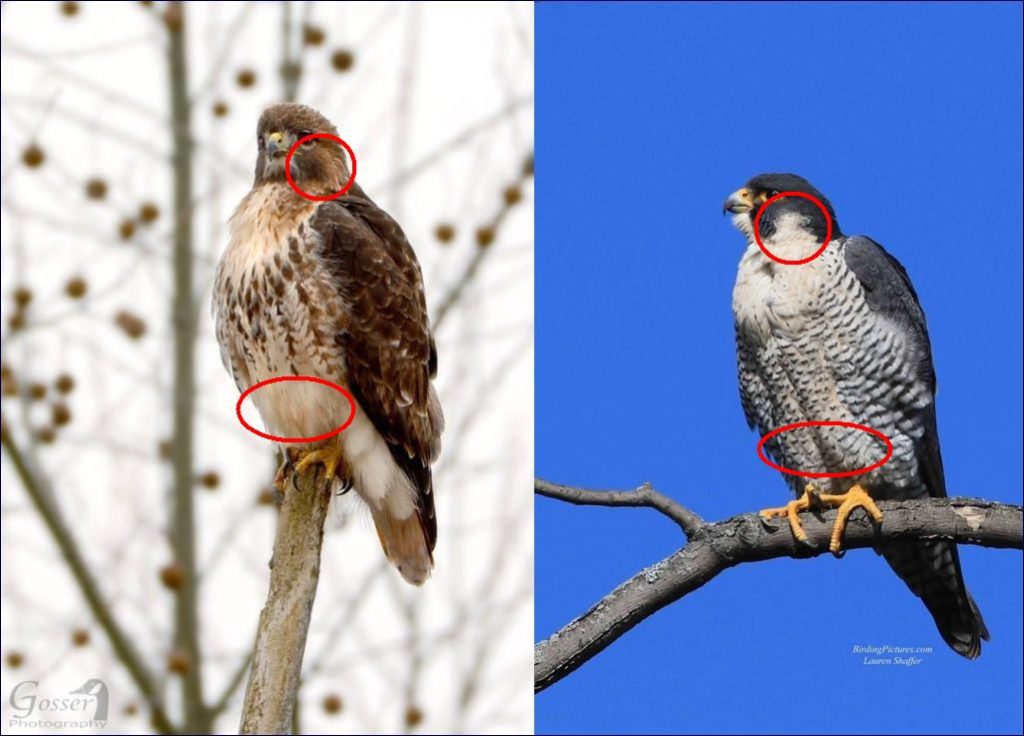
Peregrines have malar stripes. Red-tailed hawks do not.
Here are several photo comparisons of the two: red-tailed hawk on left, peregrine on right.
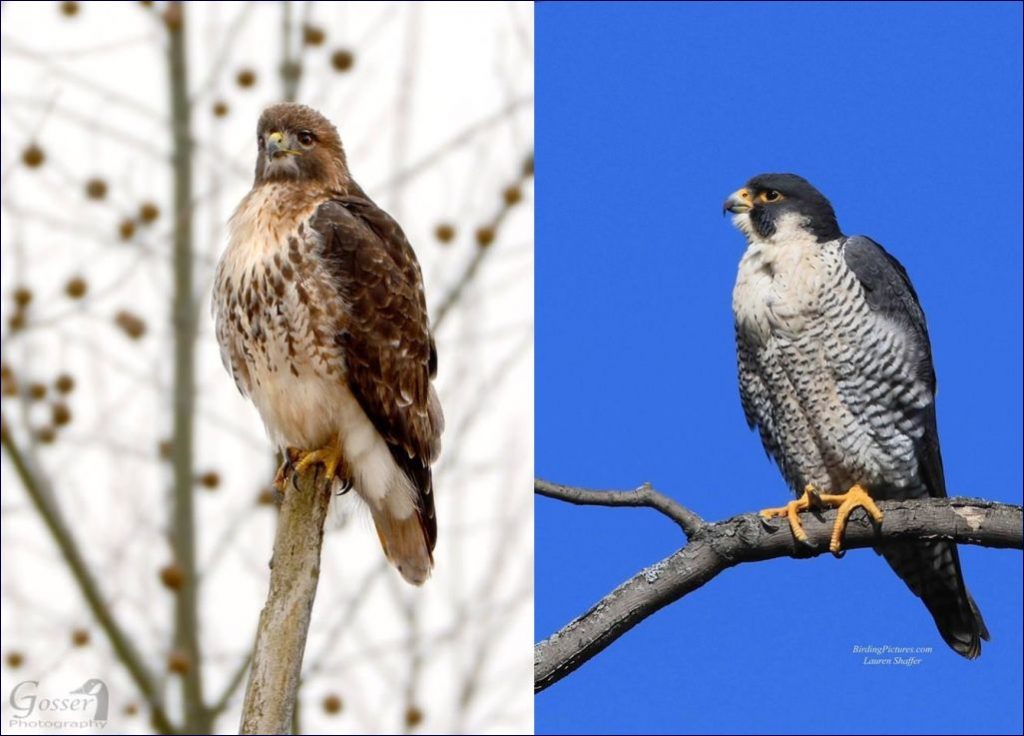
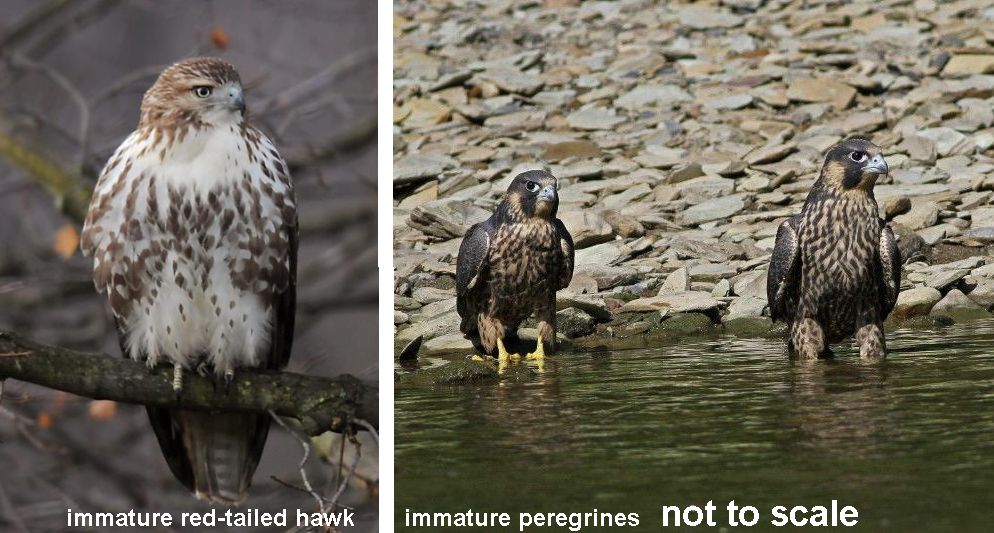
Let’s look at two key features. Red-tailed hawks have brown cheeks. Peregrines have white cheeks behind the malar stripes. Red-tailed hawks have a brown belly band with white below. Peregrines are striped all the way down.
What’s this thing about June? Immature birds!
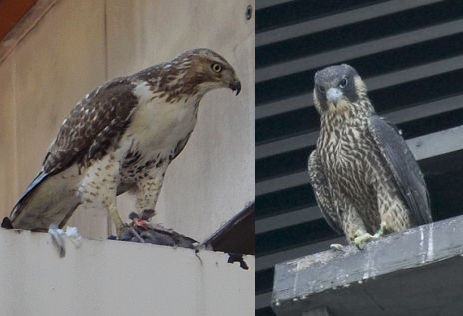
In June in Pittsburgh juvenile peregrines leave the nest and learn to fly. Immature peregrines are brown and cream-colored instead of gray and white like the adults. They have no white on their chests and the stripes on their bellies are vertical (immature) instead of horizontal (on adults).
Newly fledged juvenile peregrines may do almost anything, including perch in the human zone. Because they’re brown you can’t use color cues but the two key clues still apply: Red-tails have brown cheeks versus peregrines’ light cheeks. Red-tails have white lower bellies versus peregrines’ striped all the way down.
Here are photo comparisons of immature red-tailed hawks (left) and immature peregrines (right). Notice their cheeks and bellies.
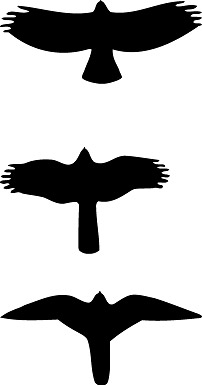
In flight, does the bird have “fingers”?
Hawks (and eagles and vultures) have “fingers” on their wingtips. Falcons have pointy wings.
What is the likelihood of seeing either bird?
Red-tailed hawks are the most common hawk in North America. Peregrines are rare. If you say it’s a red-tailed hawk, you’re usually right. You’re unlikely to see a peregrine near ground level in Pittsburgh. That’s why we get excited about peregrines.
(Red-tailed hawk photos by Katie Cunningham and Steve Gosser, Peregrine photos by Kim Steininger and Chad+Chris Saladin. Cooper’s hawk photos below by Cris Hamilton and Marcy Cunkelman)
Another hawk that resembles a peregrine: the Cooper’s hawk
Many readers have asked for help identifying a brown-and-beige-colored bird of prey in their backyards. It has vertical chest stripes like a juvenile peregrine. If you have a similar bird in your backyard confirm that it …
- does not have a pronounced malar stripe on its face
- is hunting for birds
- moves so fast that it seems high strung
- jumps on the birds in the bushes and chases them through the trees
- has “fingers” on its wing tips (Accipiter silhouette above)
If so, it’s a Coopers hawk, a bird-eating bird of prey (Accipiters) that specializes in woodland habitat and hunt in tight spaces.
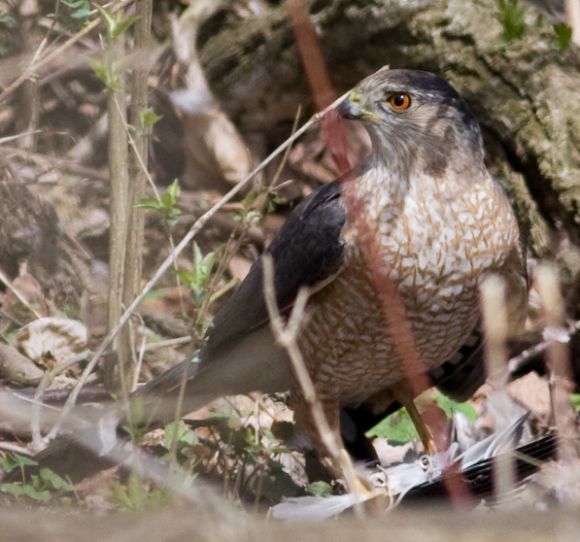
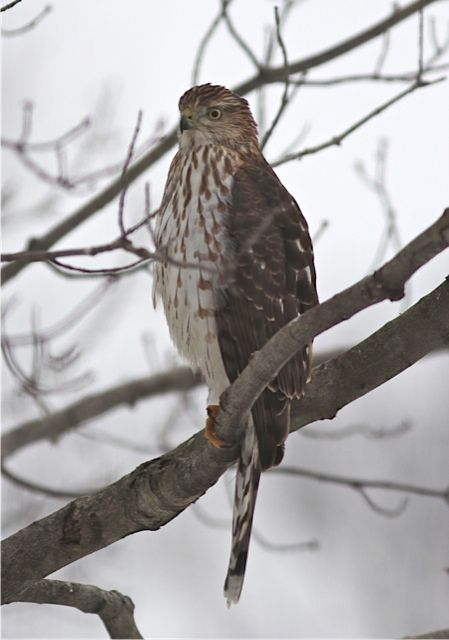
Immature Cooper’s hawks show up during winter in Pittsburgh. They’re the same color as immature peregrines but have much longer tails.
Click here for a good comparison of peregrine vs. Coopers hawk vs. merlin from the OFNC Falcon Watch in Canada. Note: Merlins occur in Canada but are unusual in Pennsylvania and south of here.
Where was this at in town? Did it cause a stir for Dori and Louie?
It’s in rio vista California
Wonderful information, Kate! Thanks for all the cues to look for and the side by side photos. I can hardly wait for the peregrine eggs to hatch. 🙂
The Pitt News has certainly had it’s share of troubles…even advertising an opening for a staff ornithologist in the April Fool’s issue. Then they got a shot of a red-tail at the union recently. That was all but two columns of the cover yesterday and across the top in all caps and bold – “THIS IS NOT A FALCON”
They got the ID right finally!
This immature red-tail was too close to the ground to upset Dori & Louie. It was about 10 feet up, they’re 400 feet up. …Worlds apart!
My daughter sent me a text yesterday saying that she had just watched a small brown hawk with a speckled breast kill a rodent and eat it in the little park in the center of downtown Erie. She asked me what I thought it was. I’m not really good at identifying birds, even when I can see them (flowers are so much easier to identify! they just sit there and let you look at them). But we have always had a lot of red tails around our house, and I think she would be able to identify a red tail. So I guessed it might be a broad wing hawk, but of course without being able to see it, there is not much of a chance of knowing what it was. I did manage to see a towhee when I was in Boyce Mayview park last Thursday, and I thought I saw an owl flying through the trees, but he was gone before I could get the binoculars on him (but I know owls usually nest in that part of the park). I just can’t find the birds with the binoculars fast enough to get a good look at them, and I have a hard time learning the songs. But I still try.
I saw a large bird today outside my house in Williamsport PA. Gray in color with gray spots on chest larger than a pigeon trying to figure out if it was a hawk or a falcon can any one tell me just from this description
Guy Allen, “gray with gray spots on the chest” doesn’t ring a bell for a PA hawk. Here are some questions to help narrow it down.
Habitat: What kind of habitat is your house located in? Are you on a farm? In a wooded suburb/town with other houses nearby? On the edge of lots of open land with few trees? In the woods?
Stance: When perched, was it upright with its tail straight down or did it perch more horizontally (leaned forward a little)?
Size: Was the bird lots bigger than a pigeon? Was it as big as other hawks you’ve seen or bigger … or smaller?
Size: Was it bulky looking or was it slim?
Kate, thanks very much for the detailed information. Am betting it was a red tail my friend saw.
Great info, Kate!
I love all of the details! That makes it much easier to i.d. in a hurry!
Thanks for another great blog, Kate! I’m amazed at the diversity of wildlife in the city.
I’ve taken more confusing while needed to ID – is it RTH or PF:
http://i559.photobucket.com/albums/ss35/gbmax/4-6-2010/P4067869_1.jpg
http://i559.photobucket.com/albums/ss35/gbmax/4-6-2010/P4067854_1.jpg
http://i559.photobucket.com/albums/ss35/gbmax/4-6-2010/P4067863_1.jpg
http://i559.photobucket.com/albums/ss35/gbmax/4-6-2010/P4067865_1.jpg
this one had little kinda “sideburns” that peregrines have…
Redtail. Definitely. At home I know mine by the cry when they fly. Great pictures, btw. Thanks
Gintaras, interesting face pattern… but not the classic malar stripe. I think of the “sideburns” as giving peregrines a helmeted appearance, like those old Roman helmets that protected the cheeks but exposed the ears.
Here’s a Roman helmet example: http://i.ehow.com/images/a04/os/8d/roman-armor-facts-800×800.jpg
Here’s a peregrine example: http://www.birdsoutsidemywindow.org/2011/01/15/webcams-and-a-warning/
Hi, Kate,
Is the website still down? I haven’t been able to get any of the cams since the maintenance takedown yesterday.
Also – check out our california peregrines: type in santa cruz with peregrines, and the links to the cameras will come up (San Jose and San Francisco). Both nests have hatched now, and are very active.
How about a Broad-winged Hawk??? This matches the facial pattern and that little yellow patch above the beak.
http://www.pinebarrensanimals.com/web_images/pix1/broadwingedhawk1.jpg
Yes it could be an immature broad-winged hawk. The smaller beak & “sweet” face reminded me of a red-shouldered hawk… which is a lot like a broad-winged. Well, this just goes to show that immature hawks can be difficult to identify!
I did see a peregrine falcon up close one time, and one time only.
One day in the fall of 2009, I was going to work in Robinson Twp. (off of Campbell’s Run Road). I stopped the car and got a very up-close look; it was a peregrine falcon (they are such a distinct raptor.)
I almost went into shock; it looked like it just ate a meal as it was walking slowly up the hill, then it took off eastbound towards the city.
In that specific area, there are lots of red-tail hawks, so I was quite surprised to see it there.
A rare treat indeed, and one I will never forget!!!!
Maybe this could be one of the two juvenile Red-tailed Hawks I saw in Schenley Park in July. Those two hawks were apparently not afraid of people, as they let me get about three feet away!
Hi Kate.
What a timely discussion of raptor identification, considering that many are in spring migration now. You might be interested to know that we had a Northern Goshawk at Eagle Creek Park in Indianapolis in late March and early April. It was quite a thrill for many local birders, including me. I was lucky enough to see it and get a photo. Here is the link to a photo taken April 2, if you care to take a look at it:
http://juliebrown.aminus3.com/image/2011-04-22.html
Thanks for the info!
There was a hawk in our factory and I was curious to know what it actually was for certain. The bird flew out one of the windows I had opened, but it was magnificent to watch from only a few feet away.
live in louisiana…….had a bird (hawk) bathing in my birdbath….took pics….is there an email address that i can send the pics for possible identification? thanks, charlene
I’ll get in touch with you… or you can post a Flickr link here.
Oh, what a complete thrill today!! My friend and I were driving in Squirrel Hill on Wilkins Ave. this afternoon. (Pittsburgh) I was the driver. This area is totally populated and residential with a good bit of traffic. Driving along, I spotted a large blur of muted colors and movement on the sidewalk to my right a good ten feet away. (I have this innate radar for nature’s creatures) As I neared, I honed in on it, and cried to my friend, Oh, Wow, I think it’s a I red-tailed hawk! I had to see more, so I pulled up to the curb parallel to the bird on the sidewalk only about a foot and a half away, and though I was blocking traffic, I could not move! I was mesmerized! The hawk had bagged a young squirrel which he held captive in his left foot talons; the poor little prey was writhing away, trying to break free, but the bird held him fast. We watched; the hawk knew we were there parked next to him, but we were silent. We observed him (or her) in profile mostly, as that is how the bird was positioned with its prey. We watched and waited, curious as to why the hawk lingered with its wiggling creature so long without further attempt to kill or eat it. The bird did cast his eyes at the car a few times, but seemed undisturbed by us; rather, there was wariness, which was apparent by his shifting his weight back and forth, turning his feet a bit, and moving his head oh so slightly. I got the sense that he was much more concerned about other predators who might steal his food or threaten him. I observed that the hawk was in decision mode…..he had the squirrel, he knew, but he wasn’t comfortable with it on the pavement. What to do? After almost 10 minutes, a long time, he moved with the squirrel a few inches forward, then stopped and contemplated further, and finally took off in flight, heading for foliage so he could enjoy the feast in private.
I was awe-struck at his beauty; your distinction, showing comparative pictures and a very good description of the differences helped me enormously. Was this, in fact, a red-tail? I got confused because I did not see red color on the tail, but then again, the tail was not spread, nor could I see under it. The bird was large with a prominent head, dramatic hooked beak, and beautifully brown, white, black flecked colors on its feathers. His wings were no doubt large as they draped along his sides almost the length of his body. I knew this couldn’t be a peregrine, not the right coloring, too large, and would unlikely not be on the sidewalk in Sq. Hill.
I have seen red-tails, but never like this; this was almost a private showing. I can still see every detail of his beautiful body and intelligent face. To see these raptors uncaged, not in an aviary, not in a video, is a gift. My friend, who is not animal savvy and never saw any birds of prey, was so moved, he kept telling everyone we met throughout the afternoon about the experience. I am so glad for him to have had such a thrilling, personal experience, one he (and I) will long remember.
Thanks for listening….I just had to share my joy with other raptor lovers!!
Thanks for the identification tips–you helped me confirm that I saw a red-tail and not a peregrine today in New York’s Union Square.
Jim, you’re right. It’s a red-tailed hawk. Thanks for sharing the photo.
from pa here and me and my daughter have seing this hawk or falcon swoop down and take birds out of the air its looks gray and has a straight white line under each wing we been trying to find out what kind of prey this is and we had no luck online and books please help
i like falcon and is my job .am from morroco
i’m in kansas and i saw what looked like a hawk or falcon, but i’m having a very hard time identifying it. the most distinguishing feature was a single white bar on each wing.
and thank you for your blog, since i’ve moved to kansas from michigan i’ve seen many red-tailed hawks (they are everywhere here) and i like your pictures!
Penny, I’m not sure which hawk you’re seeing in Kansas in the winter. My best guess is one of these three:
Northern Harrier: Most notable for the white rump patch on juveniles. Adult males look completely different. http://www.allaboutbirds.org/guide/northern_harrier/id/ac
Ferruginous Hawk: http://www.allaboutbirds.org/guide/Ferruginous_Hawk/id/ac
Rough-legged Hawk, a visitor only in winter: http://www.allaboutbirds.org/guide/Rough-legged_Hawk/id/ac
The link below is to the Kansas birding list. Perhaps you’ll find some hints there and/or people to contact in your area:
http://birdingonthe.net/mailinglists/KANS.html
that is really helpful, thanks so much!!!! 🙂 hawks are my favorite animal but i would always get them mixed up with falcons… until now.
Very interesting information. Yesterday was the second time I saw a hawk on the bush right in front of my apartment. This time I even got a picture of it..! I’m in the outskirts of the city kind of, but cars are always going by. I do however have a few bird feeders outside and lots of birds and even a pesty little chipmonk or two..err!! Most of my succulents have been eaten away this year mainly because it has been so dry and they are both hungry and thirsty. I even put out extra water for them.
Thank you so much for your help, for the past 6 months I couldn’t fiqure out what was right outside my window, it’s a Redtail Hawk!!!!!! Again thanks!!!
My family was on the way home in Wilkins Township near Monroeville this evening around 7pm (May 27, 2013). We saw a rather large bird of prey on the road pecking at a dead furry animal. We drove slowly to the side of it expecting a crow, but it was a multi-colored bird of prey. I performed an internet search to try to identify it and this article was the first to pop up. I am convinced we saw a red-tail hawk. It was beautiful.
Very cool! Glad I could help.
I have a picture of a bird that I feel someone could identify if they know birds. I took it through a screen so distorted a little. It has a yellow tail. I think it had red on its head also. Confused between Hawk and Woodpecker. Not sure how to send you my picture or where to send. Thanks for any help you can give.
I live 30 miles south of Dallas, TX.
I saw a hawk/falcon with a dark body and white tips on the wings. Any idea what it was.
I have also seen hawk/falcon with a dark body white neck. Saw it twice.
Any thoughts?
Thanks.
Jerry
Jerry, you didn’t say what sort of habitat you were in when you saw these hawks, so I will make some guesses based on what’s found in Texas in the summer. My two guesses are: dark bird with white wingtips could be a Black Vulture or a Crested Caracara. Dark bird with white wingtips *and* a white neck would be a Crested Caracara. The Caracara is present year round in part of Texas -not sure if it’s in your part of the state. It likes mesquite brushland, open prairie or farmland. It is an uncommon bird.
Here are photos of it in flight: http://www.schmoker.org/BirdPics/CRCA.html
Kate – Thanks for the final identification of the Red-Tailed Hawk family that’s been enjoying my backyard since May – maybe earlier. I’m in a neighborhood about 10 minutes from downtown Minneapolis with many huge old trees. The parents nested in a neighbors very tall pine tree and visit my yard multiple times a day to hunt and hang out. Their favorite tree is a large oak in my backyard which I fortunately had pruned in Feb. and allows for great viewing. I work from a home office with a wall of windows facing the backyard. I sit facing the windows and spend a lot of time on the phone so hawk watching has become an all day event.
I’ve observed the full circle of life – 2 adults hunting and caringly sharing dinner, to a single adult at a time during nesting, to 2 juveniles learning to fly – short stints from tree to tree in a circle. 2 weeks ago I awoke to the young sitting and playing on the ground which they’ve done a few times a day ever since. They also fly to rooftops and my deck railing – quite risky behavior and often quite noisy. I snapped some pics of one laying openly & comfortably on the deck railing for 15+ minutes. From my window I was only seeing the frolicking young -but observed a few days ago both parents sitting high in separate trees watching over their young’uns.
Now the young are learning to hunt – which is what prompted me to search for absolute identification and find your site (a neighbor thought they were falcons). That neighbor has a small pond and he’s observed the young bathing and playing in his pond! This morning it happened so fast – I didn’t see the prey in advance but saw all 4 birds come together in the air for a split second (above my computer screen) then drop to the ground. I leaped from my desk, saw all 4 on the ground for a couple seconds then one flew off clutching a bird to a nearby tree, but out of my sight. The others followed, the juveniles squawked loudly for a couple minutes wanting some breakfast I assume. Then it was silent and they were gone – for now.
During this period of time my yard has been littered with bird feathers (at 1st prey & now a lot of hawk also), less often bits of (rabbit?) fur and once a partial something – mouse maybe? During the nesting time a single adult, sitting openly in the oak tree while I observed from my deck, defeathered a nuthatch. I typically have 4 bird feeders hung to attract birds but reluctant to aid & abet in bird murder, I’d removed them already. The nuthatches had been regulars at the feeders and nested in the oak tree so it was fascinating but difficult to watch (with binoculars) the hawks head jerk and little grey feathers fluttered through the air. The hawks have been rough on the bird population especially nuthatches. To my dog’s dismay, I’ve noticed a significantly reduced chipmunk population – not sure if the hawks ate them or if they feared for their lives, packed up and moved on. My 30# dog chases the juvenile hawks off the ground but they keep coming back so even a (non-hunting) dog hasn’t been a deterrent.
This is almost a novel, “2013, the Year of the Hawks” – but I’ve enjoyed sharing it and hope another hawk fan does too. And just before the end, the 2 squawking/whistling young just landed in the oak tree again!
Major correction! Due to a lack of knowledge I assumed the birds in my yard would be the most common and wrote my story only yesterday.
Tonight I finally made it out to the deck about 7:00pm. The hawks had been active and vocal all day – like 6 to 8 times a day. They arrived again – 3 of them that I could see. They are so vocal – especially the juveniles – It seems to me they’d scare prey away but apparently not. The 3 darted all over for 10+ minutes – from tree to roof to telephone wire, out of site, back in site, passing each other, joining each other before darting off again. Then one returned in view in a neighbors tree branch, visible to me, and began to pull out what appeared to be fur. I went for the binoculars. I think it was an adult but not sure. Others didn’t turn up, it prepared and ate on its own and the others went quiet – they were out of site so I don’t know where they went or if they had their ow catch.
With binoculars – I noted the chest had distinct vertical stripes and thought, Oh my! I may have falcons. But thanks to you Kate! I understood the ground behavior to be more hawk – so more research. I identified the many tail feathers in my yard, low-flying and ground behavior as Cooper’s hawk and read they have been known to hang out in neighborhoods especially where there are bird feeders. And I read a favorite food is chipmunks – which explains my disappearing chipmunks – though I expect Red tails would enjoy them too. Also a preferred nesting site is white pines. However I don’t know if this is the same behavior as other hawks.
Kate – Do you know much about Cooper’s Hawks? How common they are or anything else about them? Re foods I read as well as rodents they like larger birds like robins and especially doves but early in my yard they ate small little nuthatches. My neighborhood did have robins but not many doves. I have few birds in my yard now other than hawks. Another thing – these hawks are very vocal, quite noisy – all day. Are hawks generally noisy birds?
When the hawks arrived tonight – 3 squirrels playing on my neighbors roof & tree – absolutely raced for cover. I think faster than when my dog chases them – they seemed to know this danger was real.
Thank you!
Jill
Jill, Sorry I didn’t reply earlier that indeed I think you have a family of Coopers hawks. The hint for me was this information from your first comment:
“I didn’t see the prey in advance but saw all 4 birds come together in the air for a split second (above my computer screen) then drop to the ground.”
Coopers Hawks hunt in forests/wooded areas and catch birds in the air. They are very agile at maneuvering around trees and through thickets which is why they have shorter wings and longer tails than peregrines. “Coops” are so agile that they scare their prey much more than red-tails do.
By comparison: Peregrines hunt in open places where they can dive from above or chase. Red-tailed hawks catch their prey on the ground or on a surface such as a tree branch.
Noise: Coopers are known to be noisy near their nests so I’m not surprised they’re making a racket in your yard. (All three species are noisy at their nests, though, so that’s not a major hint.)
Personality:
Red-tailed hawks are very laid back & their young seem almost stupid at times.
Peregrines are very “in charge” (lords of the air) and their young seem curious more than anything.
Coopers hawks are high strung and jumpy and move rapidly in spurts. (Red-tails and peregrines will perch for a long time, then strike. Coops don’t seem to have that sort of patience.)
I have not been around juvenile “coops” who are still learning from their parents so anything you see is news to me. Wow! Such a show going on in your backyard!
been watching a bird of prey in my back yard trying to catch small birds in the bushes that line my back yard in Reading PA. It looks identical to the peregrine in the picture above. Since I’ve been watching it has caught two small birds (sparrows) I think. It’s behavior is like the Red Tail described in this post but the markings are exactly like the Peregrine in the picture. It has been perching on top of the bushes and then diving into the bushes with it’s wings spread as if to block an escape route. After catching the first bird it flew into a tree and then dove back into the bushes at an alarming rate capturing a second bird. Fascinating to watch. I tried to get pictures but my camera doesn’t have the power to do it justice. It is August 27th 2013 at 6pm.
Randy, it sounds like you have a juvenile Coopers hawk in your backyard. Your description is excellent. See my comment to Jill just above yours (at this link http://www.birdsoutsidemywindow.org/2011/04/19/falcon-or-hawk/#comment-30234) that compares Coopers hawks to peregrines and red-tails. Juvenile Coopers hawks resemble juvenile peregrines except they have no malar stripe on their faces and they are high-strung and “jumpy” in the bushes. The peregrines’ hunting style works in wide open areas (or cities), not well in backyards. Peregrines don’t like to jump around in the bushes. Coopers hawks love to.
I live in Los Angeles, Silverlake area. We have a small aviary in our back yard. Every day this week a large I believe to be falcon (has stripes on its chest) comes to the aviary around 9:00 Am and again in the evening to terrorize the small birds in the aviary. It doesn’t seem afraid of the German Shepard or even me . I thought it was a hawk, but my grandson says its a falcon. What is the difference between a falcon or a cooper’s hawk other than stripes on their faces. What can I do to discourage it. Thanks
Trudee, based on the description you’ve given, I guess you have a young Coopers hawk. He is very hungry and not very smart if he is ignoring the dogs. Discouraging him: Can you cover the aviary so he cannot see see birds? Can you give your birds safe places to hide in the aviary so he cannot see them? (It would calm them down to be able to hide.) He is attracted to what he thinks will be an easy meal. If he never gets a meal he will leave.
Yes the little finches have nesting boxes they can go into. This bird has been around quite a while though. Maybe not the same one, but I had the same trouble last year.
I have been watching these two hawks in a huge tree for 2 weeks. They built a nest on top of the tree. I have never seen anything like them. I looked up white hawk but they still don’t seem to match the photos. They are mostly white with a split tail and light grey wings on top. Where can I go to find out what they are. I live in Camarillo, California.
Joyce, thank you for telling me where you live. Your description sounds like the white-tailed kite which is resident in very few places in the U.S. but they do live in western California. They are very cool birds! If you get a chance to look at them through binoculars you’ll see they have red eyes. Here are three links with photos and descriptions:
http://www.birdsoutsidemywindow.org/2011/02/06/beyond-bounds-white-tailed-kite/
http://www.allaboutbirds.org/guide/white-tailed_kite/lifehistory
http://en.wikipedia.org/wiki/White-tailed_Kite
I live in Vancouver, WA and saw a bird on my fence (in town) that I have never seen here before. It was a Falcon I think. It had a light tan chest and head and gray wings with yellow feet. It was about 12″ tall and when it flew it spread its tail feathers and they were brown and white striped underneath. Can you tell me whether it was a Falcon or what you think it may have been?
Sibyl, based on size, here are some possibilities:
a sharp-shinned or Coopers Hawk (click here) Immature birds of these species are brownish, adults have gray wings. In both species the yellow legs are noticeable because they are long. Sharp-shinned and Coopers are both hawks.
-or-
a male American Kestrel (click here). However his back is rust colored and his face so distinctive that most people mention it. (I think this is probably not the bird you described, but I can’t tell.) Kestrels are falcons.
I have, what I think is a mature, red tailed hawk in my yard. Every day for the past week it has been flying in a circular area of about 1/4 mile. Sitting high in the trees and screaming for several minutes in each location. I can hear her at the distance. Why would she act this way all day every?
Robin, an immature hawk (they’re the same size as adults) would certainly act in the way you describe. Young hawks that hatched this spring sometime whine when they’re hungry since whining brought them food in the past. It takes a while for immatures to learn they need to be silent while hunting. 😉
If it’s an adult I don’t have an answer.
I live in Georgia and two mornings now I drive past this house that is on a dead end with quite a bit of woods around it and there is a red tailed hawk sitting on their post. Again the next day the same thing and so I sat there watching it for a while and then it flew to the ground and was walking around in their yard. never seen one that up close, it was beautiful and i have looked for it each day since but is not there.
The closest I’ve gotten to a hawk was to pick up an injured red-shouldered hawk in my driveway. It was magnificent, but it died before I could get it transported to the Raptor Recovery Center here in South Carolina.
Now, I’m reading “Peregrine”, a reprint available as a companion to the new MacDonald book “H is for Hawk.” Early in “Peregrine” you’ll find a complete description of a peregrine that is not just useful but fun to read.
For some weeks now, I have seen what is most likely a red-shouldered hawk hunting for unwary birds not far from my house here in the country. No doubt with nesting season upon us, hawks will become more visible.
Karen
I live in the forest in Santa Cruz CA, mix of redwoods, oaks, pines, & Bay tress. I saw a pair of what I believe to be hawks today in one of my oaks during the mid-afternoon and then later saw one of them just before dusk. Their feathers are black and white striped with the black being slightly more pronounced. I have one of their feathers but I don’t know how to upload it here.
Can anyone help me identify the type of bird it is?
Thanks,
Fred, based on habitat and location I would guess one of these three hawk species: Red-shouldered hawk, Red-tailed hawk or Cooper’s Hawk.
My dad shot a bird of prey. We’re pretty sure that it is a hawk. It is light gray with dark wings and no stripes or markings at all. On the back of the wings there are a few reddish brown feathers. It is a really small bird,about the size of a pigeon maybe a bit bigger. We live in Kansas. Please help us identify it.
Sydney, your description sounds like a Mississippi Kite, an uncommon bird of prey that eats only insects — dragonflies and such — which it catches in the air. Here is some information about the bird: http://www.allaboutbirds.org/guide/Mississippi_Kite/id
A word of caution for your father: It is illegal to shoot birds of prey without first obtaining a special “depredating” permit from US Fish and Wildlife showing (in the permit application) that hawks are eating your farm animals — and even then only certain hawk species which might eat farm animals may be taken.
Here are 2 lists of protected birds (grouped by endangered and non-endangered): http://www.fws.gov/migratorybirds/RegulationsPolicies/mbta/compare.pdf Notice that ALL hawks are listed as protected.
Here’s a description of the “depradating” permit as described on the Backyard Chickens chat (some of the links are broken in this answer): http://www.backyardchickens.com/t/113482/legal-elimination-of-hawks-and-owls#post_1322444
The Mississippi Kite is completely protected by Federal law because it eats only insects. The penalties are strict with big fines and jail time. Perhaps your father didn’t realize that.
I took a photo of a bird that looked to me like an owl, (but could be a falcon) but only was able to get the side profile. His white underside makes me think it might not be a falcon. But I’m no bird expert. Wanted to copy and send the photo for a professional opinion but this comment box wouldn’t allow me to. Wish I knew what it was.
My wife and I just recently moved to Lancaster PA. The other day I saw a big shadow fly right over our car and when I drove by and looked to the side I saw this huge bird. I immediately thought thats gotta be a hawk so we snapped a picture and then followed it a bit and recorded it eating an animal. Thought its was cool but now after a few days have passed I keep hearing this loud bird call constantly screaming and all i wanna do is go by an airsoft gun and shoot so I can finally get some peace and quiet (of course I wouldnt really do it) but still not a bad thought.
Actually, response could have been covered with just the two photos and one simple statement.
I was hoping that you may help me. I have 4 of these in a tree near my house. They hunt everyday for squirrels, etc. I live in southern CALIFORNIA. SANTA ANA. Neighbors and I debate to the breed. Falcon or Hawk????? Neighbor says Per. Falcon and another red-shoulder hawk due to bright yellow claws. Please help!! Thank you so much.
maggie miller, your photo didn’t come through but I can give you some pointers.
“Hunting for squirrels” indicates a red-tailed or red-shouldered hawk, not a peregrine falcon. Peregrines eat birds that they catch in mid-air so the fact that these hawks are eating squirrels means they’re hawks, not peregrines.
“Four of them” indicates a family. They’re sticking together now but will disperse in a few weeks.
Red-tailed hawks are the most common hawk in North America. Check out these photos of red-tailed hawks, some of which were taken in Orange County, Calif. http://nathistoc.bio.uci.edu/birds/falconiformes/Buteo%20jamaicensis/Buteo%20jamaicensis.htm Note that juvenile red-tailed hawks don’t have red tails. It takes 2 years for the tails to come in red (actually rusty colored).
Red-shouldered hawks are less common and prefer wooded areas.
Hi!
Over the past few days we’ve notice a family of 4 have moved into the large pine trees in our backyard in Bethel, CT. We can’t tell whether they’re Falcons or Hawks and we were hoping you could help us out.
We can hear them calling to each other quite a bit back there (we can’t see them too well when they’re up in the trees, it’s pretty heavily wooded in our backyard). However they do come down and sit on our fence posts for very long periods of time and just calmly watch the world go by!
It’s hard to get a good picture of them, they tend to fly away if we get too close, so I apologize in advance for the terrible pictures, but here’s what I have of them so far:
https://s-media-cache-ak0.pinimg.com/originals/ec/3d/a7/ec3da7cf1bae2fb6b93ccbc3aaa0890e.jpg
https://s-media-cache-ak0.pinimg.com/originals/77/75/da/7775da2f34b787971404107a7f5441af.jpg
Yesterday they must have caught something, because we saw all 4 of them together hopping from our fence post down to the ground and then back up again. Almost in a rotating order? While the biggest, whitest one tends to stand watch and separate over by our pool.
Any help you could give would be appreciated, Thank you so much in advance!
Jill, your birds look like Coopers Hawks. Check this link: https://www.allaboutbirds.org/guide/Coopers_Hawk/id
My sister lives in an apartment in Boston, USA. Last night she came out onto her balcony when she heard a lot of bird noise and discovered a large bird of prey circling over her cat who was sunning herself on the balcony? The bird was back again in the morning. What raptor is it likely to be?
Sarah, was the bird upset by the cat? If so it must have a territory nearby. How high up is her balcony? Are there trees nearby? Can you provide more information on the size and appearance of the bird?
Red tail hawk
Hello, I have a guinea pig and I had it out inside near my back door, and we saw a bird hit the window and thought it was able to get it but it was just the reflection. Now I spotted a hawk yesterday. And normally we don’t see those around here. What should I look out for ?
Jennifer, birds don’t “see” glass so it makes sense that the hawk would fly into the window if it saw your guinea pig through the glass. You didn’t say what town you live in so I can’t guess what kind of hawk it was … but if you live in the eastern U.S. the most common hawk that eats rodents (which guinea pigs resemble) is the red-tailed hawk.
I am glad that all of you are so thrilled to see these hawks I however am not. We live in Moon Twp. and last year we had a red tailed Hawk visit quite often it unnerves me a bit to have it sitting just below my swimming pool looking up at me or just a few feet from our pool it has also been perched on a bush extremely close to our house. This year we have seen the hawk being chased by crows flying very very low. What concerns me now is an even bigger bird and I will say bird because at this point I dnt know what it is if it’s another hawk then it is truly the King Kong of hawks has been sitting on the railing of our neighbors basketball court and on the top of their garage which is extremely close to their house and ours. All bird feeders have been removed. This bird is very large and does not look like the red tailed hawk anyone know what it could be? I tried to get a close up picture of it, but couldn’t zoom in close enough and I wasn’t getting any closer lol.
It might be an immature red-tailed hawk that hatched this spring and is on his own for the first time. Immature hawks are kind of “stupid” about sitting next to bird feeders. They are often chased by gangs of crows.
Here’s an example: https://www.birdsoutsidemywindow.org/2009/08/23/single-mindedness/
Since bird feeders attract birds and rodents (squirrels, chipmunks and, yes, mice), they in turn attract birds and mammals that eat birds (hawks, cats and foxes). When you remove the bird feeders the birds may leave but it will take a while for the rodents to go away. “If you build it they will come.”
I live near Buffalo NY and have 4 hawks in my back yard daily, and the surrounding neighbors yards. I recorded thier sound, instead of looking up just thier look and markings, much easier to match sound to the bird….online. Turns out they are red shouldered hawks. They do perch on my pool, my deck, umbrella, they get very close!! They’ve had snakes, mice and other things fly over us as we are in the pool!!!! Its pretty cool, but they are a bit intimidating. Try taping thier sounds and identifying will be easy.
I live in California. I see either a hawk or falcon visit my yard twice a day. Just sits on my birdbath for about an hour. Other birds are around. Then flies off. What do they eat? Can I feed it?
Sharon, if other birds are around then the hawk might be a juvenile (unskilled) or a species that doesn’t eat birds, so they aren’t afraid. Without knowing the hawk’s identity I can’t guess what it eats. Some species eat dragonflies and grasshoppers. Some eat mice, rodents and rabbits. Some eat birds. In any case it doing normal stuff — sitting around a lot and hunting occasionally. It’s taking a break for water in a nice cool place.
What about the beak? I don’t know much about birds, but I thought an easy way to differentiate between hawk and falcon was to look at the beak: curved is hawk and notched is falcon. Correct?
Jeff, yes the beaks are different but it is so subtle that it’s not a good field mark.
I’m in the Midwest. It is really cold here. I have a third floor office, top floor of the building, with large windows which overlooks the Mississippi River. Today a large bird (reminded me of the angry birds game) landed on the 8 inch windowsill outside. It hung out a while I grabbed a couple of pix. It has a brown head, with the largest eyes I have seen. The beak had a definite hook. It’s chest was white with brown tips. Could not see its tail. Wasn’t phased by the large crowd gathered inside taking pictures. When everyone left the office, it looked around and then flew off. Amazing! Guesses were red tail hawk, falcon, and immature eagle – we have a lot of bald eagles here.
I recently saw a large group of what appeared to be falcons swarming over the Contoocook River as if circling for prey. Less than a half mile from the sight there were a couple of Hawks flying nearby. This was the beginning of April 2019. This was the largest sighting I have seen. I’m told it’s been going on for several days. I don’t know if they are coming out in larger number due to hunger.
Robin, you are probably seeing the return of broad-winged hawks who spent the winter in Central and South America. They are one of the few hawks that migrate in large numbers. Though this article is about their southward journey it has useful information about them: https://www.birdsoutsidemywindow.org/2018/09/11/broad-winged-hawks-on-the-move/
Contoocook NH river location.
I have seen the same bird twice. It was sitting on a high wire near my office I took the binoculars out to look at it closer and it had a hooked nose slate colered back with about four or five white vertical stripes on its tail which faned out, it did not come to a point. I believe it’s under body was possibly a taupe color? Later on that day I just happen to catch it flying after a Robin as a Robin was trying to fly under a car to hide from it. However the bird put its talons out and caught it before it got under the car and flew off with it. About three months later I believe October of last year I was walking down my private road which has trees on both sides and a Robin was flying Over my head at a high speed and right behind it, but below it was that same bird going after it. When that falcon or hawk, saw me it quickly veered away. It had the same markings as the bird I saw three months earlier. And within the last month I have found bird feathers around my birdfeeder. There are no cats around. What might this be?
I also want to note that I have a set of eagles in my backyard, the red tail hawk and also the white tail hawk. I don’t believe they would be going after the birds at my feeder?
Peggy, your description is really good. It sounds like a Cooper’s hawk to me
Awesome! Thank you so much for this helpful article. There was either a hawk or a falcon in my backyard a few minutes ago and I was curious to find out which it was. I live in a highly-wooded area and I noticed the bird’s wingspan in flight was wide, so I’ve concluded it was a hawk.
I saw a bird about the size of raven. The head was white and body was stale color.
Kate for the past 4 weeks I’ve had a Red tailed Hawk being very aggressive with my 3 little dogs under 15 lbs. twice while I was out with them it attacked only missing because of yelling and me throwing what ever was in my hands to scare it. I’ve called the game commission four times and the police twice. The game commission told me to shoot blanks in the air to scare it . That’s not working. Any advice Because it’s ticking me off.
If this is a young hawk (top of tail not red) then it hasn’t learned how to hunt and mistakenly thinks your dogs would be easy to catch. Advice which may be difficult to do: Keep your dogs inside and/or always stand near them while outdoors until the hawk leaves on migration.
Thanks for the information about falcons and hawks