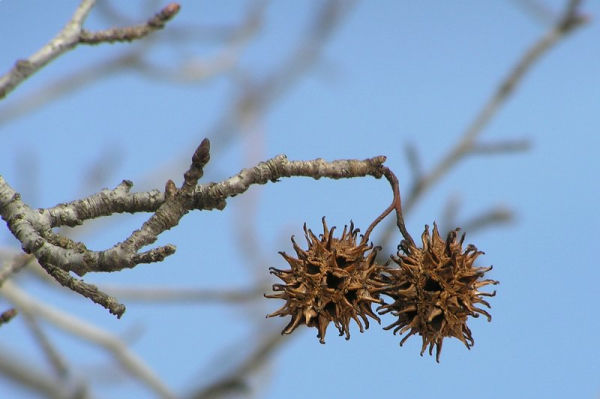
I couldn’t resist this title even though these are actually sweetgum balls.
Sweetgum trees are a southern species whose natural northern limit barely extends into Pennsylvania. However, they’re a favorite street tree so you’ll find them further north.
Sweetgums (Liquidambar styraciflua) have star-shaped leaves with 5-7 lobes. They’re easy to identify in winter because their woody seed balls dangle from the branches until spring. The balls look spiny but they don’t hurt. (*)
At this time of year the seed balls start to fall off the tree and litter the ground below. If you’re not looking up, that’s how you’ll discover you’re near a sweetgum tree.
My strangest encounter with these “gumballs” was while participating in the Mt. Davis Christmas Bird Count in Somerset County, Pennsylvania about ten years ago. At one of our stops during the count we got out of the car on a bottomland near a creek and an old farmstead. Parked in what used to be the side yard was an abandoned Volvo stationwagon and inside the back of that car were thousands and thousands of sweetgum balls. It was filled to the windowsills.
Someone went to a lot of trouble to collect those “gumballs” and then they left them there. I wonder why.
(photo by Dianne Machesney)
(*) Sweetgum balls are different here in Pittsburgh than they are in their natural range. See the comments!
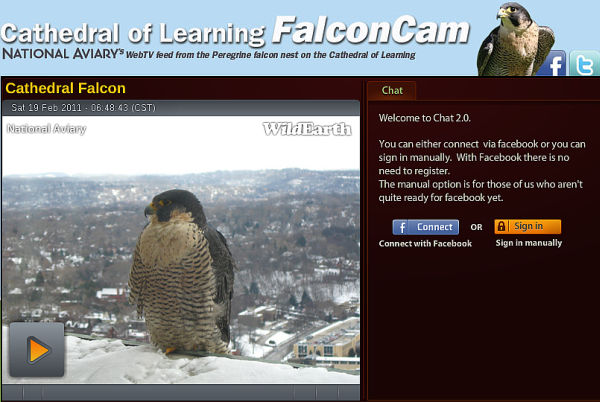
You can watch live streaming video of Dorothy and E2 at the University of Pittsburgh’s Cathedral of Learning here …and… Louie and Dori at the Gulf Tower in downtown Pittsburgh here. If you bookmarked the links last year you’re already good to go.
This year the Aviary made improvements thanks to generous donations from the peregrine fans. The video is a lot more reliable with new streaming equipment installed by PixController. It’s incredibly easy to maintain and has none of the problems we experienced with the old Flash-encoding PCs. For you webcam buffs, you’ll appreciate that PixController installed the Axis Q7401.
Streaming is again hosted at Wildearth.tv and they, too, have made improvements with all an new streaming and chat setup.
And, new this year at the Gulf Tower are 4-per-minute snapshots, just like we have at Pitt. Check out the snapshot links at the bottom right of both webpages.
Our peregrines are courting, Dorothy and Dori will lay their eggs next month, and we’re ready for a great nesting season thanks to the National Aviary’s FalconCams.
Scientists who study birds’ brains long ago discovered that, just like humans, birds can be right-handed or left-handed.
In humans, dominance on the left side of the brain results in right-handedness and vice versa. Birds’ brains have functional lateralism too and can show behavior that indicates they favor one “hand” over the other.
An easy way to tell this is on birds whose eyes face sideways (instead of straight forward) because they obviously use one eye or the other for important tasks. What eye do they use to scan for predators? In 2001, Franklin and Lima found that most dark-eyed juncoes use their right eyes.
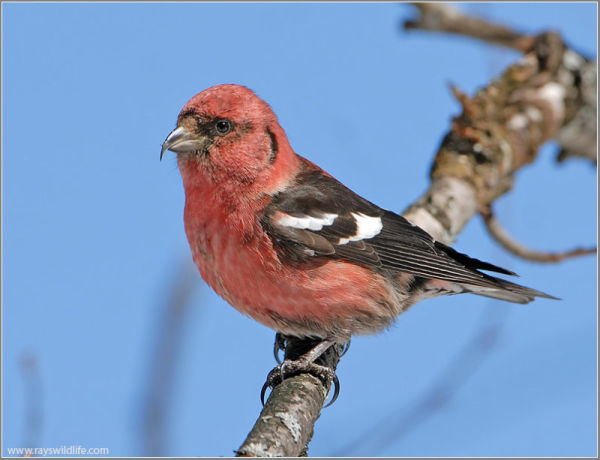
Crossbills take “handedness” one step further. Their bills cross either to the right or the left and they walk the pinecones on which they feed in a clockwise or counterclockwise direction depending on the “handedness” expressed in their bills.
So, what do you think? Is this crossbill right-handed or left-handed?
(photo of a white-winged crossbill by Raymond Barlow. Inspiration and information from Ornithology by Frank B. Gill)
Snow cover is increasingly hard to find in Pittsburgh so this scene is fading fast.
Exposed here by the melting snow is a plant whose name I’ve just learned: common haircap moss (Polytrichum commune).
I’ve often seen it in the woods where it covers the ground like a dense carpet of green bottlebrushes. Though it’s a moss, it’s rather tolerant of dry conditions and does well in a variety of Pennsylvania locations. I’ve read that in dry weather the green leaves wrap around the stem to protect the plant from moisture loss.
Its scientific name describes the plant well. Polytrichum means “many hairs.” Commune probably refers to its ability to form dense colonies.
Where are the hairs? I know we can’t see them in this photo because they’re so small. The hairs are on the caps that initially cover the brown spore capsules. The spore capsules are those brown heads on the naked brown stems poking out of the snow. So, yes, those brown stems are not a different plant. They’re the sporophytes of the haircap moss.
At this time of year the haircaps may be missing because they pop off to expose the spores for dispersal.
I’ve never seen any of this because I haven’t looked closely at this moss before. I didn’t even know that the brown stems are part of the moss’ life cycle.
Now that I know what to look for, I’m going to find those hairy caps. I wonder what time of year they’re visible…
I’ve been so absorbed by peregrine season preparations that I forgot that this weekend, Friday February 18 through Tuesday February 21, is the Great Backyard Bird Count. Thanks to Anne Curtis for reminding me.
In Pittsburgh, they spend time courting at the nest.
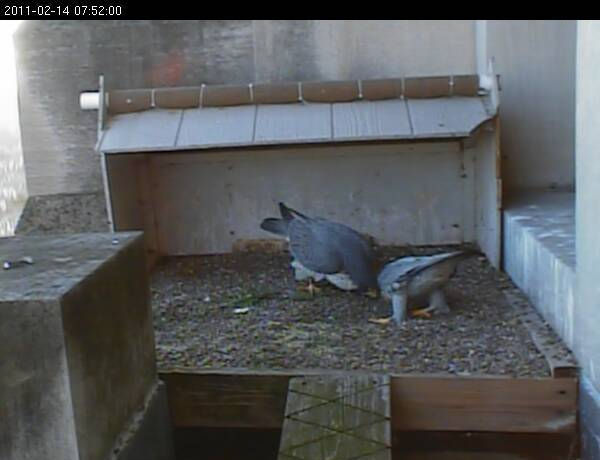
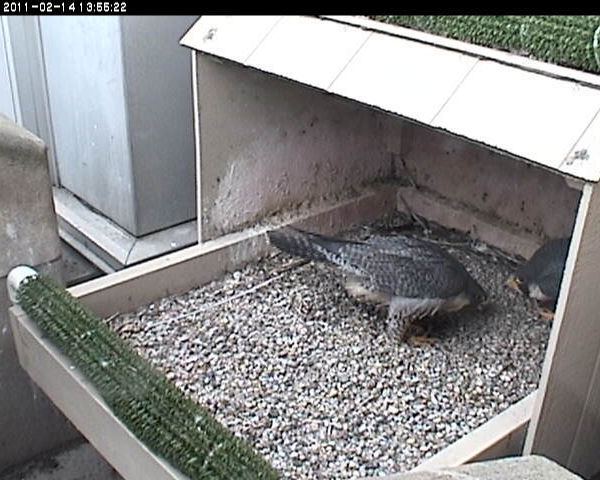
Nesting season is nearly here so we’ve been testing the National Aviary falconcams at the Gulf Tower and Cathedral of Learning in the past few days. The cameras aren’t streaming on the Aviary website yet, but they passed the motion detection test yesterday.
Here’s the result of the Gulf Tower test. The camera “saw” Dori and Louie bowing at the nest just before 8:00am on Valentine’s Day. Notice how low Louie bows (his tail is toward us). Notice how Dori’s crop looks full. I bet Louie just brought her breakfast. What a nice guy he is!
. And here’s the Cathedral of Learning motion detection test. The camera “saw” Dorothy and E2 bowing at their own nest at the University of Pittsburgh. They prefer to court in the afternoon.
Spring is coming. Love is in the air.
The falconcams will be “live” on the National Aviary website soon. Stay tuned.
(photo from the National Aviary falconcams at the Gulf Tower and the University of Pittsburgh)
Saturday morning there was a mystery on my street.
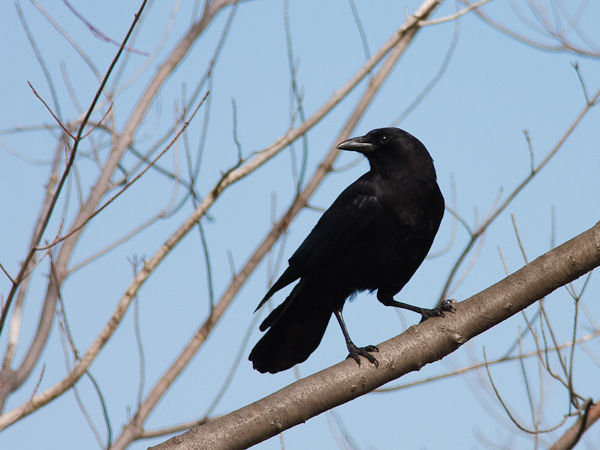
Ten minutes before dawn a huge flock of crows flew over my neighborhood, then turned and wheeled over the ballfield, cawing loudly.
They were hard to see in the dark but they were easy to hear. They circled several times outside my window. It was so unusual that I reported them on PABIRDS.
At mid-morning I heard sirens. Six police cars, a firetruck and an ambulance roared up my street to the ballfield. The firemen carried their medical emergency kits to the bleachers, an area not visible from my side of the park. Soon they returned and drove away. The ambulance stayed longer but he left too without doing anything.
Meanwhile camera crews from all three TV news stations had set up their equipment across the ballfield and were pointing their cameras at the bleachers. A plain white car arrived in front of my house and three people emerged, pulling on purple latex gloves.
By now I had guessed that someone was dead. I couldn’t stand the suspense so I got my 10-power birding binoculars and walked around the ballfield to the vicinity of the TV crews.
With binoculars I could see that there was indeed a body on the cement bleachers. The police and detectives were taking pictures, checking the scene, examining, talking. The body was on its back, upside down, crumpled over itself as if it had fallen from the sky. It was in an unnatural position but its white face was up, easily seen from above in faint light.
So that’s why the crows wheeled and cawed.
The crows know. They saw it first. Now it’s up to the coroner and detectives to find out what happened.