Archive for November, 2009

Nov 20 2009

Anatomy: Culmen

Published by Kate St. John under Bird Anatomy

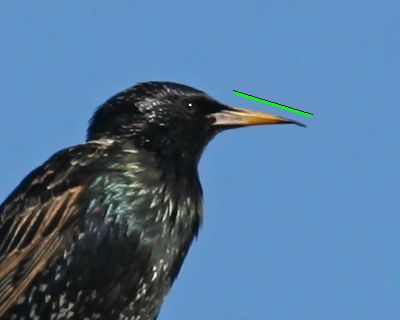
Culmen shown on European starling (photo by Chuck Tague)Winter is lousy for field work but it’s a good time to curl up with a book and learn something, so in that spirit I’ve decided to (finally!) learn more about bird anatomy. 
Yes, I’ve watched birds for decades but that doesn’t mean I know the scientific names for the parts of a bird.  During research on various blogs I’ve encountered many technical names, but what do they mean? 

Maybe the names stump you, too.  Why not make this a group project?  So here’s the first in a weekly series on bird anatomy. 

What is a culmen?  It sounds vaguely like… ummmm…. “culminate,” a related word. 

Answer:  It’s “the dorsal ridge of the bird’s bill.”  For us laypeople, it’s the top of the beak from the head to the tip, as shown by the green line. 

I encountered “culmen” when I looked for the length of the pileated woodpecker’s beak.  The answer was “the male’s culmen is 43-56 mm” so I had to look up two things:  the meaning of culmen and the conversion from millimeters to inches.

The shape of the culmen is a useful field mark for identifying birds.  Some bills (culmen) curve up as on American avocets, some are straight, and some curve down as on the long-billed curlew.

So now you know.

(photo by Chuck Tague with graphics added by Kate St. John)

2 responses so far

Nov 19 2009

Fight!

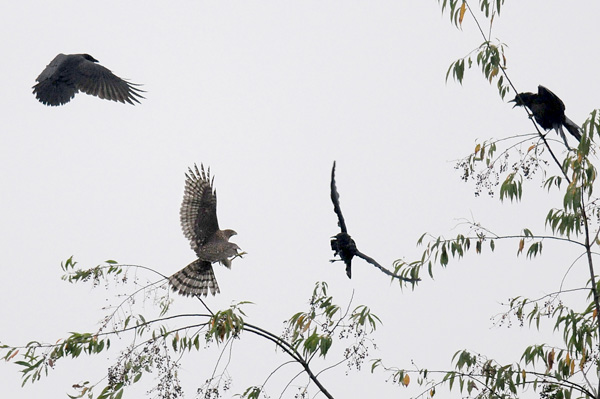
American crows attacjing an immature Coopers Hawk (photo by Steve Gosser)
With so many crows in town it’s inevitable they’ll encounter a predator they don’t like.  Pity the immature Coopers hawk in this picture! 

As a species Coopers hawks have enough moxy to cope with crows but 3 to 1 is stretching the odds. 

I’m sure the crows started it.  A “Coop” is not going to eat a healthy adult crow but the crows remember what the hawk can do to their weak youngsters, so when they found an immature Coopers hawk they decided to test their strength, maybe have a little fun at the hawk’s expense. 

They’re serious about this fight but it’s not life threatening.  Eventually it breaks up, no one gets hurt, and everyone involved learns a valuable lesson. 

The crows learn about cooperation.  The Coopers hawk learns to avoid gangs.

(photo by Steve Gosser, September 2008)

2 responses so far

Nov 18 2009

Who’s singing?

Published by Kate St. John under Bird Behavior, Songbirds

Carolina Wren (photo by Marcy Cunkelman)
I can answer that.  Almost no one.

Since midsummer we’ve lost more than five hours of sunlight so there’s not much reason to sing.  The migrant songbirds have left and only our locals (chickadees and cardinals) and some winter visitors (dark-eyed juncoes) remain.  Most of them have nothing to say.

My only hope for birdsong is at dawn and the singer is the bird pictured here - the Carolina wren.

According to the range maps, Carolina wrens don’t migrate but I wonder if they change territories in the winter.  What explains the new scuffles and song duels they engaged in in October?  Why does each wren now sing briefly at dawn? 

I hear them pipe up one after the other.  “I’m here,” says the wren down the street.  “I’m here,” says another across the ballpark.  “I’m here,” says a third up the hill.  After this brief exchange of greetings they fall silent. 

You have to be out early to hear birdsong this month.

(photo by Marcy Cunkelman)

2 responses so far

Nov 16 2009

Winter-bloom

Published by Kate St. John under Plants

Witch Hazel flowers (photo by Dianne Machesney)
After the leaves have fallen there’s one surprising bright spot in November’s forest – a yellow flowering tree nicknamed Winter-bloom.

Common Witch-hazel (Hamaelis virginiana) is a shrub or tree, 10-25 feet tall, that defies the odds and blooms from September through November.  Its ragged yellow flowers aren’t noticable during October’s splash of colors but now they stand alone, odd but beautiful.

Witch-hazel has other odd traits.

  • Though it blooms in the fall, it doesn’t set fruit until the following August, nearly a year later.
  • Just before it blooms the old fruit explodes, dispersing seeds up to 20 feet away.
  • Witch-hazel can find water; its branches are used as divining rods.  (Is that the “witch” part?)
  • And you probably have witch-hazel in your medicine cabinet, an extract from its bark.

Witch-hazel is a good tree for wildlife as its buds, seeds and twigs provide food for ruffed grouse, pheasants, bobwhite, deer, rabbits and beaver.

It’s good for me too because it makes me happy to see the winter bloom.

See Chuck Tague’s October 9th blog for close-ups of witch-hazel’s flowers and seeds.   Photo by Dianne Machesney.

2 responses so far

Nov 15 2009

November, the month for the ax

Published by Kate St. John under Phenology, Songbirds

Pileated Woodpecker (photo by Dick Martin)
In his Sand County Almanac, Aldo Leopold called November “the month for the axe.  …In winter, when we are harvesting diseased or dead trees for our fuel wood, the ring of the axe is dinner gong for the chickadee tribe… Every slab of dead bark is, to them, a treasury of eggs, larvae, and cocoons.”

Dead trees are treasure troves for woodpeckers too, and in the bird world they wield the ax.  Though the leaves have fallen the weather is still warm, the larvae are still active inside the bark, and the woodpeckers can hear them.

This weekend I found a pileated woodpecker excavating a dead tree in Schenley Park.  Among birds, the pileated’s beak is about as close as you can come to an ax.  The bird itself is the size of a crow with a beak 1.5 to 2 inches long.  That may sound small but his beak hits the wood at 13-15 miles per hour so the woodpecker experiences 10G’s of force at each blow.  

It would kill you or me to slam our heads against trees but the woodpecker’s head is designed for the work.  His neck absorbs the impact and his brain is cushioned by a network of flexible cartilage and spongy air-filled bone.  His tongue is very long for probing the openings he creates – so long that it retracts inside to the back of his skull.  It’s the right equipment for chopping trees.

Keep a lookout this month for pileated woodpeckers.  November is the month for the ax.

(photo by Dick Martin)

No responses yet

Nov 14 2009

Late Leaves

Published by Kate St. John under Phenology

Norway maple, Schenley Park, 11/13/09 (photo by Kate St. John)
Remember how on November 7th I wrote that non-native trees are often the only ones with leaves at this time of year?

Here’s a Norway maple, seen yesterday in Schenley Park.  It was the only tree with leaves on this Blue Sky day.

(photo by Kate St. John)

No responses yet

Nov 13 2009

Adopt-a-Squirrel

Published by Kate St. John under Mammals

Squirrels at the ARL Wildlife Center (photo from Jill Argall)
Ever thought about mentoring a wild squirrel?

If you enjoy these bushy-tailed creatures, have good forest habitat at your home and like to feed squirrels you’re a candidate for the “soft release” squirrel program.

The ARL Wildlife Center in Verona, PA has more than 50 orphaned squirrel pups who were rescued in September and October, very late in the breeding season.  At the time, they weren’t even weaned yet and are so young they won’t be ready for release into the wild until December.  By then their food supply will be buried under snow and ice.  How will they survive?  They need an “angel.” 

Here’s how it works.  As the squirrel pups grow up, they progress from bottle-fed babyhood to bouncing adolescence.  When they’re ready to become acclimated to the weather they’re placed in the outdoor pre-release enclosure with a specially designed wooden box that will be their permanent home.  When they’re full grown it’s time to release them, so the Wildlife Center closes the box with the squirrels inside, the box is transported to their patron’s home and mounted on a tree.  Open the door and voilà!   The squirrels have a new home with a safe, familiar nest.  And you help them survive by putting out food for them until they no longer need it.  They might leave the area but some squirrels have been known to stay and raise families in their favorite box for years to come.

The Wildlife Center is collecting a list of people who want to participate in this program.  If you’re interested in being an “angel” to a couple of squirrels, call the Wildlife Center at 412-793-6900. 

To learn more about the ARL Wildlife Center, visit their website.

(photo by Maria Pyrdek at ARL Wildlife Center)

2 responses so far

Nov 12 2009

Hard Work

Published by Kate St. John under Peregrines

Peregrine falcon carrying prey (photo by Kim Steininger)
Tuesday afternoon I glanced out my office window and was immediately mesmerized.

A peregrine falcon was flying by, pumping hard, carrying a heavy burden.  He’d killed a pigeon over Carnegie-Mellon’s campus and was taking it home to the Cathedral of Learning to eat. 

Carrying prey is strenuous work.  On average, a pigeon weighs 354g while a male peregrine weighs 612g (females average 976g).  Imagine that your lunch weighed more than half your body weight and you had to carry it half a mile before you could eat.  No way!  That’s why we invented wheels.

And so I watched, unable to continue working while the peregrine slowly disappeared in the distance.  My desk job is easy compared to a peregrine’s work.

(photo by Kim Steininger)

3 responses so far

Nov 10 2009

Budding Opportunities

Published by Kate St. John under Plants

Devil's Walking Stick bud (photo by Dianne Machesney)I thought I’d missed my chance when I didn’t write about this plant on Halloween – more on that later – but Chuck Tague’s recent blog on tree buds gives me the perfect opportunity to discuss this scary looking plant. 

Compared to the beautiful twigs Chuck photographed this one looks positively wicked.  So what is it?  Here are some hints.

  1. This bud is as fat as your thumb and covered in thorns.
  2. It grows on a tree that’s only 5 to 15 feet tall.
  3. The trunk is very thorny too and only 1 to 4 inches in diameter.
  4. The bud will sprout very large twice- or thrice-compound leaves that are 2 to 4 feet long!
  5. The flower is one huge flat-topped cluster that blooms July to September.
  6. Its fleshy, black fruit droops from the top of the tree.  The berries are such good food for birds that when you find a stand of these trees in autumn you’ll find a flock of robins, too.
  7. The name of this tree evokes Halloween.

And it is… (drum roll) … Devil’s Walking Stick (Aralia spinosa), also called Hercules-club.  The trunk is so narrow it resembles a walking stick but only the Devil would dare grasp it.

Want to look at pretty buds now?  Check out This Bud’s for You.

(photo by Dianne Machesney)

2 responses so far

Nov 09 2009

Messing Around in Mexico

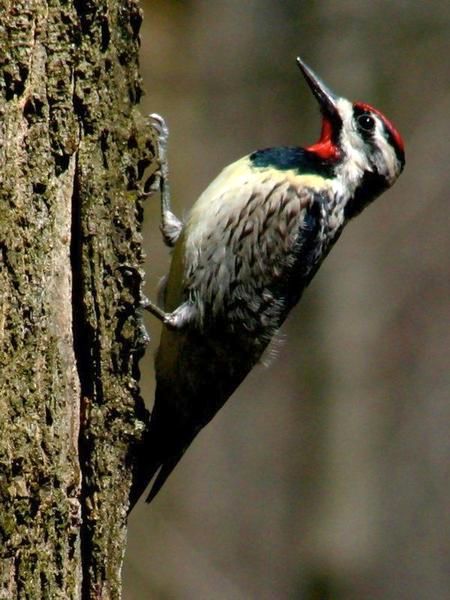
Yellow-billed Cuckoo (photo by Chuck Tague)
Why is this bird in such a hurry to migrate south in mid-summer after raising only one brood in North America? 

The answer is a surprise.  It turns out that some yellow-billed cuckoos raise a second family in the thorn forests of western Mexico.  And so do orchard orioles, hooded orioles, yellow-breasted chats and Cassin’s vireos.

Called “migratory double breeding” the discovery was stunning.  Scientists knew of just two Old World species who did this on their journey north but no birds had been found to do it in the western hemisphere and none anywhere were known to double-breed on the southbound trip.

Gathering the evidence was truly detective work.  Scientists were in the thorn forests in July and August, expecting to study the molt cycles of migratory songbirds.  Instead they found males singing on territory, female birds with established brood patches and no young birds as they’d expect if the families had already bred in the forest.  The clincher was when they found the nests and eggs.

If five songbird species are double-breeding in the thorn forest, why did it take so long to discover it?  July and August are forbidding months in western Mexico.  It’s the monsoon season with temperatures at 100 degrees, humidity at 100% and lots of biting insects.  People have only recently begun to farm the region, leading to a decline in thorn forest habitat.  Interestingly, the habitat decline coupled with migratory double-breeding may explain the decline of yellow-billed cuckoos in the western U.S.

So like the story of a man who has two families half a continent apart, these birds must hurry to squeeze in a second family in western Mexico, then finish their migration to tropical Central and South America.  That’s what the rush is all about.

Read more about the discovery in this Science Daily article.

(photo by Chuck Tague)

No responses yet

Next »

Bird Stories from OnQ