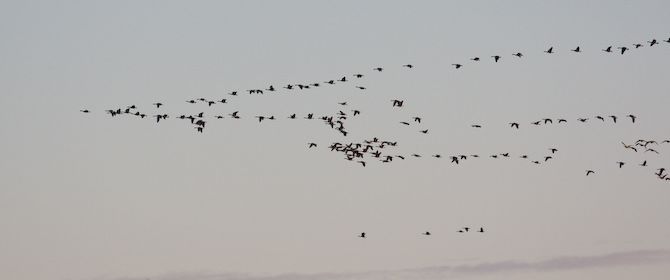
Canada Geese have been moving south for several weeks now. Yesterday morning I saw hundreds of them resting near Millers Ponds at Pymatuning. These geese are true migrants, probably just arrived from their breeding grounds in the southern James Bay region of Canada.
I mention them as migrants because in Pennsylvania we have plenty of resident geese. It seems hard to believe but the subspecies Branta canadensis maxima (Giant Canada Goose) was nearly extinct in 1900 due to overhunting and habitat change. Many states conducted reintroduction programs to help the geese along. The birds so did well that there are now nearly 290,000 resident maxima Canada geese in Pennsylvania and their population keeps growing despite a special hunting season instituted in 1992.
Why don’t our resident Canada geese migrate?
Geese travel in family groups which collect at staging areas to join larger flocks. The young geese learn their migratory paths from their parents. If their parents don’t migrate the whole family stays put. I’ll bet the geese that were reintroduced had no one to teach them to migrate so they and their descendants became residents.
Not so with the geese at Pymantuning. By 5:00pm when I left Linesville all the migrant geese were gone.
(photo by Cris Hamilton)
We live in Northern Minnesota where most of the Canadian geese have already left. But, there has been one stray goose residing in my backyard which runs adjacent to a pond. My kids have named him, Shawn. We are getting worried about the goose not leaving and possibly starving during the winter. The most we’ve seen it fly is over the pond about 1 foot above the water. We have also watched it doing weird things in the pond, putting his head under water and then flipping his body so that his feet are up in the air. Is this normal geese behavior? Thank you for your comments.
When you see the goose tip up in the pond with its feet in the air it’s eating underwater vegetation. This is normal and good. Canda geese also eat grass, which is why you see them on golf courses. The bad news is that it must leave before the pond freezes or it will likely starve in the winter. If it doesn’t fly much, it may be injured.
If you are worried about this goose, contact your local wildlife rehabilitator to find out what you (or they) can do for it. Try The Wildlife Rehabilitation Center of Minnesota, see http://www.wrcmn.org/
Kate – I love your blog. I have been wondering about a number of Canada geese that I’ve seen down by the Hot Metal Bridge for the last month or so, on the north bank of the Mon. Are these resident or migrant geese, do you think? They don’t seem to have gone anywhere for a while, yet I don’t remember seeing them there in the warmer months. I pass the spot every day on my commute. Anyhow they seem content to just munch on grass and wander on the roads and sidewalks. I hope they don’t venture on to Second Avenue as that probably wouldn’t end well.
Matt, I have wondered the same thing about those geese because I often pass them when driving on Second Ave. I have no idea how far they’ve migrated but they are certainly a winter-only flock for that location. Since they tolerate city activity they must normally live in a place that’s similar, but unless we see a band on one of them — and find out where it was banded — I don’t think we’ll ever learn their origin.
Interesting. So they have migrated from somewhere and they winter in Pittsburgh? Or maybe they will continue further south as it turns colder? I didn’t pay attention to them in previous winters but I will keep an eye out this year. They are quite big, seen close up!