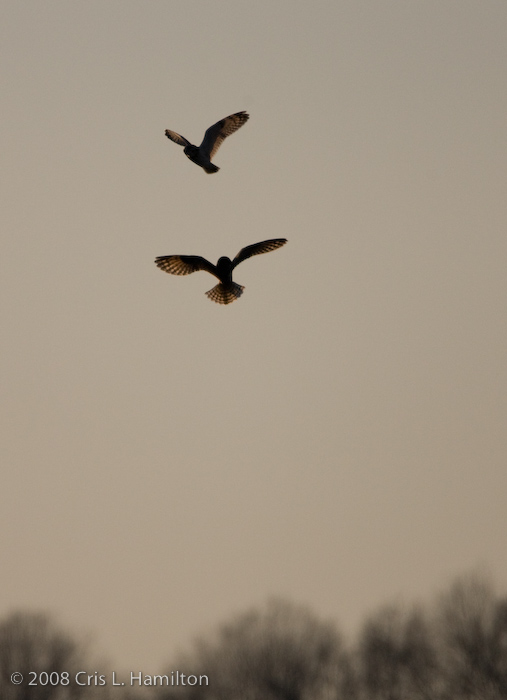
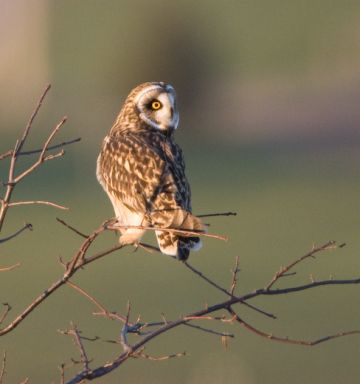
One of the best things about winter in Pennsylvania is the influx of tundra birds who spend the season here. My favorites are the daytime owls: snowys and short-eareds.
Snowy owls are rare but short-eared owls are easily found in grassland habitats at recovered strip mines, especially at Volant and West Lebanon. They’re there because there’s a lot of food: mice and voles.
It’s always amazing to see an owl during the day and short-eareds put on quite a show. They are crepuscular (active at dawn and dusk) so they can appear a couple of hours before sunset on dreary days.
Their flight is mothlike, floating over the fields as they hunt for small mammals. Sometimes they “bark” when they encounter another owl or when annoyed by an enemy such as a red-tailed hawk. Sometimes they interact in an aerial display (click on the photo above).
I’ll never forget the time Marcy Cunkelman took me to see the short-eared owls at West Lebanon. We parked on a side road in the middle of the grasslands and stood next to Marcy’s car waiting for sunset. It was cold so we pulled up our hoods and put our backs to the wind.
The sun had set but the sky was still light when the owls finally appeared in the distance. Marcy said, “I’ll bring them closer,” pursed her lips and made squeaky mouse-like sounds. The owls were unimpressed and continued floating over the distant fields. Marcy squeaked again and again.
Suddenly, an owl we hadn’t seen flew from behind and crossed directly in front of our faces. He looked back at Marcy as if to say, “Where’d you hide that mouse?”
I went to Volant last weekend and tried to call in the owls but I was never been able to match Marcy’s squeak. The owls ignored me completely.
(photos by Cris Hamilton, taken at Volant Strips. Click on the photo above to see Cris’ picture of two owls interacting.)
Funny you should post this, I went to Imperial and watched the owls today in the evening. I had 8 Short Eared owls fly around the “Toy Airport”. They do put on quite a show!
Owls are unique, aren’t they? Nice article. There is a Barred Owl that can be seen in the daytime (usually around 10 or 3) that I and Steve Gosser have photos of (of course Steves are much crisper than mine) that roosts at Crooked Creek Park/Lake. I’ll have to venture up to the Volant strips one of these days to see the Short Ears, tried West Lebanon, but all I got to see there last spring or fall were the Harriers and Kestrels (and a few Flickers on the road).
I just love your site and all the little hidden nuggets you add for us to find. The bark sound is great! It is nice to hear them even if you have never seen them! Marcy is great! Her gardens are inspiring. Always something new to see. I could just spend an afternoon watching all the birds in her yard!
Please keep up the good work! and Thanks again!!
I am interested if anyone knows of what type of owl can survive in Chicago. Last year, February 09 an owl came to my window. There is a long story behind it, but I am just wondering what type of owl I saw. Thanks!
It was grey- long feathers… and big!
Nicole, I assume you live in the city or one of the nearby suburbs of Chicago, in which case the owls you’re most likely to see are Great Horned Owls (as big as a large hawk http://en.wikipedia.org/wiki/Great_Horned_Owl) and Eastern Screech-owls (about the size of a pigeon but with a short tail and fat neck http://en.wikipedia.org/wiki/Eastern_Screech_Owl). Both of these owls have ear tufts on their heads.
Great Horned Owls are courting now so they are noisier and more conspicuous than usual. Their color varies from gray to brown and they are BIG. An Eastern Screech-owl is relatively petite (see here http://www.yorkcenterforwildlife.org/eastern-screech-owl.php).
If you live out in the country, let me know. A wider variety of owls is possible there.
i live in east texas and i went exploring in my local woods and i saw two owls stting on a powerline i dont think they were friends because they were far apart and one was eating something. they were the same species but one looked bigger. i’ll describe them. white face, blackish looking beak, greyish plumage thats all i saw and i think it also had yellow eyes im not sure.. if you could tell me what kind of owl this was it would be greatly appreciated.
oh and this happened during the day time and they started flying around
Joe, you didn’t mention the size of these owls nor whether they had horns so I’m afraid I can’t provide a specific answer. Instead I’ve listed the owls likely to be in your area and have provided links so you can read more about them.
Regarding size difference: It may be that your owls were a male & a female, possibly mates. At this time of year some owl pairs are courting. The male may have brought her a meal or she may have been asking him for one. They don’t perch close together until much closer to the mating season.
Since you are in east Texas and the owls were in the woods (not in wide open spaces), your owls were likely to be one of these four species:
Barn Owl: This owl is the size of a small hawk (12.6″-15.7″ long), does NOT have “horns”, has a large white heart-shaped face, white chest and a beige+orange+gray back. http://en.wikipedia.org/wiki/Barn_Owl
Eastern Screech-owl: This small owl has “horns” and is only 6.3″-9.8″ long. Take a look at the pictures of this owl. It is often gray. If your owls were small, this might be what you saw.
http://www.allaboutbirds.org/guide/Eastern_Screech-Owl/lifehistory
Great Horned Owl: This is the quintessential owl, big and powerful, as large as a hawk (18″-27″). It has large ear tufts (horns). It can look gray but usually looks brown. http://en.wikipedia.org/wiki/Great_Horned_Owl
Barred Owl: Another large owl, this one has no horns. Its face looks big and almost shy because of the two facial (feather) disks around its eyes. It generally looks brown.
http://en.wikipedia.org/wiki/Barred_Owl
These last three species are NOT likely to be the owls you saw but I list them here for completeness:
Burrowing Owl: (prairie habitat) a rare log-legged owl of open country that walks on the ground. http://en.wikipedia.org/wiki/Burrowing_Owl
Long-eared owl: (forest habitat, especially pines) only in your area in winter http://en.wikipedia.org/wiki/Long-eared_Owl
Short-eared owl: (prairie habitat) only in your area in winter. This bird is the subject of the blog where you posted your questions.
I hope this helps.
I wanted to share something I saw when riding my bicycle the other morning – about 9am in Kansas. I heard enough squawking to cause me to look up — and, almost directly above me, but going in the opposite direction were 3 birds flying in close formation. An owl was in the center, and he was flanked on either side by a large dark colored bird. The owl looked large and ‘fluffy’ – mostly tan and white in color with spots and striped markings on his large wings. I did not hear any noise from him, but it seemed like the other birds were perhaps squawking (to lead him home?) in the light of the sun.
Has anyone ever heard of anything like this?
Janet, that’s a very cool sighting. Here’s my guess on what was happening.
The owl: It was either an owl who was discovered sleeping by the two dark birds and they were chasing it from it’s hiding place, or it may have been a hawk called a northern harrier who has a face that resembles an owl’s. In any case, the two dark birds were chasing it.
The two dark birds: Owls and hawks eat smaller birds, especially their nestlings, so the smaller birds gang up on owls & hawks and loudly chase them away. From your description I couldn’t tell the size of the dark birds but my guess is that they were crows or grackles or blackbirds (listed in descending size).
Thanks for your prompt reply. After I submitted this post, I actually was wondering if the two dark birds could have been chasing the owl as well. That seems to make more sense. Thanks for your answer!
Hi
I have heard “whoo…. who who” near the river where I live in Nova Scotia, Canada. This has not occurred in the morning, only early to mid-afternoon. There is plenty of grassland, but we have three bald eagles, and at least one brown hawk. My husband insists the sounds come from the mourning doves we have here, but the sound is much too loud. We also have a lot of field mice…. Any information would be greatly appreciated. (Have never seen the bird making this sound.)
Thank you
Jackie, it’s likely you’re hearing mourning doves. Owls tend to hoot in early spring — even in winter — at night. By June their young have fledged (or are close to it) & they have nothing to hoot about.
The daytime owls in this blog post don’t make a hooting sound, they bark.
I live in a tiny town in northern Iowa. While looking out the window last summer we were shocked to see what looked to be a couple of baby owls perched on our kids little pool in broad daylight. Now this summer there is a group of what seems to be the same owls that are always hanging out in the trees in our yard. There are always five but sometimes six of them together. Two of them look a little larger than the others.
They are very small and look to be brown. They truly are one of the cutest and most amazing things I have ever seen. Sometimes they will even sit on our camper that’s behind our house and in daylight too. They are funny little things with cute bobbing heads. They just sit in their tree and stare right back at us! Pretty weird having 12 owl eyes staring at you. Just wondering if you might have any idea what type of owl these might be? My children and my husband and I are fascinated by them and would love to learn more but can’t seem to figure out what kind they are.
jami, based on your location I think you have a family of eastern screech-owls. (http://en.wikipedia.org/wiki/Eastern_Screech-owl) They have ear tufts and are 8.5″ long (head to tail) with a wingspan of 20″ and weight 6 oz. This makes them shorter than a robin but much heavier (robins weigh 2.7 oz).
There is a smaller owl, the northern saw-whet owl, that visits Iowa in winter but is uncommon and requires wooded habitat. Its range map shows it nesting in northern Wisconsin but not in Iowa. It does *not* have ear tufts and is noticeably smaller than a robin — approximately the size of a bluebird. (http://en.wikipedia.org/wiki/Northern_Saw-whet_Owl)
Thanks so much for the info we are going to check into it!
For the past three winters, (during a very cold and snowy January and February), I’ve seen snowy owls. Right around 8 pm, they would be sitting in a tree in Villa Park, a western suburb of Chicago, (Du Page County).
This past Saturday, (August 1st), I was walking my dog with a friend in Wheeler Park near the Fox River in Geneva, (a far-west suburb of Chicago–Kane County). I was in the middle of the park, (near an area where musical groups perform on a stone platform), around 7:15 pm, when I heard a noise to the east. I looked up into a very large, dead tree, (which had lost all of it’s bark and was tan-colored–maybe a Sycamore?), across an inlet of the river. There were three Great Horned owls, two adults and one younger owl. I could see them fairly clearly, the two adults with the tufts of feathers on the sides of their heads. They were there for awhile, and then flew off to the north. They had huge wingspans.
I was leaving for work and as I drove down the street to turn around I couldn’t believe my eyes because I never seen an owl it was sitting on the street sign sound 630 am and I leave in Memphis Tn what kind of owl did I see.
Shalonda, did the owl have ear tufts? Was it as big as a red-tailed hawk or was it smaller? … If it had ear tufts and it was really really big, it was a great horned owl. Otherwise I’ll need more information to identify it.
please help me identify the owl I posted to my facebook Norma Parrish. It was as big as a hawk, saw being active during mid morning, I think maybe a hawk owl but this is Florida! thank you so much
Thanks for the pictures & videos of the hawk and for telling me your location (FL). The bird is definitely a hawk — not an owl — probably an immature red-tailed hawk. Regarding the Hawk Owl: It doesn’t migrate and never comes further south than the Great Lakes/Minnesota so it wouldn’t be in Florida. Here’s the Northern Hawk Owl range map: https://www.allaboutbirds.org/guide/Northern_Hawk_Owl/maps-range