 Several people have asked me why birds of prey, especially red-tailed hawks and peregrines, would choose to nest close to humans. Isn’t it unnatural? Doesn’t it make them tame? Are the ones who nest on buildings already tame?
In the case of peregrines, whom I know better than red-tails, I can tell you it never makes them tame. To them, we are still their mortal enemies. Instead, conscious or not they have made a calculation: The enemy of my enemy is my friend… and besides, there’s lots to eat.
Birds of prey know that humans can and do hurt them but they also know from personal experience that it is rare. Meanwhile, they have learned there’s an advantage in being near humans because we keep their other enemies away.
A good example is that great-horned owls, a dangerous predator of peregrines, are rarely if ever found on office buildings. Peregrines who nest on buildings have one less worry as they raise their young.
Another advantage is the food we generate. Humans create a lot of garbage and many prey species eat it. For red-tailed hawks, we indirectly provide rodents. For peregrines, our buildings house pigeons and starlings, a ready food supply.
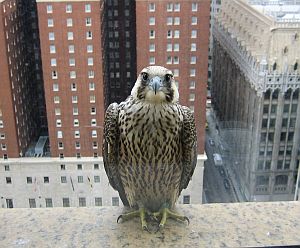
When their nests are successful their hunch about us is reinforced. The juvenile peregrine in the picture is a case in point. She was born in downtown Pittsburgh on the Gulf Tower in April 2007. Her parents made the calculation that the territory was safe with plentiful food and they successfully raised four young birds. As you can see, she was thriving last July when her picture was taken by Matt Frederick as she perched on Roberto Capriotti’s windowsill at K&L Gates in the Oliver Building.
If these birds can put up with seeing humans every day, the rest is easy.
p.s. I wish she’d landed on my windowsill… but if she had, I would have been unable to concentrate for the rest of the day!
(photo by Matt Frederick)
Wonderful words to accompany an equally wonderful photo. And I understand your comment about an inability to concentrate after unique experiences with this bird. Completely.
Has Egg #4 hatched? If it hasn’t, is this common in peregrine clutches?
Egg #4 hasn’t hatched yet and probably won’t. This happens from time to time in peregrine clutches and is normal, especially in the wild where there are greater threats to nesting.
Have you heard any information regarding last years hatchlings?
News of last year’s hatchlings: Unfortunately, the first year of a peregrine’s life is spent wandering – and it is hazardous. We usually only hear when they are injured or dead.
Of the 4 peregrines hatched at Gulf Tower in 2007, there is no further news of the above female nor of two of her other siblings so we presume they are alive. One of her male siblings was found injured in Clairton in November 2007 and died that evening.
Of the 4 peregrines hatched at Pitt in 2007, we have no news of 3 of them. The 4th was found dead along a road in southwestern Ontario in January 2008.
I wouldn’t have been able to concentrate at all, either. She seems to have such an expression of bright-eyed interest in this photo! “Hi, what are you doing in there?”
As for this young lady and the rest of last year’s unaccounted-for fledgelings, I hope that no news continues to be good news.
Kate…
I am an avid watcher of the Pittsburgh Falcon Cams, the San Jose Cam, and your blog. The photo of the young adult Peregrine on your site was so compelling, I mentioned your blog on the San Jose Perigrine digest. I was told I should not mention other Peregrine cams and should focus my remarks on San Jose only, but…I received a message from someone who was so impressed with your photo, she posted my message in the San Jose communications sites. I hope you get some readers from California way.
Can I see the peregrine’s from street level? When is the best time of day. I’m interested in either nest site in town.
You can’t see into the nests from the street. The only way to see them is on the webcams. However, when the young birds are learning to fly (called “fledging”) it is easy to see them from street level with binoculars because they stand on the edge of the nest area and flap their wings very hard.
Best time of day is morning around 8:00 or 9:00 and after work 6:00 to sunset. Peregrine chicks sleep at midday.
Gulf Tower: Best time to watch is next week, particularly May 26 to 30. Stand on the sidewalk at the entrance area of the Pennsylvanian (near corner of Liberty Ave and 11th Street) and look up at the Gulf Tower. The nest is on the left near the top but below the pyramid steps that form the Gulf Tower roof. Watch for flapping. The young birds are brown and beige, the parents are gray and white.
University of Pittsburgh: Best time to watch is June 5th to 9th. Stand at the performance tent at Schenley Plaza and look at the Cathedral of Learning. Almost at the top is a big horizontal “railing.” The young birds perch there and flap. Their parents fly by and bring food. As much as my schedule permits June 5-9 I will be at this tent 1:30pm-2:30pm and after 5:30pm every day.