 …for Pitt Peregrine Fledge Watch!
Late next week the peregrine falcon chicks at University of Pittsburgh will be ready to fly (called fledging) and I’ll be there to watch them.
Fledging is the most dangerous time for a young peregrine. He flaps at the edge of a 400-foot drop and launches into the blue. He has to learn to steer and land on his very first voyage. If he doesn’t make it, he could land in the street.
Fledging is also the most exciting time for a peregrine watcher. The entire peregrine family is busy: the parents give flight demonstrations, the young walk the edge of the building and flap their wings, one of them takes his first flight and the parents follow to make sure he’s OK. I wouldn’t miss it for the world.
The peregrine chicks are likely to fledge between June 7th and 9th so starting Thursday June 5th I plan to be at the Schenley Plaza tent before 8:15am, after 5:15pm, and during my lunch hour 1:30-2:30pm every day including the weekend. Fortunately, peregrines try not to fledge during bad weather so I get a reprieve if it’s raining.
You’re welcome to stop by for Fledge Watch. As with any hawk watch, there are stretches of boredom (opportunities to chat) punctuated by moments of excitement (peregrines flying). Unlike a rural hawk watch this one comes with amenities: a tent, indoor restrooms, free wireless Internet, places to buy food, and on-street parking.
Schenley Plaza is at the intersection of Schenley Drive and Forbes Ave across from the University of Pittsburgh’s Cathedral of Learning. The tent (pictured above by my cellphone) is visible from Forbes Avenue. Click here for a Google street map.
How will you find me? I’m the one near the tent wearing a hat and looking at the Cathedral of Learning with binoculars.
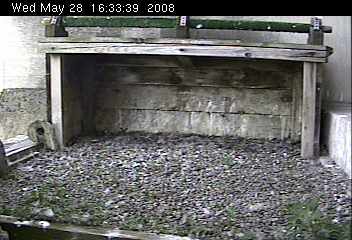 How about this! The nest at Gulf Tower looks empty.
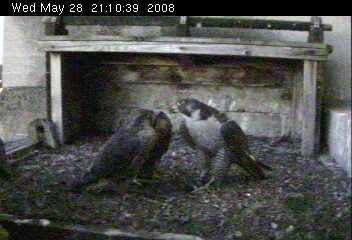 Especially examine the top floors with windows (not the stepped pyramid top of the building). You’ll know you’ve found the young peregrines if you see brown birds flapping their wings.
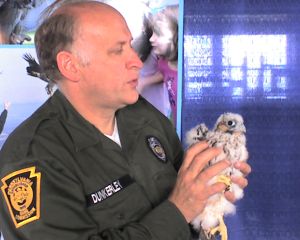 On Tuesday morning the Pitt peregrine falcon chicks were banded – two males and one female. All of them received a clean bill of health and shiny new bracelets on their legs.
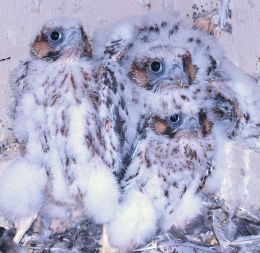 Bonus! Here are the three chicks huddled in the corner of the nest box just before they were gathered up for the banding. Photo was taken by WCO Doug Dunkerley, pictured above.
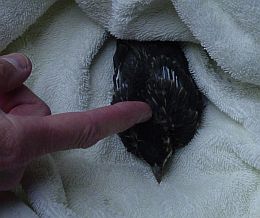 Wednesday morning at work Joan Guerin called to say a baby robin was hunched in the parking lot in front of a parked car.
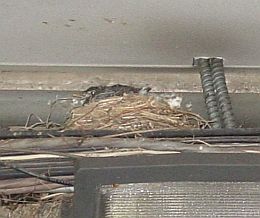 Joan and I watched the adult robins to figure out where the nest was. Soon we saw them carry food to a flimsy nest on top of a lamp. Below it a featherless nestling had fallen out days ago and was dead on the ground.
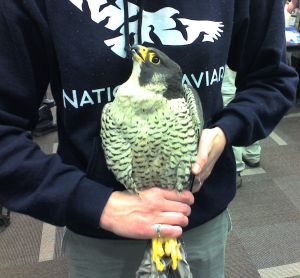 The two peregrine chicks at Gulf Tower were banded Monday morning – 1 male and 1 female.
 green on bottom. The numbers and letters on the bands are big enough that you can read them in a photograph (as shown here) or through binoculars if you’re not too far away. When observers report a bird’s bands and location, we learn where it went after it left Pittsburgh. This is scientifically useful and it’s how peregrine followers find out about
  I don’t have a photo of this but the only media that would do it justice is a video and I don’t have that either. Be prepared to use your imagination.
 No surprise that I’d ask this question.
 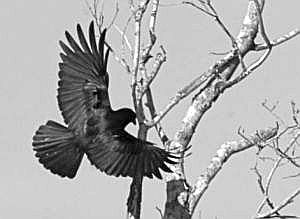 The last time I saw a crow it was being attacked by three grackles. In fact every time I see a crow lately, it’s under attack. What gives? Why are little birds attacking big ones?